Search Header Logo
Light, Waves and Optics

Light, Waves and Optics

Assessment

Presentation

Physics

12th Grade - University

Hard

Created by

Ronnie Lorilla

Used 4+ times

FREE Resource

64 Slides • 88 Questions

1

Light, Waves and Optics

by Ronnie Lorilla

2

Reflection of light

media

3

​Reflection of waves

​Watch the video and notice the direction that the wave fronts are reflected by the straight solid boundary.

4

The reflection for a light ray is similar to that of a wave.

The angle of incidence is measured from the light ray to the normal line.

The angle of reflection is also measured the same.

5

Notice how the angle of incidence and the angle of refraction is labelled.

​It is according to the how the light ray travels.

media

6

​Refraction of waves

​To answer the next question, observe the how the wave fronts change direction, wavelength and speed as it passes through a medium of higher density.

​Note, the distance between the wave fronts is the wavelength of the wave.

7

Multiple Choice

Light travels in ___________ lines

1

wavy

2

bent

3

straight

4

backwards

8

Multiple Choice

what is the angle between the incident ray and the normal called as

1

angle of incidence

2

angle of reflection

3

angle of convergent

4

angle of divergent

9

Multiple Choice

Question image

IF THE ANGLE OF INCIDENCE IS 20 DEGREES, WHAT WILL BE THE VALUE OF ANGLE OF REFLECTION?

1

0

2

10

3

20

4

40

10

Multiple Choice

If the angle of incidence is 45 degree, what is the angle between the incident ray and reflecting surface

1

45

2

90

3

180

4

none of the above

11

Multiple Choice

Question image
What is the line MN called in the given diagram
                               
1
incident ray
2
reflected ray
3
reflecting surface
4
normal

12

Reflection by plane mirror

media

13

Multiple Choice

Which statement is true for plane mirrors?

1

They are flat, smooth surfaces that produce diffuse reflection.

2

They are curved, smooth surfaces that produce diffuse reflection.

3

They are flat, smooth surfaces that produce specular reflection.

4

They are curved, smooth surfaces that produce specular reflection.

14

Multiple Select

The image formed in a plane mirror is

1

real image

2

the same size as the object​

3

bigger than the object

4

virtual image

5

in front of the mirror.

15

Multiple Choice

The following are the image formed in plane mirror except....

1

erect

2

virtual

3

same size

4

inverted

16

Multiple Choice

The bouncing off of light rays from the surface of an object such as a mirror or other shiny surface is called:

1

mirror

2

laser

3

reflection

4

refraction

17

Multiple Choice

Law of reflection state that - The angle of incidence is .................. to the angle of reflection.

1

equal

2

double

3

half

18

Multiple Choice

Question image
Which of these is the best reflector of light?
1
shiny metal
2
white paper
3
carpet
4
wood

19

Multiple Choice

Images produced by plane mirrors are real images.

1

True

2

False

20

Multiple Choice

Question image

If the man is 4 m from the mirror, his image is how far from the mirror?

1

2 m

2

4 m

3

8 m

21

Multiple Choice

According to laws of reflection,

1

angle of incidence > angle of reflection

2

angle of incidence < angle of reflection

3

angle of incidence = angle of reflection

4

both 1 and 2

22

Multiple Choice

What kind of light rays form a virtual image?

1

converging rays

2

diverging rays

3

refracting rays

4

diffracting rays

23

Multiple Choice

Question image

This image shows the reflected image of a word. It appears to be flipped. This phenomena is called......

1

lateral inversion

2

reflection

3

incidence

4

normal

5

medial inversion

24

Multiple Choice

In plane mirrors, what is the equation relating the position of an object (xo),\left(x_o\right), and the position of its image (xi)\left(x_i\right) , with respect to the mirror?

1

xo=xix_o=x_i  

2

xo=xix_o=-x_i  

3

xo=xi-x_o=-x_i  

4

xo=2xix_o=2x_i  

25

Multiple Choice

Which statement is true for the normal in a ray diagram at the point where the light strikes?

1

It is perpendicular to the surface

2

It is parallel to the surface

26

Multiple Choice

Question image

In the ray diagram shown, find the angle of incidence of the second ray.

1

5°5\degree  

2

25°25\degree  

3

35°35\degree  

4

55°55\degree  

5

undefined 

27

Multiple Choice

The image formed by a plane mirror is positioned _________ the mirror.

1

above

2

below

3

in front of

4

behind

28

media

29

media

30

media

31

media

32

media

33

Convex Lens Virtual image: 

An image that is upright.

media

34

Convex Lens: Real Image:

an image that can be “projected” 

(on a screen or on paper),

***always inverted!***

media

35

media

36

media

37

media

38

media

39

media

40

Multiple Choice

Convex mirror is also called as

1

converging mirror

2

diverging mirror

3

plane mirror

4

silver mirror

41

media

42

Multiple Choice

The relation between focal length and radius of curvature is

1

R = 2f

2

1/f = 2R

3

f = R/2

4

R = 2/f

43

media

44

Multiple Choice

The point on the spherical mirror at the middle of the surface is called

1

focus

2

centre of curvature

3

pole

4

radius of curvature

45

media

46

Multiple Choice

A convex mirror has a focal length 12 cm. Then its radius of curvature is ........ cm

1

24

2

12

3

6

4

1.2

47

media

48

Multiple Choice

When the object is in between the centre of curvature (C) and focus (F) of a concave mirror, then the position of the image is ...........

1

At focus

2

At the centre of curvature

3

at infinity

4

beyond the centre of curvature

49

media

50

Multiple Choice

Question image

Which mirror is shown in the figure?

1

convex mirror

2

concave mirror

3

plane mirror

4

silver mirror

51

media

52

Multiple Choice

Question image

Mirror formula is defined as ........

1

A

2

B

3

C

4

D

53

media

54

Multiple Choice

When the object is at infinity, a point sized image is formed at ................ by the convex mirror

1

focus behind the mirror

2

focus in front of the mirror

3

radius of curvature

4

principal axis

55

media

56

Multiple Choice

The image formed by a concave mirror when the object is placed between the pole and the focus is ......

1

virtual, erect and magnified

2

virtual, erect and diminished

3

real, inverted and magnified

4

real, inverted and diminished

57

media

58

Multiple Choice

The angle of incidence of a ray of light passing through the centre of curvature of a concave mirror is ........... degree

1

105

2

180

3

90

4

0

59

media

60

Multiple Choice

Where will be the images of the Sun or the moon are formed by a concave mirror?

1

Focus

2

Pole

3

centre of curvature

4

beyond centre of curvature

61

Multiple Choice

What is the size of the image formed when an object is kept at the focus in front of concave mirror?

1

enlarged

2

diminished

3

highly enlarged

4

highly diminished

62

Multiple Choice

Question image

MCQ 08 If a capital letter R is seen in an ordinary mirror, what does it look like?

1

A

2

B

3

C

4

D

63

Multiple Choice

If the angle of incidence is 45 degree, what is the angle between the incident ray and reflecting surface

1

45

2

90

3

180

4

none of the above

64

Multiple Choice

Question image

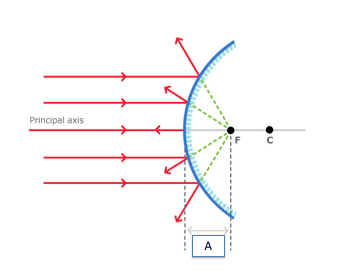
In the image, all the rays meet at F, What is F

1

focal length

2

focal point

3

center of curvature

4

reflection

65

Multiple Choice

Question image

What is an image called that forms when light rays actually meet

1

virtual image

2

real image

3

diffuse reflection

4

regular reflection

66

Multiple Choice

The two types of spherical mirrors are ...............

1

flat and plane

2

concave and plane

3

convex and concave

4

plane and rectangular

67

Multiple Choice

If 'R' is radius of curvature and 'f' is focal length of a spherical mirror then the correct relation between the two is

1

R = f

2

R = f/2

3

f = 2R

4

f = R/2

68

Multiple Choice

When distance of object from a mirror is gradually increased then image formed by it becomes inverted which was erect in the beginning. Which type of mirror is this ?

1

Plane mirror

2

Concave mirror

3

Convex mirror

4

none of the above

69

Multiple Choice

which of the following is not a property of the image formed by a [lane mirror?

1

virtual and erect

2

Object size = image size

3

object distance = image distance

4

Real and inverted

70

Multiple Choice

Which of the following is a concave mirror?

1
2
3
4

71

Multiple Choice

Question image

Four students A, B, C and D performed the experiment to determine the focal length of a concave mirror by obtaining the image of a distant tree on a screen. They measured the distances between the screen and the mirror as shown in the above figure.

The correct way of measuring accurate focal length of the mirror is

1

A

2

B

3

C

4

D

72

Multiple Select

In a concave mirror if the object is placed at the focal point, then the image is?

1

never formed as the reflected light is parallel and they never meet

2

inverted and at the focal point

3

inverted and in-between the centre of curvature and the focal point

4

inverted and before the focal point

73

Multiple Select

If the object is placed in-between the centre of curvature and the focal point in a concave mirror, then the image is?

1

inverted and at the centre of curvature

2

inverted and ahead of the centre of curvature

3

inverted and before the centre of curvature

4

inverted and in-between the centre of curvature and the focal point

74

Multiple Select

In a concave mirror if the object is placed ahead of the focal point, then the image is?

1

formed magnified and behind the mirror

2

diminished and behind the mirror

3

inverted and at the centre of curvature

4

inverted and at the focal point

75

Multiple Choice

Question image
1

Size of image is larger.

2

Size of image is farther.

3

Size of image is the same.

4

Size of image is smaller.

76

Multiple Choice

How many image characteristics do we report?

1

1

2

2

3

3

4

4

77

Multiple Choice

Question image
1

Location of image is closer.

2

Location of image is farther.

3

Location of image is the same.

78

Multiple Choice

Question image

In a ray diagram, the image is drawn:

1

wherever you want.

2

on the right of the mirror.

3

where the reflected rays cross.

4

where any two rays cross.

79

Multiple Choice

Question image

Which one of the following is the image obtained by the plane mirror ?

1
2
3
4
5

80

Multiple Choice

Question image

Which number is seen by the observer ?

1

22

2

25

3

55

4

35

5

52

81

Multiple Choice

Question image

Point objects K L M N are placed in front of the plane mirror as shown in the figure. Which point(s) can be seen by the observer at point G ?

1

K and M

2

M and N

3

K and L

4

K, M and N

5

M, N and L

82

Multiple Choice

Question image

Which picture represents what happens when light travels through a CONVERGING lens?

1

A- left picture

2

B - Right picture

83

Multiple Choice

Question image

what type of mirror is this

1

concave

2

convex

3

translucent

4

plane

84

Multiple Choice

Latha is observing her image in a plane mirror. The distance between the mirror and her image is 6 m. If she moves 2m towards the mirror then the distance between latha and her image will be

1

8 m

2

4 m

3

10 m

4

5 m

85

Multiple Choice

Images that can't be captured on a screen are called

1

Real image

2

Virtual image

3

Proper image

4

Imaginary image

86

Multiple Choice

Focus is situated behind the mirror of

1

Concave mirror

2

Convex mirror

3

Both

4

None

87

Multiple Select

Choose all the terms that are associated with Orientation of an image:

1

Inverted

2

Virtual

3

Real

4

Upright

88

Multiple Choice

When determining image location and size...

1

look at what side of the mirror it's on.

2

compare it to the object.

3

divide the distance by the height.

89

Multiple Choice

What Type of image can be shown on a screen?

1

Virtual

2

Inverted

3

Real

4

Concave

90

Multiple Choice

Question image

The mirror shown here is:

1

Plane

2

Concave

3

Convex

91

Multiple Choice

Question image
1

Location of image is closer.

2

Location of image is farther.

3

Location of image is the same.

92

Multiple Choice

Question image

1

Orientation of image is upright.

2

Orientation of image is farther.

3

Orientation of image is real.

4

Orientation of image is inverted.

93

Multiple Choice

Question image

1

Size of image is larger.

2

Size of image is farther.

3

Size of image is the same.

4

Size of image is smaller.

94

Multiple Choice

Question image

1

Type of image is real.

2

Type of image is reversed.

3

Type of image is the virtual.

4

Type of image is smaller.

95

Multiple Choice

Question image

1

This mirror is concave.

2

This mirror is convex.

3

This is a plane mirror.

96

Multiple Select

Question image

Check all the true statements:

1

The image is inverted.

2

The image is upright.

3

The image is real.

4

The image is virtual.

97

Multiple Choice

Concave mirrors cannot produce virtual images.

1

True

2

False

98

Multiple Choice

Question image

In a ray diagram, the rays start:

1

at the mirror.

2

at the bottom of the object.

3

at F.

4

at the top of the object.

99

Multiple Choice

Question image

In a ray diagram, the first ray that you draw goes:

1
2
3
4

100

Multiple Choice

Question image

In a ray diagram, the image is drawn:

1

wherever you want.

2

on the right of the mirror.

3

where the reflected rays cross.

4

where any two rays cross.

101

Vibrations & Waves

media

102

media

103

media

104

The period of a pendulum depends only on its length, mass has no effect.

105

media

106

Wave Calculations

107

media

108

media

109

media

110

Multiple Choice

What variable determines the length of a pendulum's period?

1

pendulum mass

2

pendulum length

3

time

111

Multiple Choice

A wave has a frequency of 13.5 Hz and a speed of 42 m/s. What is the wavelength of the wave?

1

570 m

2

570 m/s

3

3.1 m

4

3.1 m/s

112

Multiple Choice

Question image

Which location represents the amplitude?

1

f

2

g

3

h

4

j

113

Multiple Choice

Question image

Which location represents the wavelength?

1

f

2

g

3

h

4

j

114

Multiple Choice

Both sound and light waves do not need a medium to travel through.

1

true

2

false

115

media

116

Multiple Choice

Question image

What's going on here?

1

Reflection

2

Refraction

117

Multiple Choice

In a vacuum or in air, all types of waves (RMIVUXG) travel at the same speed (speed of light)

1

True

2

False

118

Multiple Choice

What do you think happens when a ray of visible light enters water (for example)?

1

Speeds up

2

Slows down

3

Nothing

119

media

120

media

121

122

media

123

media

124

media

125

126

media

127

media

128

media

129

Multiple Choice

Question image

What would you see after polarizer 2?

1

Nothing because the vertical light can't fit through the horizontal opening

2

Horizontal light because the vertical light gets reshaped

3

Vertical light because it can just pass through because it's light

130

media

131

media

132

media

133

Multiple Choice

Question image
This image is representing what wave interaction?
1
Refraction
2
Diffraction
3
Reflection
4
Interference

134

135

media

136

media

137

media

138

139

media

140

media

141

media

142

media

143

Multiple Choice

Question image
What can you tell about this object's motion?
1
Moving to the North (up).
2
Moving to the South (down). 
3
Moving to the West (left). 
4
Moving to the East (right). 

144

Multiple Choice

What is this phenomenon called?

1

Doppler Effect

2

Diffraction

3

Reflection

4

Interference

145

Multiple Choice

Question image

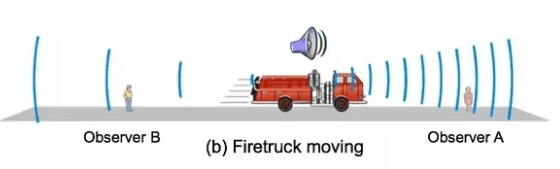
Look at the picture. Who is experiencing a higher pitched sound?

1

Observer A

2

Observer B

3

There's no difference

146

media

147

media

148

149

Multiple Choice

Question image
What can you tell about this object's motion?
1
Moving to the North (up).
2
Moving to the South (down). 
3
Moving to the West (left). 
4
Moving to the East (right). 

150

Multiple Choice

What best describes the doppler effect?
1
An apparent change in frequency of a wave due to the relative motion between a wave source and an observer
2
When sound changes pitch
3
When light changes color
4
An apparent change in the amplitude of a wave due to the relative motion between a wave source and an observer.

151

Multiple Choice

Question image
When an ambulance move TOWARD you it sounds ________ pitched. 
1
high
2
low
3
medium

152

Multiple Choice

Question image
The Doppler effect is seen when a wave-making source moves toward an observer. 
1
True
2
False

Light, Waves and Optics

by Ronnie Lorilla

Show answer

Auto Play

Slide 1 / 152

SLIDE