

LAST CHANCE Biology SOL Review!!!

Presentation
•
Science, Biology
•
9th - 12th Grade
•
Practice Problem
•
Medium
+14
Standards-aligned

Elizabeth Wait
Used 47+ times
FREE Resource
25 Slides • 48 Questions
1
By Desiree' Perkins
2
Hypothesis - a testable prediction, may be right or wrong
Theory - an explanation that has already been tested many times and supported by evidence
Law - a description of a phenomenon; usually a formula

3
Multiple Choice
Before a scientific theory is accepted and supported, it has
been tested by only one scientist.
been published in scientific journals.
been tested many times by different scientists.
been approved by the International Committee of Scientists.
4
Multiple Choice
In chemistry, the equation pV=nRT is used to describe the relationship between volume, pressure, temperature, and molarity. It is an example of a -
Hypothesis
Inference
Law
Theory
5
Independent Variable - what you change or test; your treatment
Dependent Variable - what you measure; your data
How does [IV] effect [DV]?
If I [change the IV] then [DV will change]

6
Multiple Choice
Molly investigated if the age of students caused them to be better drivers. What is the independent variable?
Type of car
Skill of driving
Age of student
Years of experience
7
Multiple Choice
A student is planning an experiment to find out how the height from which he drops a ball affects how high the ball bounces. The dependent variable is the _____.
Diameter of the ball
Force acting on the ball
Height that the ball bounces
Height from which the ball is dropped
8
Experimental Group(s) - receive the independent variable (treatment); are being tested
Control Group - receive NO treatment or are left unchanged; used for comparison
Look for words like "normal", "plain", "zero", or "none" for the control group
NOT having a control group is a common error in experimental design

9
Multiple Choice

Eiko is doing an experiment to determine the best fertilization plan for bean plants.
She will test four groups of four plants using this schedule.
Which group is the control group?
Group A
Group B
Group C
Group D
10
Multiple Choice

The data show the growth of two bean plants over several weeks using four different fertilizers. The experimental data would be more valid if which of the following variables was included in the experiment?
A control without fertilizer was included for each plant.
The plants were grown at variable temperatures.
Only one plant was tested.
A fifth fertilizer was tested.
11
Water is...
POLAR - able to dissolve other polar and ionic substances
COHESIVE - sticks together to form drops
ADHESIVE - sticks to other surfaces
Capable of climbing up plant stems or straws (capillary action) due to cohesion and adhesion!
Able to dissolve and carry nutrients

12
Multiple Choice

Why does water move from the roots to the leaves of plants?
Water is pushed by solutes
Capillary action pulls the water molecules like a chain
Water is pulled by gravity
Water’s surface tension causes it to “pull” towards the leaves
13
Multiple Choice
The water inside a cell is capable of transporting nutrients throughout the cell because -
the non-cohesive properties of water allows nutrients to move freely
the pH of pure water in a cell is 3
hydrogen bonding creates a non-adhesive characteristic of water
the polarity of water dissolves substances
14
Catalysts - speed up reactions
They lower the activation energy (cost) of reactions
Enzymes have specific shapes
Enzymes have optimal (ideal) temperature and pH ranges

15
Multiple Choice
Enzymes are _______________ that _____________________ chemical reactions by ____________ the amount of activation energy required to start the reaction.
carbohydrates, slow down, lowering
proteins, speed up, increasing
lipids, speed up, lowering
proteins, speed up, lowering
16
Multiple Choice
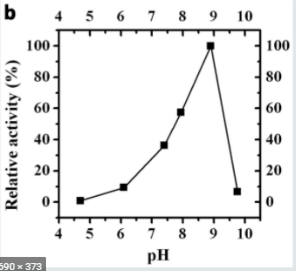
What is the optimal pH for this enzyme?
6
10
9
7
17
Prokaryotes - cells that have NO nucleus or membrane-bound organelles
Eukaryotes - cells that DO have a a nucleus and membrane-bound organelles
REMEMBER - Pro No, Eu Do (NUcleus)

18
Multiple Choice
The main difference between prokaryotes and eukaryotes is...
Eukaryotes have a nucleus and membrane-bound organelles
Eukaryotes are smaller and simpler than prokaryotes
Eukaryotes have a cell wall and prokaryotes have a cell membrane
Prokaryotes do not have DNA
19
Multiple Choice
A single-celled organism that lacks a membrane-bound nucleus, mitochondria, or any other membrane -bound organelle .
Prokaryote
Eukaryote
Nucleus
Single-celled organism
20
Photosynthesis MAKES glucose to store light energy
Cellular Respiration BREAKS glucose to release ATP energy
Water goes with CO2, Glucose (C6H12O6) goes with O2
Forms a CYCLE with photosynthesis - the PRODUCTS of one become the REACTANTS of the other!

21
Multiple Choice
In which way are photosynthesis and cellular respiration different?
Cellular respiration stores ATP, while photosynthesis releases ATP.
Cellular respiration produces oxygen, while photosynthesis uses oxygen.
Photosynthesis releases energy, while cellular respiration stores energy.
Photosynthesis uses carbon dioxide, while cellular respiration produces carbon dioxide.
22
Multiple Choice
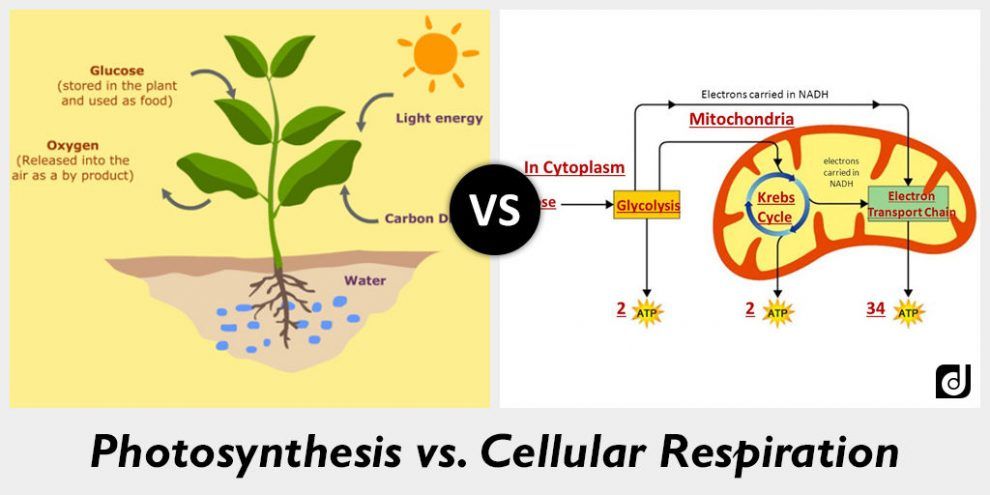
Cellular respiration and photosynthesis are related because...
They both make glucose
They both require oxygen
The products of one reaction are the reactants of the other reaction
They both make carbon dioxide
23
Type of passive transport
Does NOT use energy
Moves from H->L concentration
Movement of WATER
Water moves from where there is more water to where there is less

24
Multiple Choice
Osmosis is the diffusion of _____ across a selectively permeable membrane.
food
air
water
oxygen
25
Multiple Choice
When the number of water molecules outside of the cell is greater than inside the cell, which will most likely occur?
Molecules of water will NOT MOVE either way.
Molecules of water will move OUT of the cell.
Molecules of water will move INTO the cell.
Molecules of water will EVAPORATE.
26
Mitosis - form two identical diploid cells, makes new somatic (body) cells, used for growth and healing
Meiosis - forms four genetically different haploid cells, makes new gametes (sex cells), used for sexual reproduction
BOTH are types of cell division

27
Multiple Choice
Mitosis forms
4 identical daughter cells
2 identical daughter cells
4 different daughter cells
2 different daughter cells
28
Multiple Choice
Unlike mitosis, meiosis in male mammals results in the formation of
one haploid gamete
three diploid gametes
four diploid gametes
four haploid gametes
29
Homozygous Dominant - two dominant alleles (AA); has the dominant trait
Heterozygous - two DIFFERENT alleles (Aa); has the DOMINANT trait
Homozygous Recessive - two recessive alleles (aa); has the recessive trait

30
Multiple Choice
Recessive traits require how many copies of the recessive allele to appear?
0
1
2
4
31
Multiple Choice
In dogs, black fur is dominant to brown. A dog that is Bb would have...
Black fur
Brown fur
Brown fur with black spots
Black fur with brown spots
32
Eubacteria are "true bacteria"
Fix Nitrogen (store in soil)
Decomposers
Peptidoglycan cell walls
Archaea are still sometimes called Archaebacteria but they are NOT true bacteria
Live in EXTREME environments
Cell walls with NO peptidoglycan

33
Multiple Choice
Students research unicellular, prokaryotic organisms that live in harsh environments such as volcanic hot sprints, brine pools, and anaerobic black organic mud. Which of these groups are the students most likely researching?
Protista
Plantae
Eubacteria
Archaea
34
Multiple Choice
What is one difference between domains Bacteria and Archaea?
Archaea contain a cell wall with no peptidoglycan
Archaea are composed of prokaryotic cells
Bacteria are unicellular in body types
Bacteria are both autotrophic and heterotrophic
35
Domain Eukarya:
Fungi and Plants
Fungi
Decomposers
Heterotrophic because they absorb nutrients
Chitin cell walls
Plants
Photoautotrophic - make their food using photosynthesis
Cellulose cell walls


36
Multiple Choice
A biologist has just discovered a new life form. The newly described organism is multicellular, does not carry out photosynthesis, and absorbs nutrients from the environment. It is composed of eukaryotic cells with cell walls. In which kingdom would the organism be classified?
Animal
Eubacteria
Fungi
Plant
37
Multiple Choice
What characteristic do most adult fungi and plants share?
They both are producers
They both have cells with cell walls
They both reproduce through binary fission
They both have multiple nuclei in each cell
38

Domain Eukarya:
Protists and Animals
Protists
Mostly unicellular and aquatic
Can be autotrophic AND/OR heterotrophic
Some even use photosynthesis
Includes paramecium, amoeba, and euglena
Animals
Multicellular
Heterotrophic - we gotta eat!
NO CELL WALLS
39
Multiple Choice
Where are you most likely to find protists?
On your kitchen counter
In a lake or pond
In a volcano
In a desert
40
Multiple Choice
Kingdom Animalia is the ONLY kingdom in which ALL of its organisms -
contain eukaryotic cells
have no cell walls
are heterotrophic
reproduce sexually
41
NOT made of cells
DO contain genetic material (DNA and/or RNA), which is surrounded by a protein coat
Require a host (living cell to infect) to reproduce
CANNOT be treated with antibiotics
May be prevented by vaccines

42
Multiple Choice
Which statement regarding viruses is true?
A virus can only reproduce inside of a living host cell
Viruses can be treated with antibiotics
Viruses are unicellular
Viruses do not contain DNA or RNA
43
Multiple Choice
What do viruses have in common with living cells? They both...
store genetic information
have chloroplasts
use glucose for cellular respiration
have endoplasmic reticulum
44
The more closely related they are
The more recently they shared a common ancestor
The more similar their classification will be (share more taxa)

45
Multiple Choice
A fossil of an extinct dinosaur is found and the anatomy of the fossil shows similarities to that of a bird. What could this mean?
This is purely by chance and isn't significant
The extinct dinosaur and modern bird share a common ancestor
All dinosaurs evolved into birds and that's why there aren't any dinosaurs alive today
Dinosaurs chose to fly, and evolved into birds to escape predation and capture food
46
Multiple Choice
The skulls below belong to different animals. Which skull belongs to the animal that is probably unrelated to the other three?
47
Relative dating looks at rock layers - the deeper the fossil the older it is
Absolute dating measures radioactive isotopes (like Carbon-14) to determine an exact age
Absolute dating is MORE accurate

48
Multiple Choice

Which of the following is a correct statement about the shown geologic column?
The largest quantity of fossils are found in layer two of the geologic column
Fossils found in layer one are older than fossils found in layers three and four
Layer four includes the youngest fossils of either of the entire geologic column
Fossils found in layer three are younger than layer four but older than layer one
49
Multiple Choice
Which best helps scientists determine the age of fossils?
Physical traits
Genetic makeup
Reproductive strategy
Radioactive isotopes
50
These are body parts that have similar structures but may have different functions
The more similar, the more closely related!
Example: whale flippers and bat wings both have "finger bones"

51
Multiple Choice

Look at the homologous structures. The animal structures shown in the figure indicate that the five organisms -
use their limbs to run
reproduce sexually
develop in a similar amount of time
have a similar origin
52
Multiple Choice
Which two structures are homologous?
Butterfly wing and bird wing
Cat leg and a human arm
Lizard leg and grasshopper leg
Whale flipper and fish fin
53
Organisms that look very similar at the early embryo stages likely evolved from a common ancestor
The more similar, the more closely related!

54
Multiple Choice

Based on the embryological data, which two species would be considered the most closely related?
1 and 2
1 and 4
2 and 4
2 and 3
55
Multiple Choice
Both fish and humans develop gill pouches during an early stage of development as embryos. Fish embryos continually develop their gill pouches while human embryos refine the gill pouches into the structures for the head and neck. What does this similar feature through embryo development suggest about these two organisms?
Human embryos have the capability to develop into fish.
Fish do not have any similar embryo development stages
Both humans and fish develop into invertebrates
Both humans and fish have a common ancestor
56
Organisms with similar DNA or amino acid sequences likely shared a common ancestor
The more similar, the more closely related!
DNA evidence is the MOST accurate

57
Multiple Choice
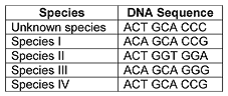
According to this data, the unknown bacterial species is most closely related to:
Species I
Species II
Species III
Species IV
58
Multiple Choice
What does the presence of similar genes in organisms that have different physical structures imply?
The organisms share a common ancestor
The organisms do not share a common ancestor
The organisms must be the same species
The DNA sequences must be completely different
59
The closer together two species are, the more closely they are related
Where the lines for two species meet is where they share a common ancestor
The closest meeting point is the most recent common ancestor

60
Multiple Choice

What number is the most recent common ancestor of C and D
1
2
3
4
61
Multiple Choice

On the cladogram, which organism is the closest relative of the human?
Parrot
Shark
Hare
Frog
62
Density-Dependent Factors - effect the size of a population differently depending on its size and density; includes resources, space, disease, and parasites
Density-Independent Factors - their effect DOES NOT depend on population size; includes weather, natural disasters, and human activity

63
Multiple Choice
Which of the following is a density-independent limiting factor?
natural disaster
predation
disease
parasitism
64
Multiple Choice
What would NOT be an example of a density dependent factor?
Predation
Parasitism
The average rainfall of a region
Communicable Disease
65
Producer - makes its own food; plants; algae; phytoplankton; most use photosynthesis
Consumer - has to eat; animals
1st is primary, 2nd is secondary, etc...
Decomposer - breaks down dead organisms and absorb their nutrients; fungi, many bacteria
THINK: Producer->Plant->Photosynthesis

66
Multiple Choice

In this food web, the seaweed is an example of a...
producer
consumer
herbivore
omnivore
67
Multiple Choice

Refer to the food web shown in the figure. Which organism is correctly classified as a primary consumer?
Grasses
Frog
Snake
Grasshopper
68
Primary Succession - starts from bare rock; NO SOIL present; lichen and moss are common pioneer species
Secondary Succession - starts WITH SOIL; grasses are common pioneer species
REMEMBER - Secondary HAS Soil

69
Multiple Choice
Primary succession usually begins with what pioneer species?
lichens and mosses
grasses
small plants
insects
70
Multiple Choice
What is an example of an area that is likely to undergo primary succession?
Glaciers melt and leave exposed rock
Plants die from drought and decompose
Land is bulldozed and soil remains
A forest partially destroyed by a forest fire.
71
Both carbon and nitrogen are needed by living things to build cell structures
The major steps in the carbon cycle are photosynthesis, respiration, and combustion
The carbon cycle also cycles oxygen
The major steps in the nitrogen cycle are nitrogen fixation, nitrification, and denitrification
Bacteria play a major role in the nitrogen cycle by converting to a form useable by plants (fixation)

72
Multiple Choice

Identify the cycle pictured.
The Water cycle
The Carbon cycle
The Nitrogen cycle
The Phosphorus cycle
73
Multiple Choice
What converts nitrogen gas into a usable form for plants and animals?
bacteria
rain
fungi
car exhaust
By Desiree' Perkins
Show answer
Auto Play
Slide 1 / 73
SLIDE
Similar Resources on Wayground

71 questions
Air Pressure & Wind Slides & Qsts
Presentation
•
9th - 12th Grade
71 questions
The Water Cycle Lesson
Presentation
•
9th - 12th Grade
65 questions
Organic Chemistry
Presentation
•
9th - 12th Grade
68 questions
Interactive Notes: The Chemistry of Life - Intro to Biochemistry
Presentation
•
9th - 12th Grade
69 questions
Evidences of Evolution
Presentation
•
9th - 12th Grade
69 questions
Introduction to Chemical Reactions
Presentation
•
9th - 12th Grade
71 questions
Chem Unit 1 Remediation- Density & Mass-Vol Graphs (LStd1.3,1.4)
Presentation
•
9th - 12th Grade
66 questions
Biology 3.2 Lesson
Presentation
•
9th - 12th Grade
Popular Resources on Wayground
10 questions
How much do you know about our Portrait of an Eagle?

Quiz
•
10th Grade
10 questions
Fast Food Slogans
Quiz
•
6th - 8th Grade
21 questions
Continents and Oceans
Quiz
•
6th Grade
20 questions
Parts of Speech
Quiz
•
5th Grade
16 questions
Subject & Predicate
Quiz
•
5th Grade
25 questions
Multiplication Facts
Quiz
•
5th Grade
12 questions
Map Skills
Quiz
•
3rd Grade
22 questions
Continents and Oceans
Quiz
•
5th Grade
Discover more resources for Science
10 questions
Exploring Chemical and Physical Changes

Interactive video
•
6th - 10th Grade
20 questions
Atomic Structure
Quiz
•
9th Grade
10 questions
Decoding the Periodic Table of Elements
Interactive video
•
6th - 10th Grade
10 questions
Exploring the Periodic Table
Interactive video
•
6th - 10th Grade
14 questions
Physical and Chemical Changes
Quiz
•
10th Grade
22 questions
Periodic Table Review
Quiz
•
9th - 12th Grade
20 questions
Observation vs. Inference
Quiz
•
7th - 9th Grade
14 questions
Periodic Trends
Interactive video
•
11th Grade