Search Header Logo
  1. Resource Library
  2. Science
  3. Earth & Space Science
  4. Land And Sea Breeze
  5. Global Winds And Ocean Currents
Global Winds and Ocean Currents

Global Winds and Ocean Currents

Assessment

Presentation

Science

6th Grade

Medium

NGSS
MS-ESS2-6, MS-ESS2-5

Standards-aligned

Created by

Kristen Yarka

Used 81+ times

FREE Resource

17 Slides • 22 Questions

1

Global Winds and Ocean Currents

By Kristen Yarka

2

media

3

media

4

media

5

Wind is created by unequal heating and cooling.

Land heats up faster and cools down faster than water.

media

6

media

7

media

8

media

9

media

10

media

11

Multiple Choice

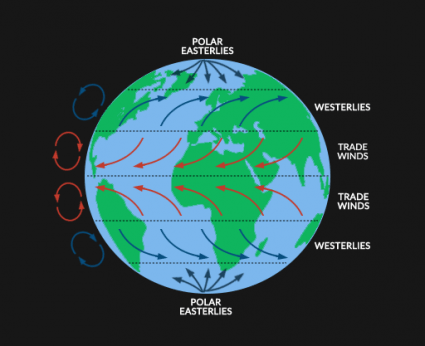
Objects in the NORTHERN Hemisphere deflect to which direction due to the Coriolis Effect?

1

Left

2

Up

3

Down

4

Right

12

Multiple Choice

Objects in the SOUTHERN Hemisphere deflect to which direction due to the Coriolis Effect?

1

Left

2

Up

3

Down

4

Right

13

Multiple Choice

The Coriolis Effect is caused by what?

1

The wind blowing

2

Earth's gravity pulling things down

3

The rotation of the Earth

4

The pull of the Moon

14

Multiple Choice

Winds blow from areas of what to what?

1

High temperature to high pressure

2

Low temperature to high pressure

3

High pressure to low temperature

4

Low temperature to high temperature

15

Multiple Choice

Question image

what is the coriolis effect?

1

change in location of warm and cold surface water every 2-7 years

2

tendency of objects moving large distances on Earth’s surface to bend to the right in the northern hemisphere & to the left in the southern hemisphere

3

winds in northern Indian ocean that blow from the southwest in the summer & from the northeast in winter

4

two layers of horizontal winds moving in opposite directions

16

Multiple Choice

The Coriolis effect causes ___________.

1

the Earth to rotate on its axis

2

earthquakes

3

global winds to move in a curved path instead of a straight line

4

the Earth to revolve around the sun

17

media

18

media

19

media

20

Multiple Choice

Do sea breezes typically happen during the day or night?
1
Day
2
Night

21

Multiple Choice

During a sea breeze which way does the wind blow?
1
from the land to the sea
2
from the sea to the land

22

Multiple Choice

When warm air rises, ______ pressure forms at the surface of the land or sea.
1
high
2
some
3
low
4
none

23

Multiple Choice

The strength of a sea breeze depends on
1
the heat of the day
2
the difference between the temperature of the sea and the land
3
the wind speed
4
the amount of precipitation that day

24

Multiple Choice

How does the air move in a sea breeze?
1
wind moves from north to south
2
wind moves from ocean to the land
3
wind moves from the land to the ocean
4
wind moves from south to north

25

Multiple Choice

In a sea breeze, the air is warmer above the _____.
1
land
2
ocean
3
sky
4
beach

26

media

27

media

28

media

29

media

30

Multiple Choice

Do land breezes typically happen during the day or night?
1
Day
2
Night

31

Multiple Choice

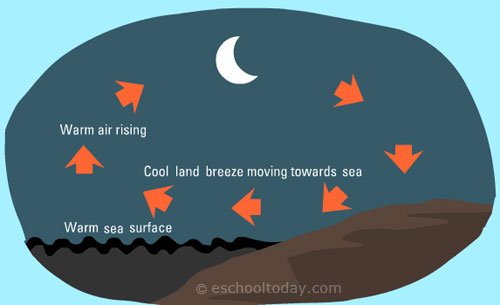
During a land breeze which way does the wind blow?
1
from the sea to the land
2
from the land to the sea

32

Multiple Choice

Question image
Is this a land or a sea breeze?
1
land breeze
2
sea breeze

33

Multiple Choice

How does the air move in a land breeze?
1
From east to west
2
From west to east
3
From the land to the ocean
4
From the ocean to the land

34

Multiple Choice

Land and water absorb and release the sun’s heat in different ways. One result of this is a sea breeze. Which statement is true of sea breezes?
1
They originate in the day and blow toward the land.
2
They originate in the day and blow toward the water.
3
They originate in the evening and blow toward the land.
4
They originate in the evening and blow toward the water.

35

Multiple Choice

Question image

Air moves from _______ pressure to ________ pressure.

1

high to low

2

low to high

3

high to high

4

low to low

36

Multiple Choice

Question image

The arrow above the water is coming down and is blue because

1

the water is warm so it warms the air and warm air sinks.

2

the water is cold so it warms the air and cool air sinks.

3

the water is cold so it cools the air and cool air sinks.

4

the water is warm so it warms the air and cool air sinks.

37

Multiple Choice

Question image

Convection currents form when

1

there are no temperature differences.

2

there are temperature differences.

3

each surface is exactly the same temperature.

4

candy is given out for Halloween.

38

Multiple Choice

Question image

The arrow above the land is coming down and is blue because

1

the land is warm so it warms the air and warm air sinks.

2

the land is cool so it cools the air and cool air sinks.

3

the water is warm so it cools the air and warm air sinks.

4

the land is warm so it warms the air and cool air sinks.

39

Multiple Choice

Question image

The arrow above the water is going up and is red because

1

the water is warm so it warms the air and warm air sinks.

2

the water is warm so it cools the air and cool air sinks.

3

the water is warm so it warms the air and warm air rises.

4

the land is warm so it warms the air and cool air sinks.

Global Winds and Ocean Currents

By Kristen Yarka

Show answer

Auto Play

Slide 1 / 39

SLIDE