Search Header Logo
Reading rock layers

Reading rock layers

Assessment

Presentation

Science

6th - 12th Grade

Medium

NGSS
MS-ESS1-4, MS-LS4-1, MS-ESS2-2

+4

Standards-aligned

Created by

Nikkole Wowaka

Used 4+ times

FREE Resource

40 Slides • 37 Questions

1

Reading rock layers

By Nikkole Wowaka

2

Multiple Choice

Layers of rocks take _______________ years to form.

1

ten

2

million

3

fifty

4

hundred

3

media

4

media

5

Multiple Choice

Geologic processes that occur today are similar to those that occurred in the past.

1

uniformitarianism

2

catastrophism

3

superposition

4

correlation

6

media

7

Multiple Choice

Who proposed the Law of Uniformitarianism?

1

Aristotle

2

Nicolas Steno

3

James Hutton

4

James Chadwick

8

media

9

Multiple Choice

Idea that conditions and creatures on Earth change in quick, violent events.

1

lateral

2

index fossil

3

uniformitarianism

4

catastrophism

10

media

11

media

12

Multiple Choice

How does sedimentary rock usually form?
1
Vertically
2
Diagonally
3
Folding
4
Horizontally

13

media

14

Multiple Choice

Question image

Wrote "Principles of Geology". Geologic events that occurred in the past will continue to occur in the future.

1

Malthus

2

Hutton

3

Lyell

4

Lamarck

5

Wallace

15

media

16

Multiple Choice

The millions of fossils that scientists have collected are called
1
The Geologic Time Scale
2
The Origin of Species
3
The Fossil Record
4
A really neat fossil collection

17

media

18

media

19

Multiple Choice

Relative age dating is used to determine the...
1
actual age of an event
2
length of time between two events
3
age of one event in comparison with other events
4
rate at which a gologic process occurs

20

media

21

Multiple Choice

Which field of science deals with the study of rock layers?

1

Geology

2

Petrology

3

Paleontology

4

Stratigraphy

22

Multiple Choice

The older layers are at the bottom and the younger layers are at the top.

1

True

2

False

23

media

24

Multiple Choice

What do scientists learn from studying rock layers?

1

The date the plant/animal died

2

The exact date the animal/plant died

3

The relative date the animal/plant died

25

Multiple Choice

Question image

Which layer is the oldest?

1

Layer F

2

Layer C

3

Layer A

26

media

27

Multiple Choice

Question image
What layer is the youngest?
1
a
2
l
3
d
4
z

28

media

29

Multiple Choice

The Principle of Cross-Cutting Relationships states that an igneous intrusion is 
1
always younger than the layers it cuts across
2
always older than the layers it cuts across
3
the same age as the rock it melted
4
none of the answers are correct

30

media

31

Multiple Choice

The surface along which rock break and slide past each other is called a:
1
fracture
2
fault
3
joint

32

media

33

Multiple Choice

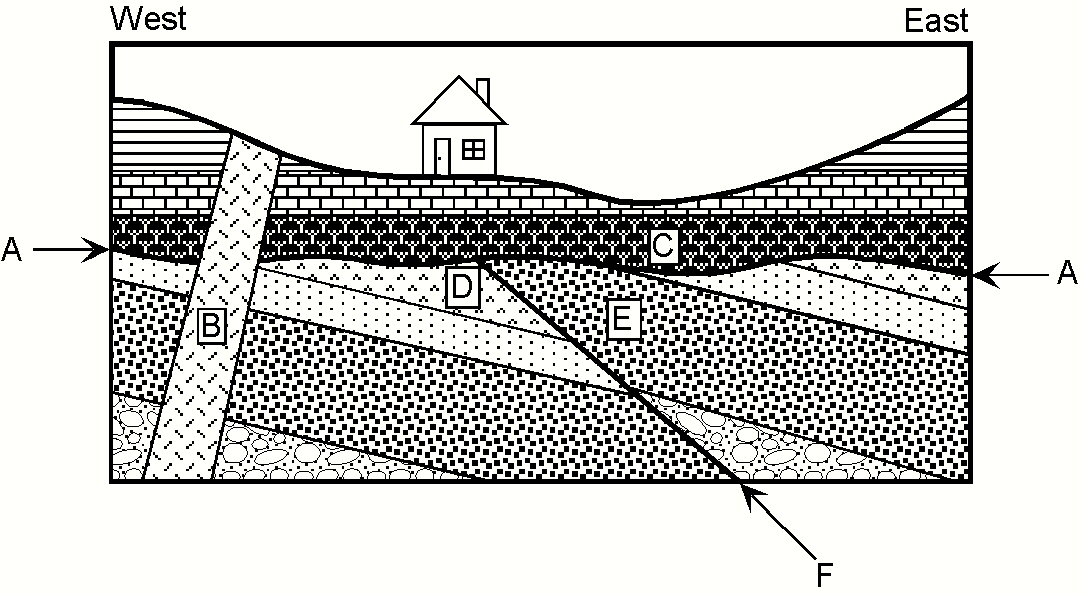
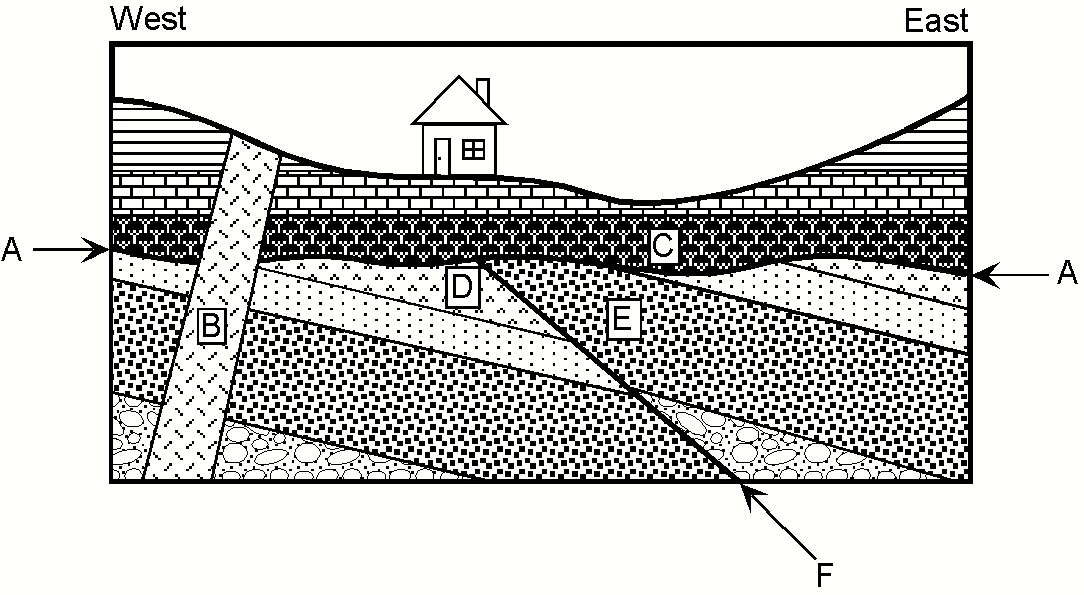
Question image
Letter "F" is a....
1
inclusion
2
intrusion
3
fault
4
unconformity 

34

media

35

Multiple Choice

folding

1

both ends of a fold in the Earth's crust are horizontal

2

downward, trough-like folds in the Earth's crust

3

upward-arching folds in the Earth's crust

4

the bending of rock layers because of stress in the Earth's crust

36

media

37

Multiple Choice

The statement that the oldest layer will be at the bottom in an undisturbed sequence of rock layers is called the Principle of ....
1
Inclusions
2
Unconformities
3
Cross-Cutting Relationships
4
Superposition

38

media

39

media

40

Multiple Choice

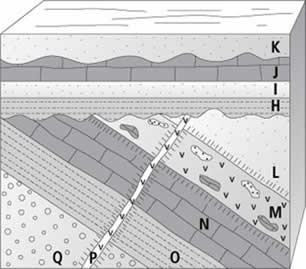
Question image
The rock formation labeled "P" is a(n)...
1
fault
2
intrusion
3
inclusion
4
unconformity

41

media

42

media

43

Multiple Choice

Question image

Which describes this rock formation?

1

fault

2

intrusion

3

unconformity

4

extrusion

44

Multiple Choice

Question image
Once the magma cools what type of rock will it be?
1
nonrenewable
2
renewable
3
igneous 
4
sedimentary

45

Multiple Choice

Why do intrusions and extrusions of igneous rock not have any fossils in them?

1

The high temperature of the magma destroyed any remains of organisms.

2

The rock is too hard.

3

The rock is too young.

4

Why not?

46

media

47

media

48

media

49

media

50

Multiple Choice

Erosion and weathering are classified as destructive processes. How is deposition classified? 
1
It is not classified
2
a constructive process
3

a destructive process

51

media

52

Multiple Choice

Surface where rock has eroded away, producing a break in the rock record

1

correlation

2

inclusion

3

superposition

4

unconformity

53

Multiple Choice

Question image
Letter "A" is an....
1
inclusion
2
intrusion
3
fault
4
unconformity 

54

media

55

media

56

Multiple Choice

Horizontal layers are tilted and uplifted. New sediment is deposited on top.

1

Unconformities

2

Cross-Cutting

3

Angular Unconformities

4

Inclusions

57

media

58

media

59

Multiple Choice

horizontal layers of old sedimentary rock erode, then get covered by new layers
1
angular unconformity
2
nonconformity
3
original horizontality
4
disconformity

60

Multiple Choice

sedimentary layer over unstratified rock
1
angular unconformity
2
disconformity
3
nonconformity
4
original horizontality

61

media

62

Multiple Choice

Question image
The diagram shows fossils in different rock layers. Which of these statements about the age of these fossils is most likely correct?
1
Fossil A and C are the same age
2
Fossil B is older than fossil C
3
Fossils A is older than fossil B
4
Fossil D is older than fossil C

63

media

64

Multiple Choice

Which of the following laws of stratigraphy gives emphasis on the assemblage of fossils embedded on rocks layers?

1

Law of Conformities

2

Law of Superposition

3

Law of Faunal Succession

4

Law of Original horizontality

65

Multiple Choice

Species that existed on Earth for a short length of time, were abundant, and inhabited many locations

1

unconformity

2

correlation

3

index fossil

4

fossil

66

media

67

Multiple Choice

Process of matching rocks and fossils from separate locations

1

correlation

2

inclusion

3

relative age

4

superposition

68

media

69

Multiple Choice

Question image
Which fossil makes the best index fossil?
1
Fossil 1
2
Fossil 2
3
Fossil 3
4
None follow all of the rules

70

media

71

Multiple Choice

Question image

What is the best reason that fossil #4 is NOT a good index fossil?

1

It is not widespread

2

it is not short-lived (in numerous layers)

3

It is in half of the outcrops

72

media

73

Multiple Choice

One of the oldest organisms discovered is called a(n) _________.
1
dinosaur
2
micro-organism
3
trilobite
4
cast and mold fossil

74

Multiple Choice

Question image
Which layer is the oldest? 
1
c
2
a
3
b
4
d

75

media

76

media

77

Multiple Choice

Question image
Which of the following correctly lists the layers in order from oldest to youngest?
1
A, B, C, D, E
2
E, B, C, D, A
3
E, D, C, B, A
4
C, B, A, D, E

Reading rock layers

By Nikkole Wowaka

Show answer

Auto Play

Slide 1 / 77

SLIDE