Search Header Logo
WAVES

WAVES

Assessment

Presentation

Physics

8th - 12th Grade

Easy

NGSS
HS-PS4-1, MS-PS4-1

Standards-aligned

Created by

Ms Sims

Used 19+ times

FREE Resource

14 Slides • 12 Questions

1

WAVES

By Ms Sims

2

media

​​The peak is like the top of the hill, while the trough is like the bottom of the hill.

Waves also have amplitudes, which is a measure of how tall a wave is above the center line.

​Parts of a wave

3

Multiple Choice

Question image
What part is represented by the blue lines?
1
Crest
2
Resting Point
3
Wavelength
4
Amplitude

4

Multiple Choice

Question image
What part is the arrow pointing to?
1
Crest
2
Trough
3
Amplitude
4
Wavelength

5

Multiple Choice

Question image
What part is the arrow pointing to?
1
Crest
2
Trough
3
Amplitude
4
Wavelength

6

media

The last identifiable feature of a wave is its wavelength, or the length of the wave from left to right. You calculate it by measuring from one peak to the next peak, one trough to the next trough, as well as from any point until one complete cycle has finished.

Wavelength

7

media
media

Wavelength can be measured from crest to crest

Or wavelength can be measured from trough to trough

The Greek letter lambda ​λ is the symbol for wavelength

8

Multiple Choice

Question image
What is represented by the blue lines?
1
Trough
2
Crest
3
Wavelength
4
Amplitude

9

Multiple Choice

Question image
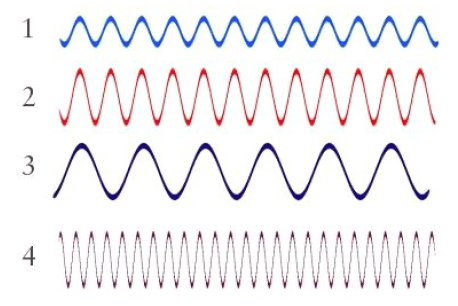
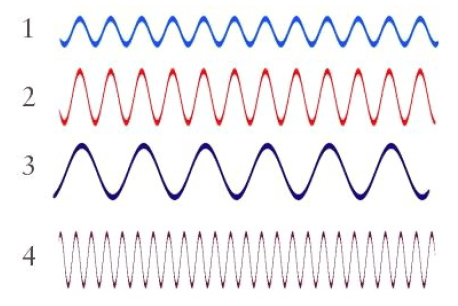
Which wave in the diagram has the greatest wavelength?
1
1
2
2
3
3
4
4

10

Imagine the red box is one second. The top wave has greater frequency than the bottom because more waves pass in that second.

Frequency is the number of waves that pass by each second.

media

11

Multiple Choice

The number of wavelengths that pass a point each per second is:
1
frequency
2
period
3
longitudinal 
4
transverse wave 

12

media

When one increases, the other decreases.

Wavelength increases= Frequency decreases

Wavelength decreases = Frequency increases​

Relationship between frequency and wavelength

13

Multiple Choice

Question image
Which wave has a greater frequency?
1
A
2
B

14

Multiple Choice

Question image
Which wave in the diagram has the greatest frequency?
1
1
2
2
3
3
4
4

15

Multiple Choice

When the frequency of a wave increases, what happens to the wavelength?
1
The wavelength is not directly affected by the frequency of a wave.
2
The wavelength increases.
3
The wavelength decreases.
4
More specific information is needed to form a conclusion about the wavelength.

16

Frequency and amplitude impact how we sense waves

17

Amplitude relates to how much energy the wave has.

Taller waves have more energy. ​

18

Multiple Choice

Amplitude reflects the amount of ____________________ in a wave.
1
energy
2
compression
3
rarefaction
4
speed

19

Examples​

Sound waves with more amplitude are louder​

Light waves with more amplitude are more intense​

20

Frequency

for light, it determines the color

for sound, it determines the pitch​

(how low or high the sound is)​

21

media

22

media
media

23

Types of Waves

Mechanical waves need a medium

like gas, liquids, or solids​

Electromagnetic waves do not need a medium

They can travel through a vacuum

24

  • Radio

  • Wi-fi

  • Gravity

  • light

  • microwaves

  • magnetic fields

  • ​electrical fields

​examples of electromagnetic waves

media

25

Multiple Choice

The type of waves that require medium to pass:
1
Mechanical Waves
2
Electromagnetic Waves

26

Multiple Choice

True or false: electromagnetic all travel at the speed of light

1

True

2

False

WAVES

By Ms Sims

Show answer

Auto Play

Slide 1 / 26

SLIDE