Search Header Logo
Throwback/Flashback Enzyme mini lesson

Throwback/Flashback Enzyme mini lesson

Assessment

Presentation

Science, Biology

9th - 12th Grade

Medium

NGSS
HS-LS1-6

Standards-aligned

Created by

Laura Rodriguez

Used 10+ times

FREE Resource

4 Slides • 6 Questions

1

Throwback/Flashback Enzyme mini lesson

By Laura Rodriguez

2

media
media

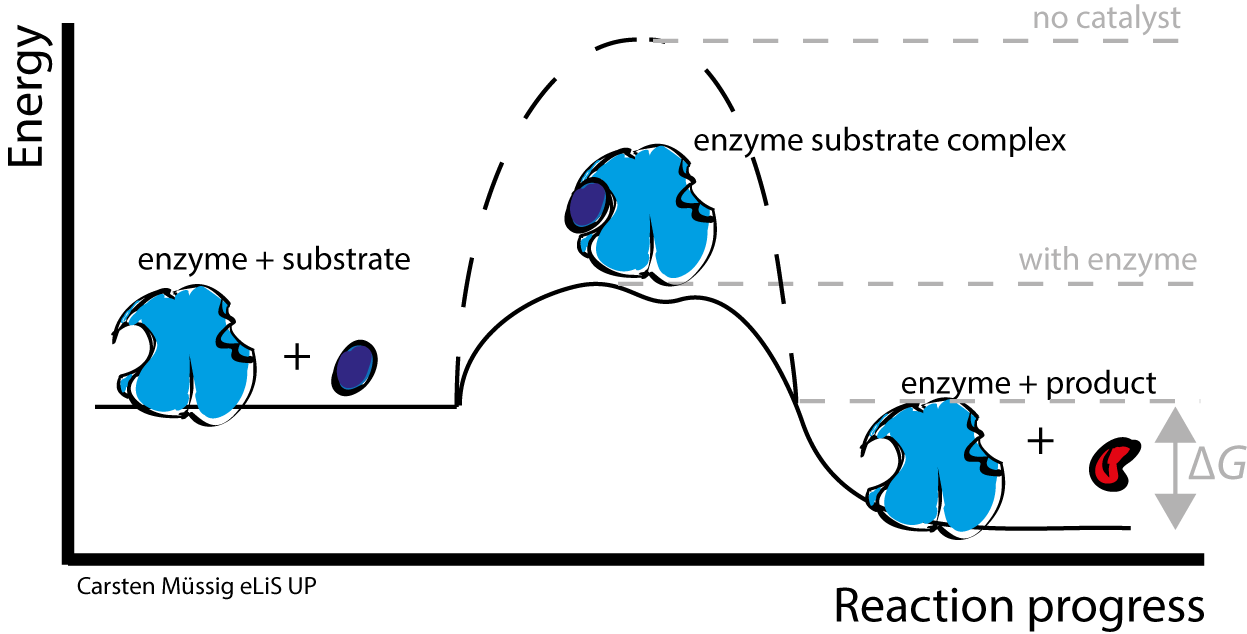
​The substrate binds to the enzyme at the active site - the shape matches - induced fit!

​​Enzymes are specific to substrates

​Enzymes speed up chemical reactions by lowering the activation energy required to start the reaction

Enzymes are catalysts

3

4

Changes in pH, temperature, salinity, will slow down the action of the enzyme

Enzymes & the environment

Enzymes work in specific environmental ranges

media

5

Multiple Choice

Question image
An enzyme speeds up a reaction by
1
lowering the activation energy.
2
raising the activation energy.
3
releasing energy.
4
absorbing energy.

6

Multiple Choice

Question image

What happens when enzymes are heated to a high temperature?

1

The enzymes die.

2

The shape of the enzyme are changed and it denatures

3

The enzymes' amino acid sequence changes.

4

The enzymes remain the same

7

Multiple Choice

Question image
Each enzyme only has 1 substrate that will fit its active site.  What is this called?
1
reusablility
2
denaturation
3
specificity
4
fragility

8

Multiple Choice

Question image
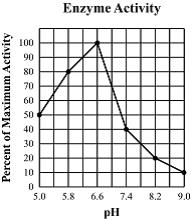
Which of the following conclusions can be drawn from this graph?
1
The optimum pH of the enzyme is 6.6.
2
The optimum pH of the enzyme is 5.8
3
The enzyme’s activity increases as pH increases 5.0 to 9.0
4
The enzyme’s activity is greater around pH of 8.0 .

9

Multiple Choice

Question image
Which enzyme is most efficient in a basic solution?
1
A
2
B

10

Multiple Choice

Question image
Enzymes are composed of which of the following monomers? 
1
amino acids
2
carbohydrates
3
nucleotides
4
monosaccharides

Throwback/Flashback Enzyme mini lesson

By Laura Rodriguez

Show answer

Auto Play

Slide 1 / 10

SLIDE