

Electric Potential and Current

Presentation
•
Science
•
11th - 12th Grade
•
Medium
+3
Standards-aligned

Robert Oliver
Used 12+ times
FREE Resource
25 Slides • 21 Questions
1
By Mr. Oliver
2
3
4
5
6
Multiple Choice
7
Multiple Choice
8
Multiple Choice
9
Multiple Choice
10
11
12
13
14
It's Joules/Coulomb
15
Multiple Choice
Units of energy (KE, PE, EE)
kg
J
kg m/s
m/s2
16
Multiple Choice
What are the proper units for an amount of charge?
volts
ohms
amps
coulombs
17
Multiple Choice
What are the proper units for a potential difference, equal to Joules/Coulomb?
volts
ohms
amps
watts
18
19

20
Multiple Choice
How could you increase the gravitational potential energy of an object without changing its mass and gravity?
Make the object larger
Lower the object towards the ground
Raise the object farther off the ground
Allow the object to roll on the ground
21

A charge in the middle would move in what direction?
22

Where would a positive charge have more potential energy?
A or B
23
Multiple Choice
The direction of electric field lines shows the
direction of the force on a test positive charge.
size of the field.
strength of the field.
all of the above
24
Multiple Choice
25
Multiple Choice
Electric potential between positive charges ____________ as distance increases.
Increases
Decreases
Remains Constant
Is 0
26
Multiple Choice
1 Volt =
1 Joule Coulomb
1 Joule per Coulomb
1 Amp Coulomb
1 Amp per Coulomb
27
Multiple Choice
Voltage is also known as potential difference. Define potential difference
The amount of energy per charge
The amount of charge per energy
The amount of charge per second
The amount of voltage per second
28
Multiple Choice
Calculate the potential difference if the work done by 10 C of charge is 50 J
500 V
5 V
0.5 V
29
30
Multiple Choice
One AA battery produces how many volts?
1500 V
1.5 V
31
32
33
34
35
36
Multiple Choice
37
Multiple Choice
38
39
40
41
Multiple Choice
42
Multiple Choice
43
44
45
Multiple Choice
By convention, current is defined as flowing from ______________ to ______________.
positive, negative
positive, positive
negative, positive
negative, negative
46
Multiple Choice

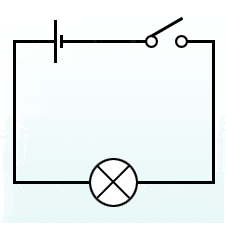
What do the arrows in the circuit represent?
conventional current flow
electron flow
voltage
resistance
By Mr. Oliver
Show answer
Auto Play
Slide 1 / 46
SLIDE
Similar Resources on Wayground

45 questions
Cellular Respiration
Presentation
•
11th - 12th Grade
40 questions
Work and Power
Presentation
•
KG
40 questions
Fossil Fuels
Presentation
•
11th Grade
41 questions
Manifest Destiny
Presentation
•
11th Grade
43 questions
Atoms Lesson
Presentation
•
KG
40 questions
Newton's Third Law
Presentation
•
11th Grade
42 questions
Experience Chemistry Lesson 3.3: Covalent Bonds
Presentation
•
10th - 12th Grade
42 questions
Origin of the Universe
Presentation
•
11th Grade
Popular Resources on Wayground
10 questions
How much do you know about our Portrait of an Eagle?

Quiz
•
10th Grade
10 questions
Fast Food Slogans
Quiz
•
6th - 8th Grade
21 questions
Continents and Oceans
Quiz
•
6th Grade
20 questions
Parts of Speech
Quiz
•
5th Grade
16 questions
Subject & Predicate
Quiz
•
5th Grade
25 questions
Multiplication Facts
Quiz
•
5th Grade
12 questions
Map Skills
Quiz
•
3rd Grade
22 questions
Continents and Oceans
Quiz
•
5th Grade
Discover more resources for Science
22 questions
Periodic Table Review
Quiz
•
9th - 12th Grade
14 questions
Periodic Trends

Interactive video
•
11th Grade
7 questions
Newton's Laws Video Quiz
Interactive video
•
9th - 12th Grade
10 questions
Electron configuration and Orbital Notation
Quiz
•
11th Grade
17 questions
Unit 3A: Cells Vocab
Quiz
•
9th - 12th Grade
89 questions
Unit 1 (Ch 2 & 3) Test Review - Water/Ocean Currents
Quiz
•
9th - 12th Grade
58 questions
Biomolecule Test Corrections
Quiz
•
9th - 12th Grade
20 questions
Unit 2: Cell Energy Review
Quiz
•
9th - 12th Grade