Search Header Logo
Vertebrates

Vertebrates

Assessment

Presentation

Biology

7th Grade - University

Medium

NGSS
MS-LS4-2, HS-LS1-4

Standards-aligned

Created by

Grace Brannen

Used 23+ times

FREE Resource

25 Slides • 18 Questions

1

media

2

Multiple Choice

Which of the following is the correct order from broadest to smallest?

1

Kingdom, Class, Order, Family, Genus, Species, Phylum

2

Species, Genus, Family, Order, Class, Phylum, Kingdom

3

Kingdom, Phylum, Order, Class, Family, Genus, Species

4

Kingdom, Phylum, Class, Order, Family, Genus, Species

3

Multiple Choice

Question image

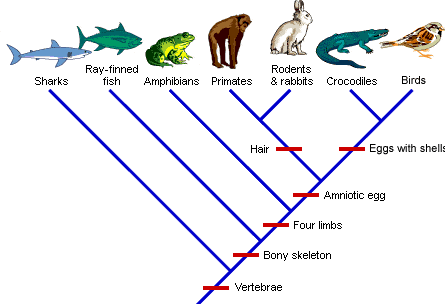
According to this cladogram, sharks are MOST closely related to which organism?

1

Amphibians

2

Ray finned fish

3

Crocodiles

4

Birds

4

media

5

media

6

media

7

media

8

media

9

media

10

media

11

Multiple Choice

The animal's digestive tract forms from the _______.

1

endoderm

2

mesoderm

3

ecotoderm

4

protostome

12

Multiple Choice

Layers of cells on the outer surface of the gastrula

1

ectoderm

2

endoderm

3

mesoderm

13

media

14

Multiple Choice

Coelom is the body cavity formed from the layer:

1

(i) Ectoderm

2

(ii) Mesoderm

3

(iii) Endoderm

4

(iv) Mesoglea

15

media

16

Multiple Choice

Question image

What type of symmetry does the organism have?

1

Asymmetrical

2

Radial

3

Bilateral

17

Multiple Choice

What is the major difference between vertebrates and invertebrates?

1

Vertebrates have a backbone and invertebrates do not.

2

Invertebrates live in water and vertebrates do not.

3

Invertebrates have a backbone and vertebrates do not.

4

Invertebrates are smaller than vertebrates.

18

media

19

Multiple Choice

What is the major difference between vertebrates and invertebrates?

1

Vertebrates have a backbone and invertebrates do not.

2

Invertebrates live in water and vertebrates do not.

3

Invertebrates have a backbone and vertebrates do not.

4

Invertebrates are smaller than vertebrates.

20

media

21

media

22

media

23

media

24

Multiple Choice

Which is the most abundant and numerous group of vertebrates

1

mammals

2

birds

3

fish

4

amphibians

5

reptiles

25

Multiple Choice

Fish take in oxygen through their ________.

1

fins

2

gills

3

scales

4

skin

5

lateral line

26

Multiple Choice

How do fish stay buoyant?

1

oily liver

2

swim bladder

3

hollow bones

4

release of gas

27

media

28

media

29

media

30

Multiple Choice

Which is an example of a cartilaginous fish

1

dolphin

2

trout

3

salmon

4

shark

31

media

32

Multiple Choice

what is a benefit to having cartilage instead of bone?

1

it is lighter

2

it is heavier

3

it makes diving easier

33

media

34

media

35

Multiple Choice

My body is moist and smooth, I lay eggs, and live in or near the water. What am I?

1

Amphibian

2

Reptile

3

Bird

4

Fish

36

media

37

Multiple Choice

reptiles are.....

1

ectotherms

2

endotherms

38

media

39

Multiple Choice

birds are.....

1

ectotherms

2

endotherms

40

media

41

Multiple Choice

hair is a requirement for mammal classification

1

true

2

false

42

Multiple Choice

a requirement for mammal classification is that it gives live birth

1

true

2

false

43

Quick Review

  • Bilateral symmetry is a body  plan in which the right and left halves look the same.

  • A coelom is a fluid-filled space between the body wall and the gut.

  • The function of genes is to carry the instructions for making a protein.

  • Phylogenic relationships provide very strong evidence for evolution, because they reflect relationships indicated by the fossil record.

media

Show answer

Auto Play

Slide 1 / 43

SLIDE