Science - Unit P Days 12-13 (light, heat, and sound)
Presentation
•
Science
•
5th Grade
•
Medium
+2
Standards-aligned
KELLY COOTS
Used 45+ times
FREE Resource
6 Slides • 24 Questions
1
Science - Light, Heat, and Sound Energy
SC.5.P.10.1: Investigate and describe some basic forms of energy, including light, heat, sound, electrical, chemical, and mechanical. SC.5.P.10.2: Investigate and explain that energy has the ability to cause motion or create change. SC.5.P.10.4: Investigate and explain that electrical energy can be transformed into heat, light, and sound energy, as well as the energy of motion.
2
Energy is the ability to cause motion or create change. Some changes caused by energy are physical changes such as ice melting. Some changes are chemical changes such as wood burning. Some changes are changes in motion, such as starts, stops, changes in direction, and changes in speed.
3
Multiple Choice
A student mixes yellow powder with water. Which observation would prove a CHEMICAL change occurred?
The powder DISSOLVED in the water
The water turned the COLOR yellow
The bag's TEMPERATURE changed
The STATE OF MATTER changed
4
Multiple Choice
What kind of change occurs if matter changes in amount, size, or shape?
substance change
chemical change
physical change
elemental change
5
Multiple Choice
Which of the following options provides evidence of a CHEMICAL change?
Wood is burned releasing ash and smoke
Rocks separate when soil is sifted
Boiling water bubbles when heated
Salt dissolves in water
6
Multiple Choice
An example of a physical property is...
Density
Rust
Atoms
Elements
7
Multiple Choice
A white tablet is dropped into water. The water becomes cloudy and bubbles are produced. What type of change has occurred?
Physical change
Chemical change
No change
8
Multiple Choice
Which observations prove a chemical change occurred
Dissolving and expected color change
Mixing and dissolving
State of matter change and boiling water bubbles
Unexpected color change and temperature change
9
There are some basic forms of energy that you should now be very familiar with. Those basic forms of energy are:
GET YOUR NOTEBOOKS OUT!!
10
I. light: radiant energy that we can see (visible)
o light travels in a straight line
o light can reflect: BOUNCE
o light can refract: BEND
o light can be absorbed: SOAKED UP
11
Multiple Choice
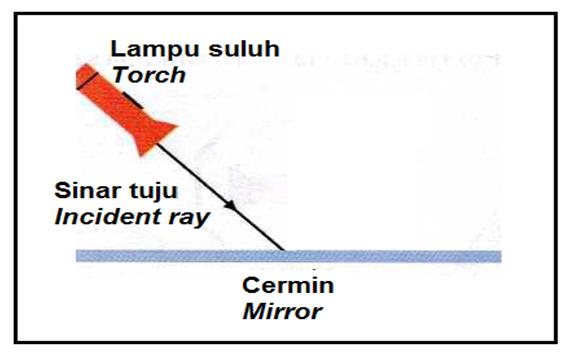
The following diagram shows the ray diagram when a torch light is torched towards a mirror. Which of the following is the correct reflected ray?
12
Multiple Choice
What is the conclusion from your observation in this picture?
Light travels in a straight line
Light can be refracted
Light can be reflected
Light can pass through a transparent material
13
Multiple Select
Which of the following shows that light travels in a straight line? Tick the correct answers.
A
B
C
D
E
14
Multiple Select
Which of the following shows the principle of light refraction? Tick the correct answers.
A
B
D
E
F
15
Multiple Select
Which of the following shows the principle of light reflection? Tick the correct answers.
A
B
D
E
F
16
II. Heat: the thermal energy of an object or material
o is measured as temperature
o measured in degrees Fahrenheit F or Celsius C
o moves from warmer objects to cooler objects
o conductors move heat well
o insulators do not move heat well
17
Multiple Choice
___________________ are materials that ALLOW heat and electricity to move easily through them.
Conductors
Insulators
18
Multiple Choice
19
Multiple Choice
Which thermometers temperature is about 25° Celcius?
Red
green
blue
blue and red
20
Multiple Choice
What are the two scales used to measure temperature?
Bathroom and Kitchen Scales
Degrees and Heat
Hot and Cold
Celsius and Fahrenheit
21
Multiple Choice
Thermal energy travels ...
outside to inside.
cold to hot.
hot to cold.
inside to outside.
22
Multiple Choice
Thermal energy is NOT able to travel quickly through this type of material.
Insulator
Conductor
23
III. sound: caused by vibrations in the air
o vibrations are heard by the ear as sound
o pitch is how high or low a sound is
o volume is how loud or soft a sound is
24
Multiple Choice
By the vibration of particles
By the transfer of particles
25
Multiple Choice
amplitude
compression
speed of sound
pitch
26
Multiple Choice
27
Multiple Choice
How loud or soft the sound is
pitch
acoustics
wavelength
volume
28
Multiple Choice
29
Multiple Choice
30
Multiple Choice
A group of students are listening to music on a laptop while they work. One of the students observes that the battery charge is getting low, and suggests they turn the music off. The most likely reason for this is that
electrical energy from the battery is being transformed into sound energy
the sound coming from the speakers actually has nothing to with the battery
sound is caused by vibration
volume is how loud a sound is, and pitch is how high or low a sound is
Science - Light, Heat, and Sound Energy
SC.5.P.10.1: Investigate and describe some basic forms of energy, including light, heat, sound, electrical, chemical, and mechanical. SC.5.P.10.2: Investigate and explain that energy has the ability to cause motion or create change. SC.5.P.10.4: Investigate and explain that electrical energy can be transformed into heat, light, and sound energy, as well as the energy of motion.
Show answer
Auto Play
Slide 1 / 30
SLIDE

Similar Resources on Wayground
23 questions
What is an ecosystem?
Presentation
•
5th Grade
23 questions
Inherited and Acquired Traits
Presentation
•
5th Grade
23 questions
Potential and Kinetic Energy
Presentation
•
5th Grade
24 questions
Science - Practice of Science Day 1
Presentation
•
5th Grade
22 questions
Slow Changes to the Earth's Surface
Presentation
•
5th Grade
22 questions
Water cycle Lesson
Presentation
•
5th Grade
25 questions
Energy Unit Review 5.6ABC
Presentation
•
5th Grade
21 questions
Science STAAR Review
Presentation
•
5th Grade
Popular Resources on Wayground
20 questions
STAAR Review Quiz #3
Quiz
•
8th Grade
20 questions
Equivalent Fractions
Quiz
•
3rd Grade
6 questions
Marshmallow Farm Quiz
Quiz
•
2nd - 5th Grade
20 questions
Main Idea and Details
Quiz
•
5th Grade
20 questions
Context Clues
Quiz
•
6th Grade
20 questions
Inferences
Quiz
•
4th Grade
19 questions
Classifying Quadrilaterals
Quiz
•
3rd Grade
12 questions
What makes Nebraska's government unique?
Quiz
•
4th - 5th Grade
Discover more resources for Science
15 questions
5.L.3.1/3.2: Inherited/Acquired Traits
Quiz
•
5th Grade
20 questions
Food Chains and Food Webs Review
Quiz
•
5th Grade
15 questions
Fossil Fuel & Sedimentary Rock Formations
Quiz
•
5th Grade
14 questions
5.8.C Light STAAR Question PIN
Quiz
•
5th Grade
19 questions
Electric Circuits 5.8 B
Quiz
•
5th Grade
20 questions
Food Webs
Quiz
•
5th Grade
20 questions
The Water Cycle
Quiz
•
4th - 5th Grade
20 questions
Earth Processes and Landforms
Quiz
•
5th Grade