

Classification terms 2023

Presentation
•
Biology
•
9th - 10th Grade
•
Medium
+2
Standards-aligned

Stacey Ramay
Used 59+ times
FREE Resource
14 Slides • 25 Questions
1

Classification Terms
2
Multiple Choice
A common ancestor of 2 species of organisms is
the organism most closely related to a living organism
the fossil organism most like a current organism
The most recent ancestor they share
the most frequent ancestor of organisms
3

5. cladistics
a method of classifying animals and plants
by the characteristics they have in
common.
4
Multiple Choice
What are Cladistics?
A system of classification that groups organisms together according to the characteristics that have evolved most recently
A system of classification that groups organisms together according to the characteristics that have appeared most recently
A system of classification that groups organisms together according to the characteristics that have evolved elsewise in relation to other species
A system of classification that separates organisms from each other according to the characteristics that have evolved most recently
5

4. Clade
A group that includes a common ancestor and
all the descendants (living and extinct) of that
ancestor.
6
Multiple Choice
A clade contains
all organisms with similar appearances.
organisms living within the same ecosystem.
an ancestral species and all the organisms that came before it.
an ancestral species and all its descendants.
7

6. Cladogram
A diagram that shows evolutionary relationships.
It is assumed that the more characteristics the two organisms share, the more
recently they diverged from a common ancestor.
8
Multiple Choice
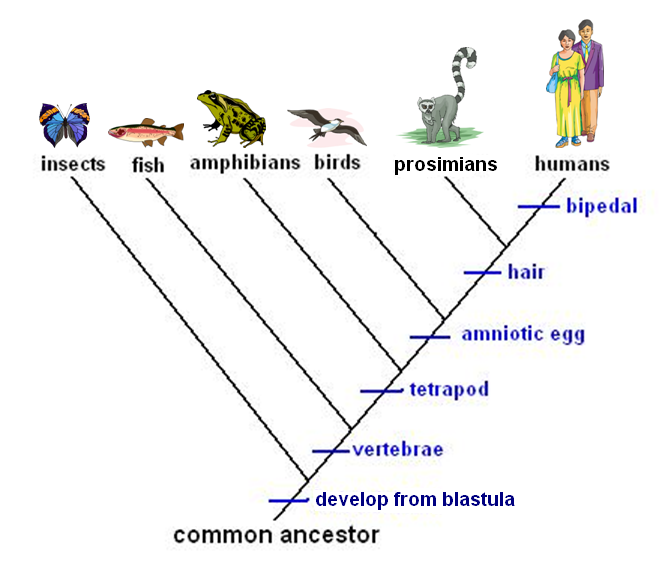
prosimians only
prosimians and humans
humans only
prosimians and birds
9

13. Taxonomy
the classification of all
organisms based on shared
characteristics
10
Multiple Choice
Geology
Biology
Taxonomy
Chemistry
11

12. Taxon
group or level of organization into
which organisms are classified
12
Multiple Choice
What do we call the groups in which we classify organisms?
Categories
Classes
Sets
Taxons
13

11. Systematics
study of the diversity of life
and the evolutionary
relationships between
organisms
14

10. Phylogeny
the evolutionary history of a
lineage
15
Multiple Choice
The groups in a phylogenetic tree are called...
Taxa
Nodes
Roots
Branches
16
Multiple Choice
Phylogenetic trees show...
Homologous structures through divergent evolution
Homologous structures through convergent evolution
Analogous structures through divergent evolution
Analogous structures through convergent evolution
17

3. Binomial Nomenclature
Two word name (genus and
species) for an organism,
usually in Latin or Greek
18
Multiple Choice
What is binomial nomenclature?
system of 3 names
system of 2 names
the names of the kingdoms
the levels of classification
19
Multiple Select
Which of the following is a reason scientists use scientific names as opposed to their common names?
Scientists around the world use the same names so there is no language barrier
No two species have the same name, so there is no confusion about which organism is being studied
Scientific names can help you know which organisms are related if they share a common genus name
20
Multiple Choice
Multicellular
Unicellular
Triocellular
One-cellular
21
Multiple Choice

Eukaryote
Heterotroph
Prokaryote
Autotroph
22

1. Archaea
domain consisting of
unicellular prokaryotes that
have cell walls that do not
contain peptidoglycan
23
Multiple Choice
Are archaea multicellular or unicellular?
Multicellular
Unicellular
24
Multiple Choice
Are archaea prokaryotes or eukaryotes?
Prokaryotes
Eukaryotes
25

2. Bacteria
domain of unicellular
prokaryotes that have cell
walls containing
peptidoglycan
26
Multiple Choice
Are bacteria multicellular or unicellular?
Multicellular
Unicellular
27
Multiple Choice
Are bacteria prokaryotes or eukaryotes?
Prokaryotes
Eukaryotes
28
Multiple Choice
True or False: ALL bacteria are bad and will make you sick.
True
False
29

5. Eukarya
domain consisting of all
organisms that have a
nucleus
30
Multiple Choice
True or False: ALL organisms in the Domain Eukarya are multicellular.
True
False
31
Multiple Choice
Organisms in the Domain Eukarya are _________.
Prokaryotes
Eukaryotes
32

7. Derived Character
traits that appear in recent
parts of a lineage, not in its
older members
33
Multiple Choice
A trait evolved by the last common ancestor of a particular lineage
DNA analysis
derived characteristics
last common characteristic
shared characteristics
34

9. Motile
Can move on its own.
Example, my phone is not motile because it
cannot move around own its own.
35
Multiple Choice
Capable of movement
Motile
Medusa
Diffusion
Nerve Net
36
Multiple Choice
Humans are:
motile
mobile
37
Multiple Choice
The field of biology that classifies organisms is called...
Taxonomy
Phylogeny
Paleontology
Embryology
38
Multiple Choice

An organism identified with binomial nomenclature includes which two taxa?
class and order
family and genus
genus and species
kingdom and phylum
39
Multiple Choice
A ______________ is a trait all organisms in a clade have.
clade commonality
derived characteristic
domain
Taxa
Classification Terms
Show answer
Auto Play
Slide 1 / 39
SLIDE
Similar Resources on Wayground

38 questions
Artificial Selection
Presentation
•
9th Grade
31 questions
Photosynthesis Intro
Presentation
•
9th - 10th Grade
30 questions
Biochemistry Review
Presentation
•
9th Grade
35 questions
Cell Cycle
Presentation
•
9th - 11th Grade
33 questions
Translation Lesson
Presentation
•
9th Grade
36 questions
Nitrogen Cycle
Presentation
•
9th Grade
34 questions
Cells Review (Cell Theory - Transport)
Presentation
•
9th - 10th Grade
33 questions
Biochemistry Review 3 - Enzymes
Presentation
•
9th - 10th Grade
Popular Resources on Wayground
10 questions
How much do you know about our Portrait of an Eagle?

Quiz
•
10th Grade
10 questions
Fast Food Slogans
Quiz
•
6th - 8th Grade
21 questions
Continents and Oceans
Quiz
•
6th Grade
20 questions
Parts of Speech
Quiz
•
5th Grade
16 questions
Subject & Predicate
Quiz
•
5th Grade
25 questions
Multiplication Facts
Quiz
•
5th Grade
12 questions
Map Skills
Quiz
•
3rd Grade
22 questions
Continents and Oceans
Quiz
•
5th Grade
Discover more resources for Biology
20 questions
Characteristics of Life
Quiz
•
9th - 10th Grade
10 questions
Exploring the 4 Major Macromolecules and Their Functions

Interactive video
•
9th - 12th Grade
20 questions
Cell organelles and functions
Quiz
•
10th Grade
20 questions
Cell Transport
Quiz
•
9th - 12th Grade
25 questions
photosynthesis and cellular respiration
Quiz
•
9th Grade
20 questions
Macromolecules
Quiz
•
10th Grade
16 questions
Population Ecology
Quiz
•
9th - 12th Grade
20 questions
Cell Organelles
Quiz
•
9th Grade