

Unit 7 Lesson

Presentation
•
Science
•
10th Grade
•
Easy
+4
Standards-aligned

Derek Hathaway
Used 13+ times
FREE Resource
25 Slides • 15 Questions
1
By Derek Hathaway
2

3
4
5
Multiple Choice
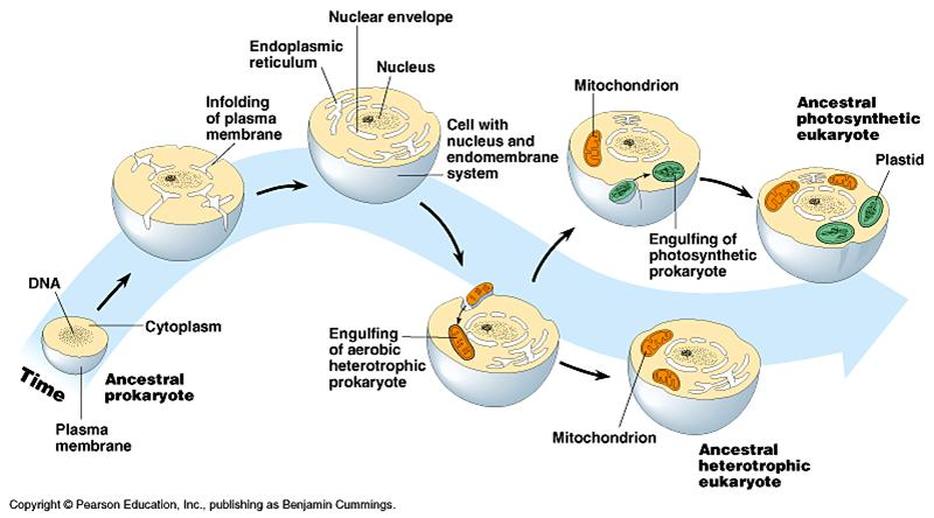
What is the endosymbiotic theory?
Shows how plants evolved from fungus
Eukaryote cells evolved from prokaryote cells
Animal cells evolved from plant cells
Bacteria cells evolved from eukaryote cells
6
Multiple Choice

The image shows a simple diagram of an early eukaryote cell. A cell containing a mitochondrion engulfs a primitive photosynthetic bacterial cell. What type of modern day cell would this become?
Plant
Animal
Bacteria
Fungus
7

8
Multiple Choice

What does 1 & 4 represent?
1 = aerobic bacteria
4 = cyanobacteria
1 = anaerobic bacteria
4 = cyanobacteria
1 = cyanobacteria
4 = aerobic bacteria
1 = cyanobacteria
4 = anaerobic bacteria
9
Domain Archaea and Domain Bacteria
Both Prokaryotic
Both don't have membrane-bound organelles (such as chloroplasts or mitochondria)

10
Domain Archaea
Domain Bacteria
Domain Eukarya
11
Kingdom Archaebacteria
Kingdom Eubacteria
Kingdom Protista
Kingdom Fungi
Kingdom Plantae
Kingdom Animalia
12
Autotroph means that the organism makes its own food for nutrition.
Heterotroph means that the organisms must eat in order to get their nutrition.
13
Archae means Primitive
Known as the "extreme bacteria"
Unicellular organisms
Lives in harsh and extreme habitats
Some are an autotroph and others are heterotroph

14
Eu means True
Also known as the "true bacteria"
Unicellular organisms
Most common and found almost everywhere!
Some are an autotroph and others are heterotroph

15
Multiple Choice
Archaea
Bacteria
Eukarya
Prokarya
16
Multiple Choice
Bacteria and archaea are similar because both _________________.
are eukaryotes
are prokaryotes
have the same kind of cell wall
store their DNA in a nucleus
17
Multiple Select
Select all of the characteristics that both kingdoms of bacteria share
Prokaryotic
No membrane bound organelles
Unicellular
Have a nucleus
18

19
Multicellular
Autotroph - photosynthesis
Contains cell walls and chloroplasts

20
Multicellular, some Unicellular
Absorptive Heterotroph
(Do not have chloroplasts/chlorophyll = no photosynthesis!)
Cell walls of chitin
Decomposers

21
Multicellular
Heterotroph
Do not have cell walls

22
Unicellular, some multicellular
Can be an autotroph or heterotroph
Can be sexual or asexual
Overall, very diverse kingdom

23
Multiple Choice
Protists are eukaryotic and bacteria are prokaryotic
Protists are prokaryotic and bacteria are eukaryotic
There is no difference; protists and bacteria are the same thing
Protists are always unicellular and bacteria are always multicellular
24
Multiple Choice
Which kingdom would I be in if I had:
no cell walls, heterotrophic, usually sexual reproduction, and multicellular
Plantae
Animalia
Fungi
Protist
25

Non-living
Nucleic Acids (DNA or RNA) genetic material
Capsid or Protein coat (protective outer surface)
Can cause disease (pathogenic)
Virus
26
Multiple Choice
Is a virus considered living or non-living?
Living
Non-Living
27

VERY Small (smaller than prokaryotes)
Do NOT have
Cytoplasm or organelles
Cannot make food or their own energy (NOT Living)
Virus
28

Need a host to reproduce
Using the host cells organelles and molecules to reproduce.
enzymes
ribosomes
ATP
Virus
29
Multiple Choice
For many years scientists debated whether viruses should be considered living organisms. Which statement would a scientist use to support the position that viruses are not living?
Viruses have genes encoded in DNA
Viruses infect both plants and animals
Viruses replicate to produce more viruses
Viruses require a host cell to reproduce
30
8 Characteristics of Life
DNA
Made of Cells
Metabolism
Grow/Develop
Evolve
Respond to stimuli
Homeostasis
Reproduce

31
Multiple Choice
All living things are
Made of cells
Made of more than 1 cell
32
A cladogram shows hypothesized relationships based on physical traits.

33
Similarly, as you trace a species lineage from top to base, it includes all the features on the line.
So the rodents & rabbits have hair, amniotic eggs, four limbs, bony skeletons, and vertebrae.

34
Multiple Choice

Which species has jaws only?
Gorilla only
Salmon
Lizard, alligator, robin, rat, and gorilla
Hagfish, salmon, and frog
35
Multiple Choice

Which is most related to crocodiles?
Sharks
Birds
Amphibians
Primates
36
A phylogeny is a branching diagram that shows evolutionary relationships of species, usually based on DNA sequencing.

37
The process of evolution produces a pattern of relationships between species.

38
Multiple Choice

Species 3 is a common ancestor of which species?
Species C only
Species D only
Species A and B
Species C and D
39
Multiple Choice

Which species is most closely related to species L?
species E
species M
species G
species I
40


By Derek Hathaway
Show answer
Auto Play
Slide 1 / 40
SLIDE
Similar Resources on Wayground

34 questions
Populations: Crater Lions
Presentation
•
10th Grade
36 questions
UNIT 1: ENERGY FLOW/CYCLE OF MATTER REMEDIATION LESSON
Presentation
•
10th Grade
34 questions
Virus Replication
Presentation
•
10th Grade
36 questions
DNA Intro Review
Presentation
•
9th Grade
35 questions
Mitosis/Meiosis review
Presentation
•
10th Grade
31 questions
Science Prefixes and Suffixes Lesson
Presentation
•
10th Grade
35 questions
Regulating the Cell Cycle + Cancer (part 3)
Presentation
•
9th - 12th Grade
38 questions
2023 EOC Review - Day 1 - Plant / Animal Body Systems
Presentation
•
9th - 10th Grade
Popular Resources on Wayground
10 questions
Safety Day 2026 – Student Review

Quiz
•
9th Grade
21 questions
Continents and Oceans
Quiz
•
6th Grade
20 questions
Parts of Speech
Quiz
•
5th Grade
16 questions
Subject & Predicate
Quiz
•
5th Grade
25 questions
Multiplication Facts
Quiz
•
5th Grade
12 questions
Map Skills
Quiz
•
3rd Grade
22 questions
Continents and Oceans
Quiz
•
5th Grade
15 questions
Rounding Decimals
Quiz
•
5th Grade
Discover more resources for Science
10 questions
Exploring Chemical and Physical Changes

Interactive video
•
6th - 10th Grade
10 questions
Exploring the Electromagnetic Spectrum for Middle School Science
Interactive video
•
6th - 10th Grade
10 questions
Exploring Force and Motion Concepts
Interactive video
•
6th - 10th Grade
10 questions
Exploring Air Masses and Weather Fronts
Interactive video
•
6th - 10th Grade
10 questions
Exploring the States of Matter
Interactive video
•
6th - 10th Grade
10 questions
Exploring Forces: Net Force, Normal Force, Gravity, and Friction
Interactive video
•
6th - 10th Grade
10 questions
Differentiating Thermal Energy and Temperature
Interactive video
•
6th - 10th Grade
10 questions
Exploring the States of Matter and Thermal Energy
Interactive video
•
6th - 10th Grade