Search Header Logo
Earth's Movements (Seasons, Day/Night)

Earth's Movements (Seasons, Day/Night)

Assessment

Presentation

Science

6th Grade

Medium

NGSS
MS-ESS1-1, MS-ESS2-6, MS-ESS1-2

+5

Standards-aligned

Created by

Bobby Menendez

Used 38+ times

FREE Resource

17 Slides • 31 Questions

1

Earth's Movements

Lesson Goal: ​SWBAT describe and model how the movement of the Earth causes seasons and day and night.

media
media
media

2

Seasons

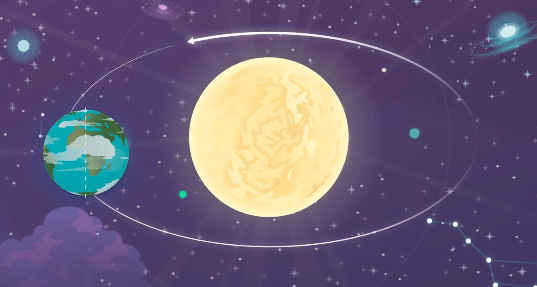
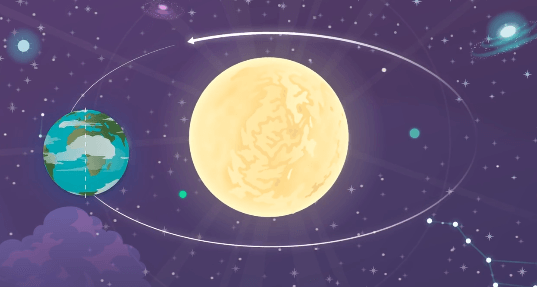
  • Tilted Axis + Orbit Around Sun = Seasons

  • Tilt of axis never changes, always points in the same direction

  • Areas tilted toward the sun get more sunlight and heat (summer)

  • Areas tilted away from the sun get less sunlight and heat (winter)

media

3

media

4

5

Multiple Choice

Question image

Why do seasons occur?

1

Due to Earth’s revolution and the tilt of our planet

2

Due to Earth’s rotation and the tilt of our planet

3

Due to Earth’s revolution only

6

7

media

8

Multiple Choice

Question image

Rotation of the Earth causes..

1

Convection in the mantle

2

Seasons

3

Day/Night

4

Hurricanes

9

media

10

Multiple Choice

Question image
How long does it take for the Earth to make one full orbit around the Sun?
1

one day

2

one week

3

one month

4

one year

11

media

12

Poll

Question image

What is the reason for warm weather during the summer in the northern hemisphere?

The Earth is closer to the Sun in the summer.

The Northern Hemisphere is closer to the Sun in the summer.

The Sun gives off more heat in the summer than in the winter.

The North pole is tilted toward the Sun during the summer.

13

When it is summer in the Northern Hemisphere, it is winter in the Southern Hemisphere.

This is because the Northern Hemisphere is receiving more direct sunlight.

Summer in the Northern Hemisphere

media
media

14

The Southern Hemisphere is receiving more direct sunlight than the Northern Hemisphere.

Winter in the Northern Hemisphere

media

15

media

16

Fall and Spring Equinoxes

  • Both hemispheres receive the same amount of direct sunlight.

  • Both hemispheres have equal day and night (12 hours of day, 12 hours of night).

  • Neither hemisphere is tilted toward/away from the sun at this time.

  • Neither hemisphere is very warm or cold.

media

17

media

18

Multiple Choice

The days of the year where Earth experiences equal amounts of sunlight and darkness.

1

Equinoxes

2

Solstices

3

Darquinoxes

19

media

20

Match

Match the Season in the Northern Hemisphere that corresponds to the Season that occurs in Southern Hemisphere

Summer in Northern Hemisphere

Fall/Autumn in Northern Hemisphere

Winter in Northern Hemisphere

Spring in Northern Hemisphere

Winter in Southern Hemisphere

Spring in Southern Hemisphere

Summer in Southern Hemisphere

Fall/Autumn in Southern Hemisphere

21

Multiple Choice

Question image

Which season(s) have the same amount of daylight hours as nighttime hours?

1

Winter & Summer

2

Spring & Fall

3

Spring & Summer

4

They are all equal

22

media

23

Multiple Choice

Question image

When the Earth completes a full orbit around the Sun, it has completed _____ rotations.

1

7

2

30

3

91

4

365

24

Multiple Choice

Question image

What looks like the motion of the Sun in the sky...

is really caused by the motion of _____.

1

the Earth

2

the stars

3

the planets

4

the Earth's axis

25

Multiple Choice

Question image
The spinning movement of the Earth about its axis is called the Earth's _____
1

revolution

2

rotation

3

precession

4

orbit

26

Multiple Choice

Question image
The movement of the Earth around the Sun is called its _____
1

revolution

2

rotation

3

precession

4

retrograde

27

The North Star

  • Polaris, the North Star, sits quite near the celestial north pole

  • Polaris was not always the North Star and will eventually be replaced as the stars move across the sky

media

28

Multiple Choice

Question image
In what direction does the Sun appear to move across the sky?
1

West to east

2

North to south

3

East to west

4

South to north

29

Multiple Choice

Question image

Which of these cycles is a direct result of Earth's ROTATION

1

Day and Night

2

Moon Phases

3

Convection in the Mantle

4

Seasons

30

Multiple Choice

Which of these best explains why the sun appears to move across the sky each day?

1
2
3
4

31

Multiple Choice

Question image

A student draws a model showing the movements on Earth, the moon, and the sun. Which arrow shows the movement that caused day and night on Earth?

1

Arrow 1, because it shows the rotation of the sun

2

Arrow 2, because it shows the orbit of Earth around the sun

3

Arrow 3, because it shows the orbit of the moon around Earth

4

Arrow 4, because it shows the rotation of the Earth

32

Multiple Choice

Question image

The Night happens because one side of the Earth is facing away from the Sun.

1

True

2

False

33

Multiple Choice

Question image

The Sun rises in the ____ and sets in the ____.

1

West, East

2

North, South

3

East, West

4

Sputh, North

34

Multiple Choice

A student draws diagrams of her house and the location of the sun in the sky. Which diagram below does NOT correctly represent the location of the sun at the time indicated?

1
2
3
4

35

Multiple Choice

Question image

You experience Summer when...

1

the hemisphere you are in is tilted TOWARD the Sun.

2

the hemisphere you are located in is tilted away from the Sun.

36

Multiple Choice

Question image
At position A, in the Northern hemisphere it would be _____?
1
Summer
2
Winter
3
Spring
4
Fall

37

Fill in the Blank

Question image

What season are people experiencing if they live on G ?

38

Fill in the Blank

Question image

What season are people experiencing if they live on F?

*Hint: think about what season they just came from*

39

Fill in the Blank

Question image

What season are people experiencing if they live on B?

*Hint: think about what season they just came from*

40

Multiple Choice

Question image

The hemisphere where you live:

1

equator

2

southern

3

northern

4

eastern

41

Multiple Choice

Question image

Which hemisphere will experience shorter days based on the diagram?

1

Northern Hemisphere

2

Southern Hemisphere

42

Multiple Choice

Question image
Which season is taking place in the Northern Hemisphere in Position 1?
1
Winter
2
Spring
3
Summer
4
Fall

43

Multiple Choice

Question image
Which  of the following best describes the tilt of the earth during the spring and fall equinoxes?
1

The earth is tilted away from the sun (Northern hemisphere)

2

The earth is tilted neither toward or away from the sun

3

The earth is tilted toward the sun (Northern hemisphere)

4

The earth is not tilted during spring and fall

44

Multiple Choice

Question image
At position D in the Northern hemisphere it would be _____?
1
Summer
2
Winter
3
Spring
4
Fall

45

Multiple Choice

Question image

What is an Equinox?

1

Full tilt toward sun

2

Full tilt away from sun

3

Shortest day

4

Equal day and night

46

Multiple Choice

Question image
The Earth's _______ is an imaginary line that goes from the North Pole to the South Pole.
1
vernal equinox
2
axis
3
solar eclipse
4
solar flare

47

Multiple Choice

Question image

When are day and night usually equal?

1

Always

2

Winter solstice

3

Summer solstice

4

The Equinoxes

48

Some text here about the topic of discussion.

Congrats! You have completed this lesson!

media

Earth's Movements

Lesson Goal: ​SWBAT describe and model how the movement of the Earth causes seasons and day and night.

media
media
media

Show answer

Auto Play

Slide 1 / 48

SLIDE