

Solar flare/ Star size

Presentation
•
Science
•
8th Grade
•
Medium
Standards-aligned

Aguado Angelica
Used 5+ times
FREE Resource
19 Slides • 8 Questions
1
By Aguado Angelica
2
Sunspts
Prominences
Solar flares
Solar wind

3
Structure, Atmosphere, and Features

4
The Sun's Interior is composed of three main sections:
Core
Radiation Zone
Convection Zone

5
The Sun produces an enormous amount of energy in the core
This energy is produced through nuclear fusion
Nuclear fusion occurs when HYDROGEN atoms join to form HELIUM
This process requires extremely high temperatures and pressure
6
The energy produced in the Sun's core moves outward through the radiation zone
This is a region of very tightly packed gas where energy moves mainly in the form of electromagnetic radiation
This zone is so dense that it can take over 100,000 years for the energy to move through it
7
This is the outermost layer of the Sun's interior
Hot gases rise from the bottom of the convection zone and slowly cool as they approach the top
Cooler gases sink, forming loops of gas that move energy toward the Sun's surface
8

9
Multiple Choice
What layer of the Sun's interior produces the energy?
Convection Zone
Core
Radiation Zone
Corona
10
Multiple Choice
In the convection zone, ______ gas rises and ______ gas sinks.
hotter, cooler
cooler, hotter
11
Multiple Choice
The sun produces energy through what process?
Fission
Fusion
Photovoltaic cells
Photosynthesis
12
The Sun's atmosphere is composed of three main sections:
Photosphere
Chromosphere
Corona

13
Inner layer of the Sun's atmosphere
This layer of gas is thick enough to be visible and is considered the surface layer
When you look at an image of the Sun, you are looking at the photosphere
14
Middle layer of the Sun's atmosphere
This layer is a reddish glow around the photosphere
Can only be seen at the start and end of a total eclipse
The Greek word chroma means "color" so the chromosphere is really the "color sphere"
15
Outer layer of the Sun's atmosphere
Looks like a white halo around the sun
Only seen during an eclipse
Extends into space for millions of kilometers
Corona means "the crown" in Latin
16
Multiple Choice
Which layer of the Sun's atmosphere is only seen at the beginning and end of an eclipse?
Photosphere
Corona
Chromosphere
Radiation Zone
17
Fill in the Blanks
What is the layer of the Sun that you can see?
Type answer...
18
Sunspots
Prominences
Solar flares
Solar wind
19
Areas of gas on the Sun's surface that are cooler than the gases around them
Cooler gases don't give off as much light
Can be larger than the Earth
The # of sunspots varies in a regular cycle, with the most appearing about once every 11 years

20
Huge loops of gas that often link different parts of sunspot regions
These loops of gas are anchored to the photosphere and extend to the corona
Can last for months

21
A release of magnetic energy that heats gas in the Sun's atmosphere and causes an eruption into space
Typically lasts for a few minutes

22
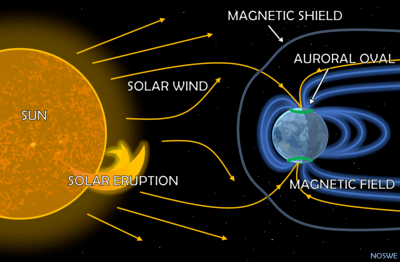
Streams of electrical particles from the Sun
Solar flares can increase the amount of particles
Earth's magnetic field blocks the majority of solar winds except on the North and South Poles
At the poles, the particles create electric currents that cause gas in the atmosphere to glow (Aurora Borealis a.ka. Northern Lights)
Worst case scenarios: too many particles entering the atmosphere can cause magnetic storms and blackouts
23

24
25
Multiple Choice
Large eruptions of heated gas from the Sun's surface are called
Prominences
Solar winds
Sunspots
Solar flares
26
Multiple Choice
The corona sends out a stream electrical particles called the
Solar flares
Solar winds
Sunspots
Prominences
27
Fill in the Blanks
The Sun's layers, from innermost to outermost, are the core, the
Type answer...
By Aguado Angelica
Show answer
Auto Play
Slide 1 / 27
SLIDE
Similar Resources on Wayground

20 questions
Physical vs Chemical Changes
Presentation
•
8th Grade
20 questions
Quizizz Recovery: Forces
Presentation
•
8th Grade
20 questions
H-R Diagram
Presentation
•
8th Grade
20 questions
Waves
Presentation
•
8th Grade
21 questions
Types of Rocks
Presentation
•
8th Grade
21 questions
Unit 8 Mini Review
Presentation
•
8th Grade
22 questions
Motion, Speed, Velocity, & Acceleration
Presentation
•
8th Grade
19 questions
Chap 1-3 Acceleration
Presentation
•
8th Grade
Popular Resources on Wayground
10 questions
Safety Day 2026 – Student Review

Quiz
•
9th Grade
21 questions
Continents and Oceans
Quiz
•
6th Grade
20 questions
Parts of Speech
Quiz
•
5th Grade
16 questions
Subject & Predicate
Quiz
•
5th Grade
25 questions
Multiplication Facts
Quiz
•
5th Grade
12 questions
Map Skills
Quiz
•
3rd Grade
22 questions
Continents and Oceans
Quiz
•
5th Grade
15 questions
Rounding Decimals
Quiz
•
5th Grade
Discover more resources for Science
20 questions
Newton's Laws of Motion
Quiz
•
8th Grade
15 questions
potential and kinetic energy
Quiz
•
8th Grade
21 questions
Newton's Laws of Motion
Quiz
•
8th Grade
20 questions
Elements, Compounds and Mixtures
Quiz
•
8th Grade
10 questions
Exploring Chemical and Physical Changes

Interactive video
•
6th - 10th Grade
20 questions
Physical vs Chemical Changes
Quiz
•
8th Grade
20 questions
Conduction, convection, and Radiation Practice
Quiz
•
8th Grade
21 questions
Waves and Wave Properties
Quiz
•
6th - 8th Grade