Search Header Logo
Benchmark 4 review day 1 (Unit 10 thermo,K&E)

Benchmark 4 review day 1 (Unit 10 thermo,K&E)

Assessment

Presentation

Chemistry

10th Grade - University

Medium

NGSS
HS-PS1-4, HS-PS1-5, HS-PS3-4

+5

Standards-aligned

Created by

Katie Smit

Used 6+ times

FREE Resource

27 Slides • 30 Questions

1

Wednesday 5/11- Benchmark review- Unit 10

Announcements/Reminders

Agenda:

  • 12 class DAYS until final!

  • Thurs 5/9- English EOC, 1st &2nd block

  • Mon 5/13-Benchmark #4

  • 5/22- no school- Biology EOC

  • 5/23- USH EOC

  • 5/28- final exam (1st&2nd periods)

  • ​Unit 10 review

Bellwork: ​​

2

media

3

media

4

media

5

media

6

media

7

media

8

media

9

media

10

media

11

media

12

media

13

media

14

Multiple Choice

Can energy be created?

1

Yes

2

No

15

Multiple Choice

Which of the following is not a form of energy?

1

Thermal (heat)

2

temperature

3
Nuclear
4
Mechanical
5

light

16

Multiple Choice

Question image

Heat flows from _______ to ______ objects

1

cooler to warmer

2

warmer to warmer

3

warmer to cooler

4

cooler to cooler

17

Multiple Choice

Question image

Phase changes: ice to water to steam

1

endothermic

2

exothermic

18

Multiple Choice

Question image

Phase changes: steam to water to ice

1

endothermic

2

exothermic

19

Multiple Select

Select all the processes that are exothermic. The system is underlined in each example.

1

Your hand gets cold when you touch ice.

2

The ice gets warmer when you touch it.

3

Water boils in a kettle being heated on a stove.

4

Water vapor condenses on a cold pipe.

5

Ice cream melts.

20

Multiple Select

Select all the processes that are endothermic. The system is underlined in each example.

1

Your hand gets cold when you touch ice.

2

The ice gets warmer when you touch it.

3

Water boils in a kettle being heated on a stove.

4

Water vapor condenses on a cold pipe.

5

Ice cream melts.

21

Multiple Choice

If they energy required to break the bonds is greater than the energy given out by making new bonds the reaction is
1
Exothermic
2
Endothermic
3
Neutralisation

22

Multiple Choice

O2(g) + 2 H2 (g)  2 H2O (g) + EnergyO_2\left(g\right)\ +\ 2\ H_2\ \left(g\right)\ \rightarrow\ 2\ H_2O\ \left(g\right)\ +\ Energy  

1

endothermic

2

exothermic

23

Multiple Choice

ΔH value in an endothermic reaction is a positive number.
1
True
2
False

24

Multiple Choice

A catalyst works by
1
changing the order of the reaction
2
increasing the temperature
3
lowering the activation energy
4
making the activated complex

25

Multiple Choice

Question image

What is the Heat of Reaction ΔH\Delta H  for this reaction?

1

-200 KJ

2

200 KJ

3

400 KJ

4

-300 KJ

26

Multiple Choice

Question image

How much activation energy is needed for this reaction?

1

300 KJ

2

500 KJ

3

400 KJ

4

100 KJ

27

Multiple Choice

Question image

What type of reaction is this?

1

Exothermic

2

Endothermic

3

Energy Producing

4

No way to tell

28

Multiple Choice

What kind of reaction is this: 2KI + MgCl2 + 200KJ ----> 2KCl + MgI2

1

Endothermic

2

Exothermic

29

Multiple Choice

Question image
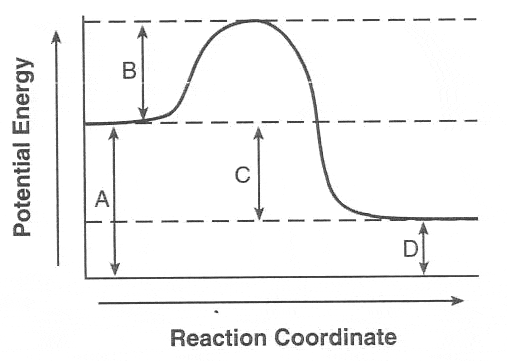
What letter represents the energy of the products?
1
A
2
B
3
C
4
D

30

Multiple Choice

Question image
What letter represents the activation energy?
1
A
2
B
3
C
4
D

31

Multiple Choice

Question image
What letter represents ΔH?
1
A
2
B
3
C
4
D

32

Multiple Choice

Question image
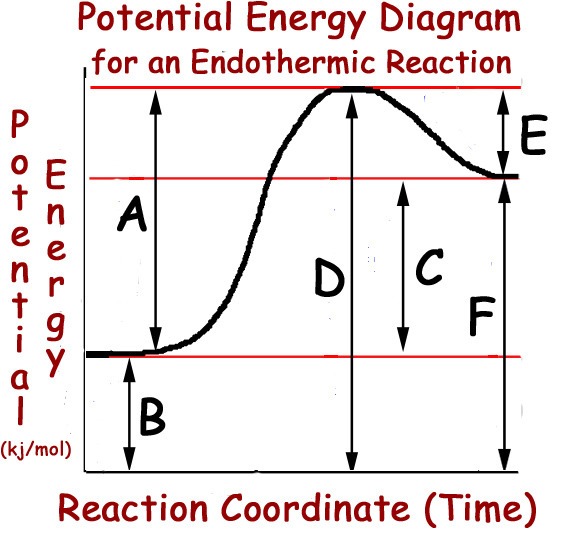
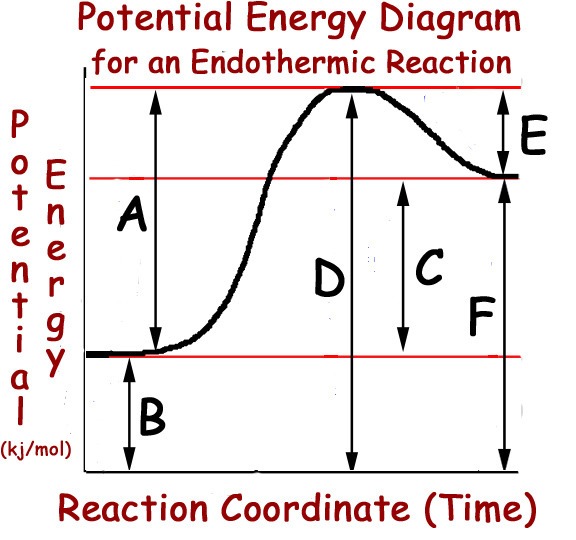
Which letter represents the activation energy?
1
B
2
E
3
C
4
D

33

Multiple Choice

Question image
What is the PE of the reactants?
1
100 kJ
2
175 kJ
3
50 kJ
4
75 kJ

34

media

35

media

36

nIonic solutions have faster reactions than molecule compounds. (bonding)

néTemp. é Rate

né conc. érate

né surface area é rate

né Pressure é rate, ê P ê rate 

nCatalysts speed up reactions.

​Quick review- Factors affecting rate

37

media

38

Multiple Choice

Question image

This symbol indicates that a reaction is _____

1

reversible

2

irreversible

39

media

40

Multiple Choice

When the rate of the forward reaction is equal to the rate of backward reaction, the system is said to be in
1
Chemical Equilibrium
2
Chemical Balance
3
Chemical Constant
4
Chemical Reaction

41

Multiple Choice

Which of the following is NOT true at equilibrium?
1
The forward and reverse reactions proceed at the same rate.
2
The concentrations of reactants and products do not change.
3
The concentration of the reactants is equal to the concentration of the products.
4
The forward and reverse reactions continue to occur.

42

media

43

media

44

media

45

media

46

media

47

Concentration increase shift away from increase

  • Concentration decrease shift toward decrease

  • 🡹 pressure shifts in direction of fewer gas molecules.

  • 🡻 pressure shifts in direction of more gas molecules

  • 🡹 temperature favors endothermic reaction

    • Shift away from heat

  • 🡻 temperature favors exothermic reaction

    • Shift towards heat

Equilibrium shifts due to stresses:

48

​Example- The Haber process (making ammonia NH3)

N2 (g) + 3 H2 (g) ⮀ 2 NH3 (g) + heat

  1. 🡹 [N2]

  2. 🡻 [H2]

  3. 🡹 [NH3]

  4. 🡻 [NH3]

  5. 🡹 pressure

  6. 🡻 pressure

  7. 🡹 temperature

  8. 🡻 temperature

49

media

50

media

51

Multiple Choice

Le Chaltelier's Principle states that if a chemical system at equilibrium is stressed,
1
the system will adjust to increase the stress
2
the system will adjust to reduce the stress
3
the system will not adjust

52

Multiple Choice

(🡹 pressure shifts in direction of fewer gas molecules)

(🡻 pressure shifts in direction of more gas molecules )

N2(g) + 3H2(g) ↔ 2 NH3(g) + heat

Increasing the pressure will cause the equilibrium to:

1

Shift right

2

Shift left

3

Have no change

4

Speed up

53

Multiple Choice

🡹 temperature favors endothermic reaction Shift away from heat 🡻 temperature favors exothermic reaction Shift towards heat

N2(g) + 3H2(g) ↔ 2 NH3(g) + heat

Increasing the temperature will cause the equilibrium to:

1

Shift right

2

Shift left

3

Have no change

4

Speed up

54

Multiple Choice

(Concentration increase shift away from increase)

(Concentration decrease shift toward decrease)

N2(g) + 3H2(g) ↔ 2 NH3(g) + heat

Decreasing H2 will cause the equilibrium to:

1

Shift right

2

Shift left

3

Have no change

4

Speed up

55

Multiple Choice

(Concentration increase shift away from increase)

(Concentration decrease shift toward decrease)

N2(g) + 3H2(g) ↔ 2 NH3(g) + heat

Removing N2 will cause the equilibrium to:

1

Shift right

2

Shift left

3

Have no change

4

Speed up

56

Multiple Choice

(Concentration increase shift away from increase)

(Concentration decrease shift toward decrease)

N2(g) + 3H2(g) ↔ 2 NH3(g) + heat

Increasing H2 will cause the equilibrium to:

1

Shift right

2

Shift left

3

Have no change

4

Speed up

57

Multiple Choice

For the reaction...
SO2(g) + O2(g) <−>  SO3(g)
If the concentration of 
SO2(g)  is increased, the equilibrium of the reaction will ___________.
1
shift to the left
2
shift to the right
3
not shift

Wednesday 5/11- Benchmark review- Unit 10

Announcements/Reminders

Agenda:

  • 12 class DAYS until final!

  • Thurs 5/9- English EOC, 1st &2nd block

  • Mon 5/13-Benchmark #4

  • 5/22- no school- Biology EOC

  • 5/23- USH EOC

  • 5/28- final exam (1st&2nd periods)

  • ​Unit 10 review

Bellwork: ​​

Show answer

Auto Play

Slide 1 / 57

SLIDE