

Thermochemistry

Presentation
•
Chemistry
•
10th Grade
•
Medium
+3
Standards-aligned

Mihir Paranjape
Used 24+ times
FREE Resource
9 Slides • 18 Questions
1
Thermochemistry
By Mihir Paranjape
2
Heat
Heat is Thermal Energy which is transferred due to a difference in Temperature.
Heat is transferred from higher temperature to lower temperature.
Heat is transferred by collissions between molecules. At higher temperature, molecules have more Kinetic Energy (as they move faster), these collide with molecules with lower Energy thereby transferring this energy.
Units are Joules (J) or Calories (cal)
Some text here about the topic of discussion
3
Temperature
Temperature is the average Kinetic Energy of molecules within a system.
Difference in Temperature causes Heat to Flow.
Can be measured using a Thermometer.
Units - C, F, K, R
K = C+273
Some text here about the topic of discussion
4
Exothermic Processes
Heat EXITS the system or flows out.
Given a negative sign. Imaging Money flowing out of your account which is bad and hence negative.
This heat goes to the surroundings, which feel warmer.
As heat leaves the system, molecules SLOW DOWN.
Gas > Liquid > Solid is example of Exothermic Process as Molecules are slowing down.
Some text here about the topic of discussion


5
Endothermic Processes
Heat ENDERS the system or flows in.
Given a positive sign. Imaging Money flowing in your account which is good, will increase your balance and hence positive.
This heat enters from surroundings, which feel colder.
As heat enters the system, molecules SPEED UP.
Solid > Liquid > Gas is example of Endothermic Process as Molecules are speeding up.
Some text here about the topic of discussion


6
Multiple Choice
During an exothermic reaction, heat content in the surroundings increases because
heat energy is destroyed during reactions
the reaction absorbs heat energy
the energy contained in the reactants is lower then the products
the energy contained in the products is lower than the reactants
7
Multiple Choice
8
Phase Changes
Some text here about the topic of discussion

9
Multiple Choice
What is the phase change of a solid to a liquid?
freezing
melting
boiling
condensation
10
Multiple Choice
11
Multiple Choice
What happens to particles when energy is added (heated)?
They speed up and spread out
They slow down and compress
They stop moving
They move closer together and speed up
12
Multiple Choice
13
Heating Curve
Some text here about the topic of discussion

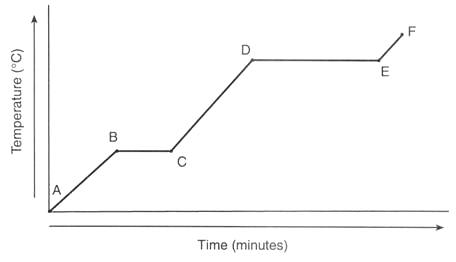
Start with Ice (SOLID) and heat it.
Ice will rise in Temp till it reaches 0C.
It will then melt to water (LIQUID). Temp does not change.
Water(LIQUID) will then heat up as more heat is added.
Water(LIQUID) will rise in Temp to 100C
At 100C, Water changes to Steam.(GAS)
14
Multiple Choice

15
Multiple Choice
16
Multiple Choice

17
Multiple Choice

18
Heating Curve
Some text here about the topic of discussion
Slope Part: (Red)
Temp increases as Heat is added.
Q = m x c x ΔT
Q = Heat (J)
m = mass (g)
c = Specific Heat (J/gC)
ΔT = Change in Temp (Tf-Ti)
19
Multiple Choice
20
Multiple Choice
How many joules of heat are needed to raise the temperature of 10.0 g of aluminum from 22.0°C to 55.0°C, if the specific heat of aluminum is 0.903 J/g°C?
298 Joules
0.003 Joules
297 J/g°C
0.003 J/g°C
21
Multiple Choice
The specific heat of aluminum is 0.9025 J/g°C. How much heat(Q) is released when a 10.0 g piece of aluminum foil is taken out of the oven and cools from 100.0° to 50.0°?
451 J
45.1 J
400 J
22
Multiple Choice
20.0 g of water. specific heat of water is 4.184 J/g°C. temperature changes from 25.0° C to 20.0° C, how much heat energy (Q) moves from the water to the surroundings?
418 Joules
209 J
83 J
4.18 J
23
Heating Curve
Some text here about the topic of discussion
Flat Part: (Blue)
Temp remains same as Heat is added.
All Heat is going towards Phase Change, called latent (lost) heat.
Q = m x ΔH
Q = Heat (J)
m = mass (g)
ΔH = Latent Heat (J/g)
24
Multiple Choice
Latent heat is
the heat absorbed or released at a boiling process during a change of phase
the heat absorbed or released at a constant temperature during a change of phase
the heat absorbed or released at a constant temperature during a change of phase of 1 kg object
the heat absorbed or released by an object to increase or decrease its temperature by 1 degree Celcius
25
Multiple Choice

How much energy is required to freeze 150 g of water? [lv=2260000 J kg−1; lf=334000 J kg−1]
50 100 cal
339 000 J
339 000 cal
50 100 J
26
Multiple Choice
How much energy is required to change 5 kg of ice at 0 ° C into water at the same temperature? (latent heat of fusion is 3.36 X 10⁶ J/kg )
16.1 XundefinedJ
16.8 XundefinedJ
15.1 Xundefinedcal
16.8 Xundefinedcal
27
Multiple Choice
How much energy is required to melt down a 2000 g of mercury?(latent heat of fusion is 1.14 x 10⁴ J/kg)
2.55 x undefinedJ
2.28 x undefinedJ
2,280 x undefinedJ
3.28 x undefinedJ
Thermochemistry
By Mihir Paranjape
Show answer
Auto Play
Slide 1 / 27
SLIDE
Similar Resources on Wayground

22 questions
Characteristics of life
Presentation
•
10th Grade
20 questions
Naming and Writing Acids
Presentation
•
10th Grade
23 questions
Solutions, Suspensions, & Colloids
Presentation
•
10th - 11th Grade
20 questions
Hydrocarbons nomenclature
Presentation
•
11th Grade
23 questions
14.1 The Progress of Chemical Reactions
Presentation
•
10th Grade
20 questions
Memoir Intro
Presentation
•
10th Grade
20 questions
ATP Photosynthesis Cellular Respiration Review
Presentation
•
10th Grade
21 questions
Imperialism in India
Presentation
•
10th Grade
Popular Resources on Wayground
6 questions
PRIDE Always and Everywhere
Presentation
•
12th Grade
20 questions
Lab Safety Quiz

Quiz
•
6th Grade
26 questions
KOR Review Kahoot Questions
Quiz
•
8th Grade
21 questions
Continents and Oceans
Quiz
•
6th Grade
12 questions
Unit Zero lesson 2 cafeteria
Presentation
•
9th - 12th Grade
20 questions
Parts of Speech
Quiz
•
5th Grade
10 questions
Riddles Riddles fun Riddles
Quiz
•
6th - 12th Grade
16 questions
Subject & Predicate
Quiz
•
5th Grade
Discover more resources for Chemistry
21 questions
Lab Safety
Quiz
•
10th Grade
20 questions
Scientific Method
Quiz
•
10th - 12th Grade
20 questions
Lab Safety
Quiz
•
10th Grade
12 questions
Significant figures
Quiz
•
9th - 12th Grade
20 questions
COUNTING ATOMS
Quiz
•
10th Grade
40 questions
26-27 Unit 1 Density and Metric Conversions
Quiz
•
10th Grade
20 questions
12.2 Scientific Notation and Significant Figures
Quiz
•
10th Grade
5 questions
Atomic Theory Intro Video

Interactive video
•
10th Grade