Search Header Logo
Force and Motion Review

Force and Motion Review

Assessment

Presentation

Science

5th Grade

Medium

NGSS
3-PS2-1, 3-PS2-2, MS-PS2-1

+6

Standards-aligned

Created by

Charles Bullins

Used 207+ times

FREE Resource

39 Slides • 18 Questions

1

Force and Motion Review

2

Forces

  • Forces can stop - pushing, pulling, friction, gravity

  • Change Directions- think about hitting a baseball.

  • Change from potential to Kinetic (moving)

3

Multiple Choice

Forces can cause objects to

1

stop moving only.

2

start moving only.

3

start moving, change direction, or stop moving.

4

change direction only.

4

Newton's Laws

  • 1st Law- Objects in motion will stay in motion; objects at rest will stay rest.

  • 2nd Law- More mass needs more force/ more force = more acceleration.

  • 3rd Law - For every action, there is an equal and opposite reaction.

5

Multiple Choice

According to Newton's third law of motion, when a hammer strikes and exerts force on a nail, the nail

1

disappears into the wood.

2

exerts an equal force back on the hammer.

3

creates a friction with the hammer.

6

Multiple Choice

Jasmyn can run 50 yards in 10 seconds and Jaylah can run 100 yards in 20 seconds. Who has a faster speed? (Remember speed equals distance divided by time.)

1

They both have the same speed.

2

Jasmyn

3

Jaylah

7

Friction

One surface or object rubbing against another.

High Friction surface examples: Sandpaper, Grass, Carpet, rough surface

Low Friction- Hardwood floors, ice, smooth surfaces

8

media

9

media

10

media

11

media

12

Multiple Choice

Question image

Four boxes are lifted straight up from the ground to a shelf. Each box has a different mass, as shown in the table. Which box requires the smallest force to lift it off the ground?

1

L

2

M

3

N

4

O

13

What is motion?

Motion is when an object moves.


Can you show me motion right now?

14

15

What is gravity?

Gravity is a force that pulls objects together.

16

17

Who was Isaac Newton?

He was a scientist who studied gravity and motion.

media

18

Review

  • Force=Push or pull

  • Push=Moves things away

  • Pull=Moves things closer or picking something up

  • Balanced force=Equal and opposite directions. NO MOTION!

  • Unbalanced force=2 or more forces where one force is stronger. MOTION!

media

19

Review

  • Gravity=A force that pulls an object towards another object

  • Mass=Not affected by gravity. Always stays the same.

  • Weight=Changes based on where it is located

  • Friction=The force that slows down an object that is rubbing on a surface

media

20

Multiple Choice

What is a PUSH or PULL of an object?
1
Motion
2
Force
3
Friction
4
Gravity

21

Multiple Choice

Question image

Which requires more force to move it?

1

A heavy object, like a bowling ball.

2

A light object, like a tennis ball

22

Multiple Choice

Question image

When you pick things up, you're _______.

1

pushing

2

pulling

23

Multiple Choice

Question image

A pull moves things _______ .

1

Close to you

2

Away from you

24

Multiple Choice

Question image

A push moves things _______ .

1

Close to you

2

Away from you

25

Multiple Choice

Imagine you kick four balls with the same amount of force. Which one will go the farthest?

1

a 3 pound ball

2

a 5 pound ball

3

a 15 pound ball

4

a 25 pound ball

26

Multiple Choice

Question image
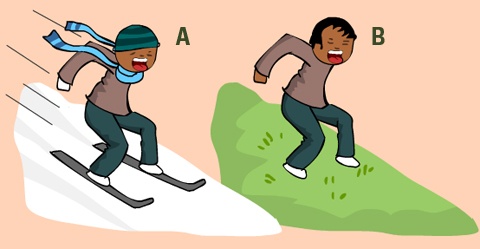
Why is it harder for the boy in Image B to get down the hill?
1
Motion
2
Friction
3
Work
4
Displacement

27

Forces and Motion

  • Force-any push or pull on an object. Example: You use force to push a ball and make it roll across the field.

  • Motion-when an object is moving it is in motion.

28

Multiple Choice

Which of the following is an example of a force?

1

Kicking a soccer ball with your foot.

2

Pulling a wagon to make it roll.

3

Both are examples of a force.

29

Friction

Friction-a force that slows objects down, when two objects rub together. Example: When you hit the brakes in a car, the friction from the tire causes you to stop moving or slow down.

media

30

Inertia

When traveling in a train or any other vehicle, have you noticed how you continue to move forward when it stops. You just experienced INERTIA! Inertia is the tendency of a body to resist a change in motion or rest. When a vehicle stops, you tend to jerk forward before coming to a complete stop. In the same way, you will jerk backwards when the vehicle begins to move.


The phenomenon occurs because of Newton’s First Law of Motion: An object at rest (or motion ) will continue to be in the same state unless acted upon by an external force. Which means objects tend to “keep on doing what they’re doing,” unless disturbed.

31

media

32

Multiple Choice

Why does the seatbelt stop you from going into the windshield of your car?

1

Inertia

2

Velocity

3

Condensation

33

Balanced and Unbalanced Forces


Newton's Second Law of Motionwhen an unbalanced force acts on an object, the object's acceleration equals the force divided by the object's mass.

Acceleration Formula: acceleration = force / mass

Balanced Forces: forces that cancel each other out when acting together on a single object 

Unbalanced Forces forces that do not cancel each other out when acting together on a single object 

34

media

35

Action=Reaction

Newton's Third Law: for every action, there is an equal and opposite reaction


36

media

37

Remember:

  • Motion is a change in position measured by distance and time.

  • Speed tells us the rate at which an object moves.

  • Velocity tells the speed and direction of a moving object.

  • Acceleration tells us the rate speed or direction changes.

38

Distance - Time Graphs

Let's take a look!

39

media

40

If an object is not moving, a horizontal line is shown on a distance-time graph.  

media

41

If an object is moving at a constant speed, it means it has the same increase in distance in a given time.

media

42

Let’s look at two moving objects: Both of the lines in the graph show that each object moved the same distance, but the steeper dashed line got there before the other one.

media

43

Graphs that show acceleration look different from those that show constant speed.  

media

44

Summary

  • A distance-time graph tells us how far an object has moved with time.

  • The steeper the graph, the faster the motion.

  • A horizontal line means the object is not changing its position - it is not moving, it is at rest.

  • A downward sloping line means the object is returning to the start. 

45

media

46

Multiple Choice

Question image

In which of the following graphs below are both runners moving at the same speed? *Look at which graph is which. They are labeled A, B, D, C.*

1

Graph A

2

Graph B

3

Graph D

4

Graph C

47

media

48

Speed - Time Graphs

Speed-Time graphs are also called Velocity-Time graphs.  

49

media

50

media

51

media

52

Summary

  • A speed - time graph shows us how the speed of a moving object changes with time.

  • The steeper the graph, the greater the acceleration.

  • A horizontal line means the object is moving at a constant speed.

  • A downward sloping line means the object is slowing down. 

53

media

54

Multiple Choice

Question image

Which runner stopped for a rest?

1

Albert

2

Bob

3

Charlie

55

Multiple Choice

Question image

Look at the graph above. It shows how three runners ran a 100-meter race. Which runner won the race?

1

Albert

2

Bob

3

Charlie

56

Multiple Choice

When an object is not moving, it is referred to as:

1

acceleration

2

deceleration

3

at rest

4

constant speed

57

Multiple Choice

The time can be found on:

1

the x-axis

2

the y-axis

Force and Motion Review

Show answer

Auto Play

Slide 1 / 57

SLIDE