PhySci Final Review 4: Waves
Presentation
•
Science, Physics
•
9th Grade
•
Easy
William Jared Lovering
Used 4+ times
FREE Resource
38 Slides • 36 Questions
1
PhySci Final Review 4: Waves
By William Lovering
2
What is a wave?
A wave is a disturbance that carries energy from place to place.
A wave does NOT carry matter with it! It just moves the matter as it goes through it.
3
4
5
6
Parts of a transverse wave:
Crest: the highest point of a transverse wave.
Trough: the lowest point of a transverse wave.
7
Parts of a transverse wave:
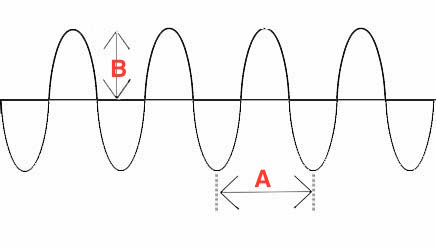
Wavelength: the distant between two crests or two troughs.
Amplitude: the distance between the middle horizontal line and the highest point or between the middle line and the lowest point.
8
Wavelength:
9
10
Parts of a longitudinal wave:
11
Parts of a longitudinal wave:
Compression: the parts of the wave where the loops are close together.
12
Parts of a longitudinal wave:
Rarefaction: the parts of the wave where the loops are spread-out.
13
Parts of a longitudinal wave:
Wavelength: the distance between two compressions.
14
15
Types of wave
Electromagnetic (EM) waves: Do NOT require a medium to travel.
16
17
18
19
20
21
22
23
24
25
26
27
28
29
30
Sound can be reflected and produce ECHO
31
32
33
34
35
Visible light
(commonly referred to simply as light) is electromagnetic radiation that is visible to the human eye and is responsible for the sense of sight. Visible light has a wavelength in the range of about 380 nanometres to about 740 nm – between the invisible infrared, with longer wavelengths, and the invisible ultraviolet, with shorter wavelengths.
36
Waves in visible range appear to us as a spectrum of colors.
Each color corresponds to a certain wavelength and frequency of light.
The wavelength and frequency of light determines its color.
Light waves & color
37
38
39
Multiple Choice
What do all waves transfer?
Matter
Heat
Electricity
Energy
40
Multiple Choice
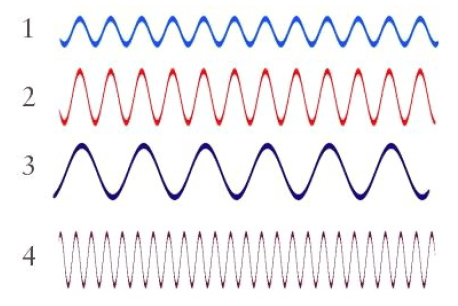
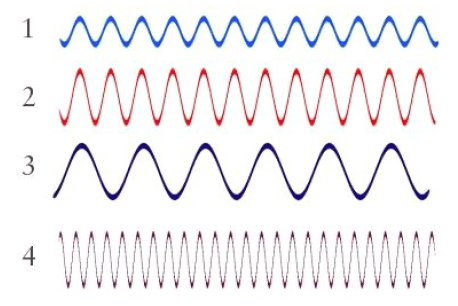
What is the number of complete waves passing a fixed point in a given amount of time?
Amplitude
Intensity
Wavelength
Frequency
41
Multiple Choice
What is frequency measured in?
Milliseconds
Miles
Hertz
Kilograms
42
Multiple Choice
Which type of waves have the longest wavelength?
Visible light
Radio waves
X-rays
Gamma-Rays
43
Multiple Choice
Wavelengths are usually measured in ....
seconds
Hz
inches
meters
44
Multiple Choice
What does #1 represent?
Period
Frequency
Wavelength
Amplitude
45
Multiple Choice
What does #2 represent?
Period
Frequency
Wavelength
Amplitude
46
Multiple Choice
What happens when you increase the amplitude of a sound?
it makes the sound louder
it makes the sound travel faster
it makes the sound softer
it changes the pitch or note of the sound
47
Multiple Choice
48
Multiple Choice
49
Multiple Choice
50
Multiple Choice
51
Multiple Choice
52
Multiple Choice
53
Multiple Choice
54
Multiple Choice
55
Multiple Choice
56
Multiple Choice
57
Multiple Choice
58
Multiple Choice
59
Multiple Choice
60
Multiple Choice
Which type of waves have vibrations that run parallel to the direction the wave travels?
transverse
longitudinal
61
Multiple Choice
Which type of waves have vibrations that run perpendicular to the direction the wave travels?
transverse
longitudinal
62
Multiple Choice
An example of this type of wave is a sound wave.
transverse
longitudinal
63
Multiple Choice
In a longitudinal wave, a ________ is an area where the particles are spread apart.
rarefaction
compression
crest
trough
64
Multiple Choice
In a longitudinal wave, a ________ is an area where the particles are close together.
rarefaction
compression
crest
trough
65
Multiple Choice
The formula for _________ is λ = v/f.
wavelength
frequency
period
66
Multiple Choice
CHECK YOUR UNDERSTANDING
Velocity = ________
Wavelength = 0.5m
Frequency = 150 hertz
0.75 m/s
75 m/s
300 m/s
0.300 m/s
67
Multiple Choice
68
Multiple Choice
69
Multiple Choice
This is an example of a ....
Longitudinal Wave
Squishy Wave
Transverse Wave
Standing Wave
70
Multiple Choice
This is an example of a ...
Longitudinal Wave
Wiggly Wave
Transverse Wave
Standing Wave
71
Multiple Choice
The time for one cycle is the ...
Wave speed
Frequency
Wavelength
Amplitude
Period
72
Multiple Choice
How fast the wave travels along the medium is the ...
Wave speed
Frequency
Wavelength
Amplitude
Period
73
Multiple Choice
Electromagnetic waves cannot travel through a medium.
True
False
74
Multiple Choice
Which of the following is an example of a longitudinal wave?
light
sound
radio
EM
PhySci Final Review 4: Waves
By William Lovering
Show answer
Auto Play
Slide 1 / 74
SLIDE

Similar Resources on Wayground
70 questions
Chemical Reactions
Presentation
•
8th Grade
71 questions
distance, displacement and speed
Presentation
•
9th Grade
71 questions
Benchmark Review Part 1
Presentation
•
KG
71 questions
Chap 15 Practical Electricity (5105)
Presentation
•
8th - 9th Grade
70 questions
Missouri History and Government Overview
Presentation
•
9th Grade
69 questions
Waves
Presentation
•
8th - 11th Grade
70 questions
Macromolecules MACRO-Lesson
Presentation
•
9th Grade
70 questions
Integrated Science Final Review
Presentation
•
9th Grade
Popular Resources on Wayground
20 questions
STAAR Review Quiz #3
Quiz
•
8th Grade
20 questions
Equivalent Fractions
Quiz
•
3rd Grade
6 questions
Marshmallow Farm Quiz
Quiz
•
2nd - 5th Grade
20 questions
Main Idea and Details
Quiz
•
5th Grade
20 questions
Context Clues
Quiz
•
6th Grade
20 questions
Inferences
Quiz
•
4th Grade
19 questions
Classifying Quadrilaterals
Quiz
•
3rd Grade
12 questions
What makes Nebraska's government unique?
Quiz
•
4th - 5th Grade
Discover more resources for Science
46 questions
Unit 4 Geosphere Test Review
Quiz
•
9th - 12th Grade
25 questions
Naming Ionic and Covalent Compounds
Quiz
•
9th Grade
20 questions
Human Impact on the Environment Review #2
Quiz
•
9th Grade
16 questions
Ecosystem Stability
Quiz
•
9th Grade
20 questions
Mendelian Genetics Review
Quiz
•
9th Grade
12 questions
Unit 6 Quiz #3 (Life Cycles of Stars)
Quiz
•
9th Grade
34 questions
Human Impact on Ecosystems Quiz
Quiz
•
9th Grade
10 questions
Exploring Alfred Wegener's Continental Drift Theory
Interactive video
•
6th - 10th Grade