

DNA!

Presentation
•
Science
•
9th Grade
•
Medium
Standards-aligned

Jodi Edge
Used 1K+ times
FREE Resource
6 Slides • 8 Questions
1
By Jodi Edge

Identify components of DNA, identify how information for specifying the traits of an organism is carried in the DNA, and examine scientific explanations for the origin of DNA
and
recognize that components that make up the genetic code are common to all organisms
2
Deoxyrhybonucleic Acid
Made of:
Phosphae groups
Deoxyrhybose sugars
Nitrogenous Bases
Series of nucleotides creating a long stranded molecule
Code for ALL life; from us to the bacteria that make us sick!
Molecule resides in the nucleus of eukaryotic cells and freely floats in prokaryotic cells
What is DNA?
3
Fill in the Blanks
DNA is the code for
Type answer...
4

Each nucleotide contains a Phosphate, sugar, and nitrogenous base.
Some text here about the topic of discussion.
What is a nucleotide?
5
Multiple Select
What molecules are in nucleotides?
Phosphate group
Protein
Sugar
lipid
Nitrogenous base
6
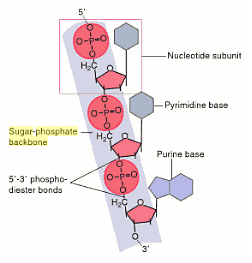
These alternate to form the ladder-like backbone of DNA
What does the sugar and phosphate group do?
7

Nitrogenous bases are the "code" part of DNA and/or RNA. Their order is what tells the cell what to make and how to do it. 4 bases found in DNA; in RNA U replaces T.
BASES include:
Cytosine
Thymine (DNA ONLY!)
Guanine
Adenine
Uracil (RNA ONLY!!)
What is a nitrogenous base?
8
Multiple Select
Which molecules make up the "backbone" of DNA and RNA?
Sugar
Phosphate group
Nucleotide base
9
Multiple Choice
Why are the nucleotides so gosh darn important? (Careful, all statements are true! Make sure you are picking what makes them IMPORTANT!!!!)
They hold the DNA together.
They live in the nucleus.
This is the chemical part that CODES for life.
There are 5 different kinds.
10

Nitrogenous bases "clip" together with HYDROGEN BONDS.
But they can't bond randomly.
Thymine must bond with Adenine
Cytosine must bond with Guanine
Until RNA has to copy... then Adenine bonds with Uracil (HOW AM I SUPPOSED TO REMEMBER THIS!!!!!)
Remember:
G-CAT!
What's up with the double strand, and how does it effect coding?
NOVELA
TIME!!!!!
I'm the G-CAT! The Groovy CAT!
11
Multiple Choice
Thymine will bond with...
Guanine
Cytosine
Adenine
Uracil
12
Multiple Select
Adenine can bond with... (CAREFUL!!!)
Guanine
Cytosine
Thymine
Uracil
13
Multiple Choice
Guanine will bond with...
Thymine
Cytosine
Adenine
Uracil
14
Multiple Select
Which bases are only found in DNA?
Thymine
Cytosine
Adenine
Uracil
Guanine
By Jodi Edge
Identify components of DNA, identify how information for specifying the traits of an organism is carried in the DNA, and examine scientific explanations for the origin of DNA
and
recognize that components that make up the genetic code are common to all organisms
Show answer
Auto Play
Slide 1 / 14
SLIDE
Similar Resources on Wayground

6 questions
4C: Viruses
Presentation
•
9th Grade
11 questions
Cells - Prokaryotes vs. Eukaryotes
Presentation
•
10th Grade
10 questions
Macromolecules part 2
Presentation
•
9th Grade
13 questions
Cell Cycle
Presentation
•
9th - 10th Grade
11 questions
BIOTEKNOLOGI
Presentation
•
9th Grade
9 questions
Introduction to Mutations
Presentation
•
9th - 10th Grade
13 questions
Carbon, Oxygen, Nitrogen and Phosphorus Cycle
Presentation
•
9th Grade
12 questions
Cell Biology
Presentation
•
9th Grade
Popular Resources on Wayground
21 questions
Continents and Oceans

Quiz
•
6th Grade
20 questions
Parts of Speech
Quiz
•
5th Grade
16 questions
Subject & Predicate
Quiz
•
5th Grade
25 questions
Multiplication Facts
Quiz
•
5th Grade
12 questions
Map Skills
Quiz
•
3rd Grade
22 questions
Continents and Oceans
Quiz
•
5th Grade
15 questions
Rounding Decimals
Quiz
•
5th Grade
20 questions
Brand Labels
Quiz
•
5th - 12th Grade
Discover more resources for Science
10 questions
Exploring Chemical and Physical Changes

Interactive video
•
6th - 10th Grade
20 questions
Atomic Structure
Quiz
•
9th Grade
10 questions
Exploring the Periodic Table
Interactive video
•
6th - 10th Grade
10 questions
Exploring Earth's Spheres and Their Interactions
Interactive video
•
6th - 10th Grade
20 questions
The Cell Cycle and Mitosis
Quiz
•
9th Grade
15 questions
Cell Cycle
Quiz
•
9th Grade
10 questions
Exploring Chemical Changes
Interactive video
•
6th - 10th Grade
10 questions
Exploring Weathering, Erosion, and Deposition Processes
Interactive video
•
6th - 10th Grade