

Microscope and Microscopy

Presentation
•
Biology
•
11th - 12th Grade
•
Practice Problem
•
Medium
Standards-aligned

Ailyn Anglo
Used 92+ times
FREE Resource
42 Slides • 14 Questions
1

At the end of this lesson, I can:
differentiate the types of microscopes,
identify the different parts of a microscope; and
manipulate a microscope correctly
2

3

4

5

6

7
8

9

10

11

12
Multiple Choice
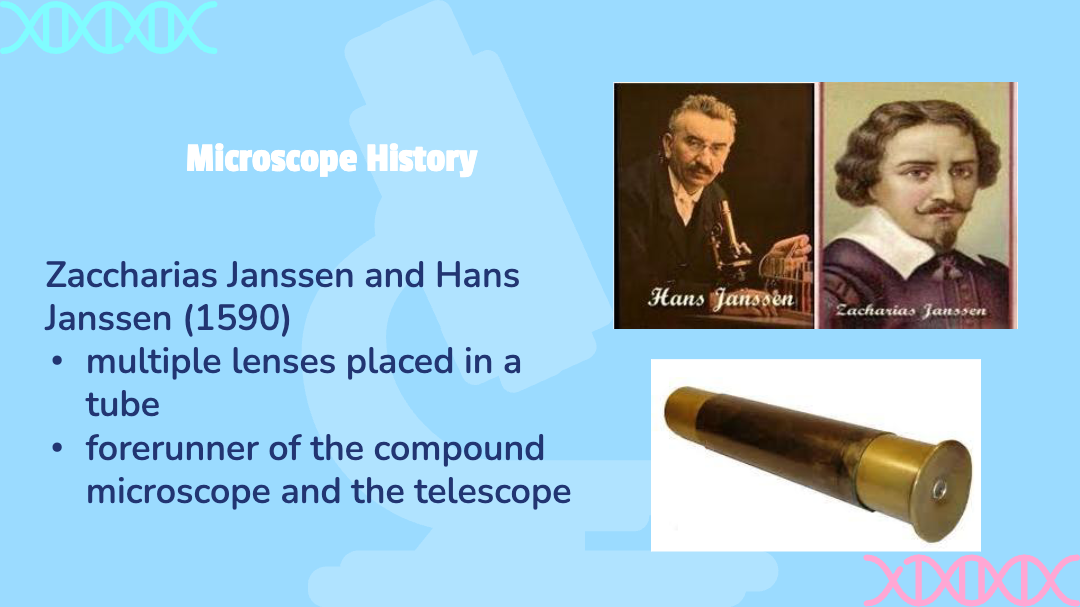
Zaccharias Janssen and Hans Janssen created a magnifying device that served as the forerunner of the compound microscope and the telescope.
True
False
13
Multiple Choice
Who coined the term "cell"?
Anton Van Leeuwenhoek
Joseph Lister
Robert Hooke
Janssen and Janssen
14
Multiple Choice
What results in misalignments and other distortions between different channels in a microscope image which reduces spherical aberration?
field curvature
chromatic effect
distortion
coma
15

16

17

18

19

20

21

22

23

24

25
Multiple Choice
What is a condition that must be fulfilled by a lens or other optical system in order for it to produce sharp images of off-axis as well as on-axis objects?
Light intensity condition
Snell's law and total internal reflection
Abbe sine condition
Angle of incidence
26
Multiple Choice
What kind of microscope, developed by Zsigmondy, can study objects below the wavelength of light?
compound microscope
electron microcope
ultramicroscope
scanning microscope
27
Multiple Choice
Who developed the phase-contrast microscope?
Ruska
Zernike
Binnig
Rohrer
28

29

30

31

32

33

34

35

36

37
Multiple Choice
What type of microscope is commonly used and can show images in two dimensions?
compound
electron
scanning
phase-contrast
38
Multiple Choice
What microscope uses electron illumination and can show images in three dimensions?
electron scanning
compound
ultramicroscope
transmission
39

40

41

42

43

44
Multiple Choice
If the ocular lens' magnification if 10x, and you observing a specimen using LPO, what is the total magnification?
10x
100x
1000x
10000x
45
Multiple Choice
What part of the microscope controls the amount of light going through the specimen?
diaphragm
ocular lens
objectives
mirror
46
Multiple Choice
What is used to fine focus the image when viewing at the higher magnifications?
coarse adjustment knob
fine adjustment knob
stage
objectives
47

48

49

50

51

52

53

54
Multiple Choice
When carrying a microscope, you must must use both hands -- one holding the arm, the other supporting the base.
true
false
55
Multiple Choice
Optical surfaces must be cleaned in a zig-zag pattern.
True
False
56
Multiple Choice
When changing objectives, use the revolving nosepiece.
True
False
At the end of this lesson, I can:
differentiate the types of microscopes,
identify the different parts of a microscope; and
manipulate a microscope correctly
Show answer
Auto Play
Slide 1 / 56
SLIDE
Similar Resources on Wayground

53 questions
Cell Respiration AP Biology
Presentation
•
12th Grade
46 questions
Coral and Coral Bleaching
Presentation
•
11th - 12th Grade
53 questions
Protein Structure Lesson
Presentation
•
11th - 12th Grade
53 questions
Protein Folding
Presentation
•
11th - 12th Grade
50 questions
Cell Transport
Presentation
•
10th - 12th Grade
50 questions
Unit 2 Populations Review
Presentation
•
10th - 12th Grade
49 questions
PhET Interactive Simulations, Kahoot & Quizizz
Presentation
•
12th Grade
48 questions
Plant Classification
Presentation
•
11th Grade
Popular Resources on Wayground
21 questions
Continents and Oceans

Quiz
•
6th Grade
20 questions
Parts of Speech
Quiz
•
5th Grade
16 questions
Subject & Predicate
Quiz
•
5th Grade
25 questions
Multiplication Facts
Quiz
•
5th Grade
12 questions
Map Skills
Quiz
•
3rd Grade
22 questions
Continents and Oceans
Quiz
•
5th Grade
15 questions
Rounding Decimals
Quiz
•
5th Grade
20 questions
Brand Labels
Quiz
•
5th - 12th Grade
Discover more resources for Biology
10 questions
Exploring the 4 Major Macromolecules and Their Functions

Interactive video
•
9th - 12th Grade
20 questions
Cell Transport
Quiz
•
9th - 12th Grade
16 questions
AP Biology: Unit 2 Review (CED)
Quiz
•
9th - 12th Grade
16 questions
AP Biology: Unit 1 Review (CED)
Quiz
•
9th - 12th Grade
20 questions
Ecological Succession Review
Quiz
•
9th - 12th Grade
30 questions
Quiz Week 6 Review (10/2/26)
Quiz
•
9th - 12th Grade
40 questions
Unit 3 Cell Growth and Differentiation
Quiz
•
10th - 12th Grade
25 questions
3.2 Protein Synthesis Practice
Quiz
•
9th - 12th Grade