atom
Presentation
•
Chemistry
•
9th Grade
•
Medium
Fatih Akay
Used 13+ times
FREE Resource
23 Slides • 26 Questions
1
2
Open Ended
What do you think everything around us is made of?
3
Open Ended
What do all these have in common?
4
Draw
draw (on paper or tablet) how they imagine the smallest particle of matter might look like.
5
6
7
Multiple Choice
What is the smallest particle a substance can be divided down to and still be the same called?
matter
molecule
electron
atom
8
Draw
What is the smallest subatomic particle known today?
Research and discuss the results in class.
9
10
11
12
13
14
15
Multiple Choice
What is the negatively charged particles in an atom?
nucleus
protons
neutrons
electrons
16
Multiple Choice
What is the neutral particles in an atom?
nucleus
protons
neutrons
electrons
17
Multiple Choice
What is the positively charged particles in an atom?
nucleus
protons
neutrons
electrons
18
Multiple Select
What two particles are located in the nucleus of an atom?
protons
electrons
nucleus
neutrons
19
Multiple Choice
Where are the electrons located?
inside the nucleus
outside the nucleus
on the elemental square
on the top of the atom
20
21
22
23
Multiple Select
Which two particles of an atom make up most of the mass?
protons
electrons
neutrons
24
Multiple Choice
Why is an atom considered to be neutral?
same number of protons and neutrons
same number of protons and electrons
same number of neutrons and electrons
same number of protons, electrons, and neutrons
25
Multiple Choice
How many electrons can the 1st orbit of the electron cloud hold?
2
8
18
36
26
Multiple Choice
How many electrons can the 2nd orbit of the electron cloud hold?
2
8
18
36
27
Multiple Choice
How many electrons can the 3rd orbit of the electron cloud hold?
2
8
18
36
28
Multiple Choice
What are the valence electrons?
electron cloud
all the electrons
electrons in the first shell
electrons in the outer most shell
29
Multiple Choice
What is an atom that has more neutrons than protons called?
isotope
even
isotonic
unstable
30
Valence Electrons
Electrons on the outter shell are called "valence electrons."
The first shell can hold 2 electrons.
The 2nd shell can hold 8 electrons.
The 3rd shell can hold 8 electrons.
31
Multiple Choice
How many valence electrons in this diagram:
1
3
5
7
32
Particle Charges:
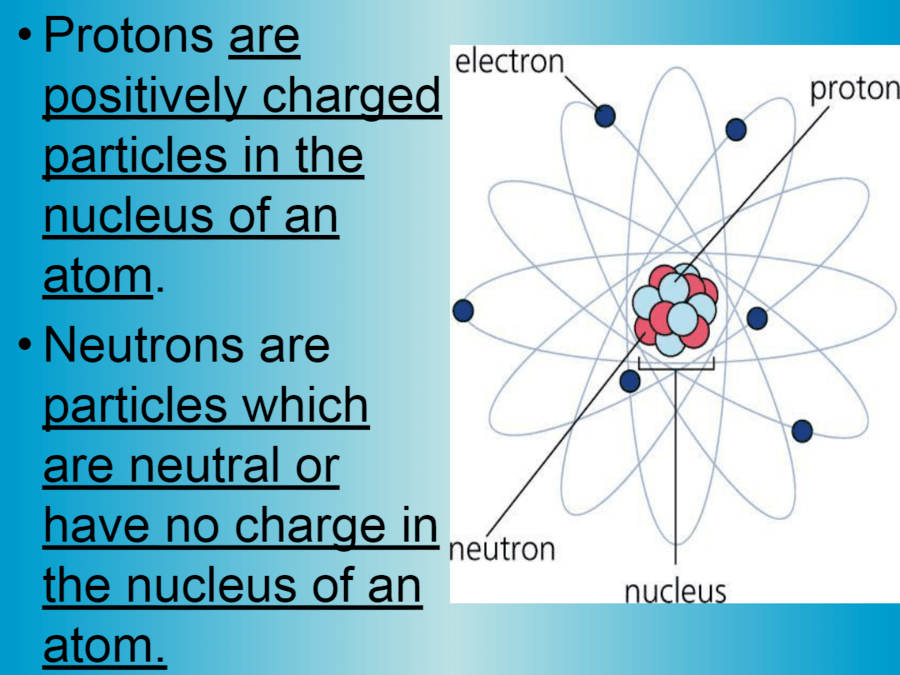
Protons are positively charged.
Neutrons are neutrally charged.
Electrons are negatively charged.
33
Multiple Choice
How many valence electrons in this diagram:
1
3
5
7
34
Copy this picture into your notes
35
36
Match
atomic number of 8
atomic number of 10
atomic number of 3
atomic number of 8
atomic number of 10
atomic number of 3
37
38
39
Draw
What is an ion? How many types of ions can be found?
40
41
Multiple Choice
REVIEW: What is the atomic number of Neon?
10
20.180
10.180
One, because you can't spell Neon with O- N -E
42
Multiple Choice
How is average atomic mass determined?
By adding all of the protons and neutrons together.
by summing the masses of the element's isotopes, each multiplied by its natural abundance on Earth
By multiplying of often protons and neutrons occur and adding up the averages.
43
Multiple Choice
How many neutrons does an atom of symbol pictured have?
26
-26
70
44
Multiple Choice
How many protons does an atom of symbol pictured have?
22
26
70
45
Multiple Choice
What is the total number of particles in the nucleus atom of symbol pictured have?
22
70
48
46
47
48
49
Show answer
Auto Play
Slide 1 / 49
SLIDE

Similar Resources on Wayground
43 questions
Body Composition
Presentation
•
9th - 10th Grade
48 questions
Periodic Table of Elements
Presentation
•
8th Grade
45 questions
Active and Passive
Presentation
•
9th Grade
43 questions
Atmospheric Processes
Presentation
•
9th Grade
40 questions
EOC Biology Review 1 - Cells
Presentation
•
9th Grade
46 questions
Transcription and Translation
Presentation
•
9th Grade
42 questions
TSIA 2.0 Math Practice Test #1w/Explanations 2023
Presentation
•
9th Grade
47 questions
Life in the Earth System
Presentation
•
9th Grade
Popular Resources on Wayground
20 questions
Math Review
Quiz
•
3rd Grade
15 questions
Fast food
Quiz
•
7th Grade
20 questions
Context Clues
Quiz
•
6th Grade
20 questions
Inferences
Quiz
•
4th Grade
19 questions
Classifying Quadrilaterals
Quiz
•
3rd Grade
20 questions
Figurative Language Review
Quiz
•
6th Grade
20 questions
Equivalent Fractions
Quiz
•
3rd Grade
10 questions
Identify Fractions, Mixed Numbers & Improper Fractions
Quiz
•
3rd - 4th Grade