


Unit 3 IGCSE Polynomial Review
Presentation
•
Mathematics
•
10th - 11th Grade
•
Medium
Jim Cross
Used 12+ times
FREE Resource
25 Slides • 61 Questions
1
Unit 3 Polynomial Review IGCSE
In this unit we look at the graphs and equations with degrees of 3 and higher
2
Coeffients are numbers that are multiplied times a variable
Constants are numbers not multipled times a variable
Variables are letters that represent unkown numbers
Terms are numbers, variables, or numbers times variables
Vocabulary
3
Multiple Choice
What is the constant in
7y4−5x3+9y2−8x+4
7
-5
-8
4
4
Multiple Choice
How many terms are in
3x2 +4x − 5
1
2
3
None
5
Multiple Choice
8 + 5x
6
Multiple Select
Select all the coefficients:
f(x) = 5x4+3x2+1
1
2
3
4
5
7
-Degree of a term vs the degree of polynomial
To find the degree of a term
add up all the exponents in term
To find the degree of the polynomial, identify the term with largest degree.
In this case, the polynomial is a 6th degree polynomial
The term with the biggest power is often said to have the "leading coefficient"
but may or may not be the first term.
8
Multiple Choice
Identify the degree of: the term
2b8c2
9
Multiple Choice
What is the degree of the polynomial:
4x3 - 5x2 + 2x - 1
10
Multiple Choice
What is the leading coefficient of the polynomial?
6x2 + 7x4 + x3 + x
1
2
6
7
11
Polynomias are often described by the number of terms they have and their degree.
12
Multiple Choice
Classify by number of terms:
5x2 – 6x + 3
Monomial
Binomial
Trinomial
4-Term Polynomial
13
Multiple Choice
3x3 – 6x
14
Multiple Choice
What is the degree of this polynomial?
2x4 - 3x5 + x
-3
2
4
5
15
Multiple Choice
What is the degree of the polynomial:
f(x) = 3x2 + 4x - 5
16
End behavior for a graph is what the y values are doing as the x's get infintely large and infinitely small.
Visually, it is what the graph is doing as you look to the right side and the left side.
This graph has an end behavior of
down up
or it may also be expressed this way
f(x) →∞ as x →∞
f(x) →-∞ as x →-∞
Polynomial Function End Behavior
17
The sign of the leading coefficient tells us what is happening to the y values on the right side of the graph
The degree tells us whether the other end behavior is the same or not
Leading Coefficient and Degree
18
Some text here about the topic of discussion.
19
Multiple Choice
The sign of the leading coefficient determines the
behavior of the right end of the graph.
The degree determines whether the left end behavior is the same or different.
find the end behavior : f(x) = 2x3 - x + 5
Left up
Right up
Left up
Right down
Left down
Right up
Left down
Right down
20
Multiple Choice
Determine the end behavior
f(x) = 4 + 3x - 6x7 + 3x4
21
Multiple Choice
f(x) = - 2x3+3x2-5x+3
f(x)→−∞ as x →∞
f(x)→∞ as x →∞
f(x)→−∞ as x →∞
f(x)→∞ as x →∞
22
Multiple Choice
h(x) = x4-3x3 +2x-4
f(x)→−∞ as x →∞
f(x)→∞ as x →∞
f(x)→−∞ as x →∞
f(x)→∞ as x →∞
23
Multiple Choice
f(x) =−3 (x−3)2(x+4)
Hint: to determine the degree of a polynomial in factored form, add up all of the multiplicities (exponents of factors with a variable)
The end behavior for this polynomial is...
24
Multiple Choice
The sign of the leading coefficient determines the
behavior of the right end of the graph.
The degree determines whether the left end behavior is the same or different.
Which is true for the graph?
Degree - Even
Degree - Odd
Degree - Even
Degree - Odd
25
Multiple Choice
Which is true for the graph?
Degree - Even
Degree - Odd
Degree - Even
Degree - Odd
26
When looking at a polynomial equation in standard form:
you can find the maximum number of turning points by taking the degree minus 1
27
Multiple Choice
28
Multiple Choice
What is the maximum number of turning for a cubic function?
29
Multiple Choice
What is the maximum number of turning points for the function with a 5th degree?
30
you can reverse the process to determine the minimum degree of the function.
This function has two turning points, so that means that the minimum degree for the function would be 3
the nmber of turning points Plus 1 will give you the minimum degree of the polynomial
When given a graph...
31
Multiple Choice
32
Multiple Choice
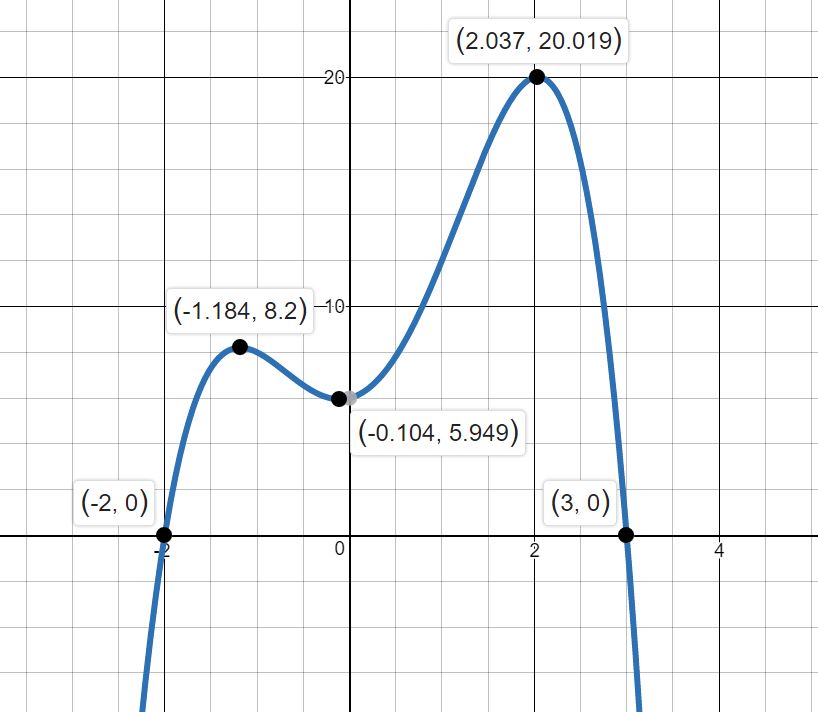
What is the minimum degree is the function?
33
To determine intervals of increasing, decreasing or constant:
-always look form left to right
-always give your interval with x values
Intervals of increasing and decreasing
34
To determine intervals of increasing, decreasing or constant:
-always look form left to right
-always give your interval with x values
Intervals of increasing and decreasing
35
Multiple Choice
36
Multiple Choice
37
The absolute or gobal maximum or minimum are the highest or lowest point on a graph.
A realtive (local) maximum is a high point in a small area
A realtive (local) minimum is a low point in a small area
Local or Relative Maximum and Minimum
38
Multiple Choice
39
Multiple Choice
40
The zeros of a function is the number or numbers that I can substitute in place of x that will cause the entire function to equal zero.
There are real and complex zeros.
The degree of a polynomial will give you the number of complex and real zeros
Complex zeros always come in pairs.
Zeros of a function
41
This graph has two turning points, so it has a minimum degree of 3.
This means there has to have at least 3 zeros.
Real zeros can be found where the graph crosses the x axis.
The x intercept at -3 is a real zero.
The other two zeros must be complex.
Real vs Complex Zeros
42
Multiple Choice
43
Multiple Select
Pick all statements that apply to this polynomial.
It is an odd degree function.
It is an even degree function.
It has a positive leading coefficient.
It has a negative leading coefficient.
It has 3 real roots.
44
Multiple Choice
P(x) = 3x3+4x-8 to have?
45
When a polynomial is written in factored form, the zeros are the number(s) that we could replace x with that would make any of the factors equal to zero
The multiplicity of each zero, is how many times that factor happened. This can be found by looking at the exponent.
Zeros and Multiplicities
46
Multiple Choice
zeros of the polynomial
y = 3(x + 4)(x + 1)(x - 3)?
47
Multiple Choice
What are the zeros with multiplicities?
g(x)=(x+4)2(x+8)3(x−5)
-4 multiplicity 1,
-8 multiplicity 1,
5 multiplicity 3
4 multiplicity 2,
8 multiplicity 3,
-5 multiplicity 1
4 multiplicity 3,
8 multiplicity 2,
-5 multiplicity 1
-4 multiplicity 2,
-8 multiplicity 3,
5 multiplicity 1
48
Multiple Choice
What are the zeroes with multiplicity?
k(x)=(x+2)10(x−12)9
-2 multiplicity 9,
12 multiplicity 10
-2 multiplicity 10, 12 multiplicity 9
2 multiplicity 10, -12 multiplicity 9
2 multiplicity 9,
-12 multiplicity 10
49
Multiple Choice
Write the polynomial in standard form given the following zeros. x = -2, 1, 4
f(x) = (x+2)(x-1)(x-4)
f(x) =x3 - 3x2 - 6x + 8
f(x) = x3 + 8
f(x) = x3 - 3x2 + 8
50
Multiple Choice
*a positive leading coefficient
*zeros: 9, 3, -2, 0
51
Real zeros and their multiplicities can be identified by looking where the graph intersects with the x axix
If the graph goes straight through the x axis, the multiplicity is one
if the graph bounces off the x axis the multiplicity is two
If the graph flattens out and then goes straight through the x axis the multiplicity is three
Zeros and Multiplicities of polynomial graphs
52
Multiple Choice
Which root has a multiplicity of 2?
-1
2
4
-4
53
Multiple Choice
54
Multiple Choice
What are the zeros of the graph?
-4 multiplicity 2, 0 , 2, 5
-4 multiplicity 3, 0 , 2, 5
4 multiplicity 2, 0 , -2, -5
4 multiplicity 3, 0 , -2, -5
0, 11, -5 , 25
55
Multiple Choice
56
Polynomial Lond division
Typically used when the divisior is not just x plus a number.
Does Divide
McDonalds Multiply
Serve Subtract
Breakfast Bring down
Then repeat until you run out of numbers
57
58
Multiple Choice
(4x4−8x3−3x2+7x−2)÷(2x−1)
Use long division to evaluate
2x3−3x2−3x+2
2x3+3x2+3x+2
2x3−3x2−3x−2
2x3+2
59
Multiple Choice
Identify the missing term to complete the solution.
4
-4
5
-5
60
Multiple Choice
4x - 2
4x + 2
4x - 2 + (1/3x - 1)
4x + 2 + (1/3x - 1)
61
synthetic division
can be only be used when you are dividing a polynomial by
x + a number
or
x - a number
Multiply
Bring over
Add
62
Don't forget to fill is a zero for any missing terms
63
Multiple Choice
Find the quotient
(2x3 − 5x2 + 3x + 7) ÷ (x − 2)
2x3 − x2 + x + 9
2x2 − x + 1
2x2 − x + 1 + 9/x−2
2x2 − 9x − 15 − 23/x−2
64
Multiple Choice
What is the proper way to write the answer for the following problem?
2x3-x2-25x+12
2x4-x3-25x2-12x+0
2x3-x2-25x-12
2x4-x3-25x2-12x-0
65
Multiple Choice
Cam divided (x4 + 3x2 - 4x - 2) by factor of (x-2) using synthetic division. His work is shown above. Which best describes his mistake?
Cam wrote the remainder incorrectly.
Cam did not use a zero place holder for the x3 term.
Cam added instead of subtracting the rows.
Cam should have used -2 as his division since the factor was x-2.
66
Multiple Choice
Which term is missing in this problem?
(2x3 + 5x2 + 9) ÷
(x + 3)
x4
x3
x2
x
67
Use this when you just need to know the remainder,
or
whether a binomial is a factor
because if the remainder is zero when you divide two polynomials, they must be factors.
68
Multiple Choice
69
Multiple Choice
(x3 - 3x2 + 2x + 2)?
70
Multiple Choice
71
Multiple Choice
72
Multiple Choice
when
f(x) = x4 − x3 + kx2 − x + 1
is divided by x + 2, the remainder is 31. Find k
−1
2
1
−2
73
Multiple Choice
x + 1 is a factor of
f(x) = x3 + 2x2 + k
Find k
−1
2
1
−2
74
When adding polynomials:
-combine like terms
When subtracting polynomials:
-distribute the negative 1 and then combine like terms
When multiplying monomials:
-multiply the coefficients and add the exponents.
75
Multiple Choice
f(x) = 3x2 + 7x and g(x) = 2x2 - x - 1,
find (f + g)(x).
76
Multiple Choice
Given f(x)=3x2−2x+1 and g(x)=2x ,
find (f×g)(x)
6x2−4x−2
6x3−4x2+2x
6x3+4x2+2x
5x3+4x2−9x−4
77
78
79
Basic operations with Complex numbers
adding and subtracting is just like adding and subtracting polynomials.
Multiplying is the same as multiplying polynomials except
i2 = =1
80
Multiple Choice
81
Multiple Choice
(3 + 2i) + (4 - 5i)
7 + 7i
1 - 3i
1 - 7i
7 - 3i
82
Multiple Choice
(4 - 2i) - (3 + 6i)
7 - 4i
1 + 4i
1 - 8i
7 - 8i
83
Multiple Choice
What does i2 equal?
-1
√-1
1
-√1
84
Multiple Choice
85
Multiple Choice
86
Multiple Choice
(3 + 8i)(-2 - i)
2-19i
23-i
34+5i
23-i
Unit 3 Polynomial Review IGCSE
In this unit we look at the graphs and equations with degrees of 3 and higher
Show answer
Auto Play
Slide 1 / 86
SLIDE

Similar Resources on Wayground
80 questions
Chapter 15: The Biosphere
Presentation
•
10th Grade
82 questions
Cell Transport EOC Review Lesson
Presentation
•
9th - 10th Grade
80 questions
Normal Distribution
Presentation
•
11th Grade
83 questions
Solve by Square Roots
Presentation
•
10th Grade
79 questions
Operations with Complex Numbers
Presentation
•
10th Grade
84 questions
Principles of Design
Presentation
•
10th - 12th Grade
83 questions
Algebra 1 3rd 9 Weeks Review
Presentation
•
9th - 12th Grade
80 questions
Icfes sesión 1 Propiedades de la materia
Presentation
•
10th - 11th Grade
Popular Resources on Wayground
6 questions
PRIDE Always and Everywhere
Presentation
•
12th Grade
20 questions
Lab Safety Quiz
Quiz
•
6th Grade
26 questions
KOR Review Kahoot Questions
Quiz
•
8th Grade
21 questions
Continents and Oceans
Quiz
•
6th Grade
12 questions
Unit Zero lesson 2 cafeteria
Presentation
•
9th - 12th Grade
20 questions
Parts of Speech
Quiz
•
5th Grade
10 questions
Riddles Riddles fun Riddles
Quiz
•
6th - 12th Grade
16 questions
Subject & Predicate
Quiz
•
5th Grade
Discover more resources for Mathematics
7 questions
EAHS PBIS Lesson- Bathroom
Presentation
•
9th - 12th Grade
16 questions
Segment Addition Postulate
Quiz
•
10th Grade
20 questions
Classifying Real Numbers
Quiz
•
7th - 12th Grade
19 questions
Classify Types of Real Numbers
Quiz
•
9th - 12th Grade
18 questions
Integer Operations
Quiz
•
5th - 12th Grade
10 questions
Mastering Integer Operations: Addition, Subtraction, Multiplication, and Division
Interactive video
•
6th - 10th Grade
12 questions
Identify Rigid Transformations
Quiz
•
8th - 12th Grade
19 questions
Solve for Unknowns in Geometry
Quiz
•
9th - 12th Grade