Search Header Logo
Thermal Energy & the Kinetic Molecular Theory

Thermal Energy & the Kinetic Molecular Theory

Assessment

Presentation

Science

10th Grade

Medium

NGSS
MS-PS1-4, MS-PS3-4, MS-PS3-3

+5

Standards-aligned

Created by

John Oglesby

Used 8+ times

FREE Resource

19 Slides • 23 Questions

1

Kinetic Molecular Theory :

Thermal Energy

media

2

Thermal Energy Transfer

Conduction → Transfer of thermal energy by collisions between particles in matter. Occurs in solids, liquids, & gases. Metals are the best conductors.


Convection → Transfer of thermal energy in a fluid by the movement of warmer and cooler fluid from place to place. Occurs in liquids & gases.


Radiation → Transfer of energy by electromagnetic waves. Occurs in gases only.


3

Conduction

Transfer of thermal energy that occurs in solids, liquids, and gases when two substances of different temperatures touch.


media

4

Convection

Heat transfer caused by the rising of hotter, less dense fluids and the falling of cooler, more dense fluids.

media

5

Radiation

The transfer of energy by the movement of electromagnetic waves or subatomic particles.

media

6

Conductor

A substance that allows the flow of electrical charge or transfers thermal energy through matter.

media

7

Insulator

A material that does not conduct heat or electric current

media

8

Multiple Choice

Heat is the transfer of _____ from one object to another due to a difference in temperature.

1

Time

2

Force

3

Energy

4

Velocity

9

Multiple Choice

Question image

The man's hand will immediately receive heat from the metal as the candle gradually warms it. That is called____?

1

Conduction

2

Convection

3

Radiation

10

Multiple Choice

Question image

"Metals" are the best____?

1

Insulators of heat

2

Conductors of heat

3

Conductors of light

4

Insulators of electricity

11

Multiple Choice

How does heat move?

1

from a warmer to a cooler object

2

from a cooler to a warmer object

3

toward a hot object

4

away from a cold object

12

Multiple Choice

Energy transmitted by electromagnetic waves

1

conduction

2

convection

3

radiation

13

Multiple Choice

Question image

When you touch hot sand, heat is transferred by _________ to your skin.

1

conduction

2

convection

3

radiation

14

Multiple Choice

Transfer of energy between solids by direct contact is:
1
Conduction
2
Convection
3
Radiation

15

Multiple Choice

Question image
The sun shines down on this family as the play on the beach.
1
conduction
2
convection
3
radiation

16

media
media

17

media
media

18

media

​Kinetic Theory

​Think like a molecule

19

KMT

Kinetic Molecular Theory | with Teacher Dan

Kinetic Molecular Theory

  1. Gases are composed of tiny particles.

  2. There are no attractive forces between molecules.

  3. Gas molecules are always in constant random motion.

  4. The molecules collide classically with container walls and one another.

  5. The movement of gas molecules is affected by temperature. The average kinetic energy of the molecules is directly related to the temperature of a gas.

20

Phet - States of Motion

Some text here about the topic of discussion

21

media

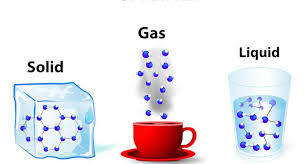
​Solid

22

media

​Liquid

23

media

​Gas

24

media

​Heat of fusion

25

media

​Melting point

26

media

​Heat of vaporiztion

27

media

​Boiling point

28

Multiple Choice

What state of matter has a definite volume and a definite shape?

1

Solid

2

Liquid

3

Gas

4

Plasma

29

Multiple Choice

What state of matter has a definite volume but no definite shape?

1

solid

2

liquid

3

gas

4

plasma

30

Multiple Choice

What state of matter has not definite shape or volume?

1

Solid

2

Liquid

3

Gas

4

Plasma

31

Multiple Choice

In which state of matter are the particles moving the least random
1
Gas
2
Liquid
3
Solid
4
Plasma

32

Multiple Choice

In which state of matter are the particles only vibrating?
1
Gas
2
Liquid
3
Solid
4
Plasma

33

Multiple Choice

Question image
1
Gases do not move in straight line
2
Most of the volume of gas is empty space
3
Gas particles are not in constant random motion
4
Gas particles attract each other

34

Multiple Choice

The slower the particles in a substance move,
1
the colder it is.
2
the warmer it is.
3
the more energy it has.
4
the less energy it has.

35

Multiple Choice

Question image
Of these three states of matter, which one has the most kinetic energy? 
1
Solid 
2
Liquid 
3
Gas

36

Multiple Choice

Question image

These properties describe a ___.

1

solid

2

liquid

3

gas

37

Multiple Choice

Question image

These properties describe a ___.

1

solid

2

liquid

3

gas

38

Multiple Choice

The more energy that particles have, the ___ they move.

1

slower

2

faster

39

Multiple Choice

The force of attraction between molecules is ___.

1

intermolecular forces

2

bridge forces

3

chemical bonds

40

Multiple Choice

Question image

As matter changes state from liquid to solid, the atoms have ____ kinetic energy.

1

more

2

less

3

the same

41

Multiple Choice

Question image

Which state of matter is found in our Sun and other stars?

1

solid

2

liquid

3

gas

4

plasma

42

Multiple Choice

The energy of an object as it is in motion is defined as
1
Kinetic Theory
2
Kinetic energy
3
Potential energy
4
Electric energy

Kinetic Molecular Theory :

Thermal Energy

media

Show answer

Auto Play

Slide 1 / 42

SLIDE