

Intro to Kinematics

Presentation
•
Physics, Science
•
6th - 9th Grade
•
Medium

Lloyd Cascabel
Used 18+ times
FREE Resource
18 Slides • 30 Questions
1
Introduction to
Mr. Cascabel
2
As physics try to study the fundamental parts of the universe in terms of relationship of matter and energy, one of its branches focus on describing motion – kinematics.
Kinematics describes the motion of objects based on a specific frame of reference. It describes its velocity, acceleration, displacement and amount of time it travelled.
In describing motion, it is very important to convert units and apply rules on significant figures.
3
Multiple Choice
Which branch of Physics deals with describing motion?
Kinematics
Acoustic
Thermodynamics
Mechanics
4
Multiple Choice
Which of the following is physics concerned about?
relationship of matter and energy
truth about life after death
morality and justice
aesthetics i design
5
Multiple Choice
Which of the following is NOT a unit used for describe motion?
displacement and velocity
frequency and wavelength
direction and distance
time and acceleration
6
Multiple Choice
The SI unit for speed is_______.
meters per second
miles per hour
miles per second
meters per hour
7
Multiple Choice
The SI unit for distance is_______.
inches
feet
meters
kilometers
8
Multiple Choice
The SI unit for time is_______.
hours
minutes
seconds
millisecond
9
Multiple Choice
Which quantity refers to the rate of movement, or fast a moving object is?
displacement
speed
time
force
10
Distance is the total length of travel irregardless of the direction of motion. It is a scalar quanitity.
Displacement is the total distance moved based on where the object came from. It is a vector quantity

11
Distance is the total length travelled irregardless of the direction of motion. It is a scalar quantity.
Displacement is the total distance moved based on where the object came from. It is a vector quantity. It is also defined as "change in position."

12
Distance is the total length travelled irregardless of the direction of motion. It is a scalar quantity.
Displacement is the total distance moved based on where the object came from. It is a vector quantity. It is also defined as "change in position."

13
If you walk from home going to school for 2.5 km and then went back home...
your distance travelled is
5.0 km
your displacement is
0 km.
14
In solving for displacement, you can assign positive or negative directions.
If you took 3 steps forward, 5 steps backwards, and then 10 steps forwards again, what will be the displacement?
(+5 steps) + (-7 steps) + (+10 steps) = +8 steps
What about the total distance travelled?
15
Multiple Choice
The sum of all movements from start to the end of motion is best described as____.
distance
displacement
motion
donkey
16
Multiple Choice
The change in an objects position from the final position to initial position.
displacement
distance
motion
reference point
17
Multiple Choice
A man walks 5 miles forwards, 6 miles backwards and then 2 miles forwards. What is his displacement?
1 mile forward
13 miles
3 miles forward
1 mile
18
Multiple Choice
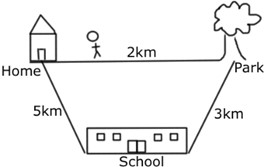
Jerry walked from home to school, then from the school to the park. What is his total distance?
2 km
5 km
8 km
10 km
19
Multiple Choice
20
Speed is the total distance travelled per unit of time. It refers to how fast the object moves.
Velocity is the total displacement per unit of time. It is the speed in a given direction.
Both are measured using the SI unit m/s or ms-1 or sometimes km/hr or kmhr-1

21
Speed is the total distance travelled per unit of time. It refers to how fast the object moves.
Velocity is the total displacement per unit of time. It is the speed in a given direction.
Both are measured using the SI unit m/s or ms-1 or sometimes km/hr or kmhr-1

22

23

24
Multiple Choice
25
Multiple Choice
26
Multiple Choice
27
Multiple Choice
28
Multiple Choice
29
Multiple Choice
Distance over time is the definition of ___.
30
Multiple Choice
31
speed for the travel, speed for a specific instance
As an object travels, it may change speeds. It may speed up, slow down, change direction or even stop.
The speed for the total distance over time frame is the average speed.
The speed at any given instance is the instantaneous speed.

32
speeding up, slowing down, or changing directions
When an object speeds up, slows down or changes direction, it also changes the displacement and velocity. This change is called acceleration.
Acceleration can be a positive or negative depending on the direction of the velocity (+ or -) and whether it speeds up or slows down.
33

34

You experience acceleration when you:
step on the gas and speed up
step on the breaks and slow down
turn your steering wheel
35

In this graph, velocity is constant, and acceleration is zero because there is no change in velocity.
36
In this graph, initial velocity is 50 m/s, and final velocity is 0 m/s. Acceleration is NOT zero because the velocity changed.


37
Multiple Choice
The velocity of an object increases from 30 m / s to 50 m / s in 5.0 seconds.
What is the average acceleration of the object?
0.10 m / s2
0.25 m / s2
4.0 m / s2
10 m / s2
38
Multiple Choice
A car travels at an average speed of 60 km / h for 15 minutes. How far does the car travel in 15 minutes?
4.0 km
15 km
240 km
900 km
39
Multiple Choice
If you drive for 2 hours and travel 120 miles. What was your average speed.
60
60 mi/hr
240 miles
2 hours
40
Multiple Choice
You roll a tennis ball a distance of 18 meters it takes 6 seconds to cover the distance. What is the average speed of the tennis ball?
3 km/s
6 m/s
3
3 m/s
41
Multiple Choice
a=tΔv
Sami coasted on her bike straight down a hill, accelerating from a speed of 3 m/s to 15 m/s in a total time of 6 seconds. What was her acceleration?
1 m/s2
-1 m/s2
2 m/s2
1m/s
42
Multiple Choice
the unit of acceleration is
(m/s2)
jouls
m
s
43
Multiple Choice
A bus starts from rest and accelerates to 14 m/s in 4 s. What is the average acceleration of the bus?
3.5 m/s2
5.9 m/s2
10.5 m/s2
24 m/s2
44
Other equations can also be used in solving kinematic problems.

45
Multiple Choice
What are the standard units of acceleration?
m
s
m s-1
m s-2
46
Multiple Choice
What is the acceleration of a train that takes 2.3km to stop from a speed of 67 m/s
0.98 m/s2
-0.98 m/s2
0.12 m/s2
-0.12 m/s2
47
Multiple Choice
A space shuttle accelerates from rest (0 m/s) to a top speed of 600 km/h. if the average acceleration of the space shuttle is 10m/s, what is the distance the space shuttle accelerates over (roughly)
1200m
1390m
1800m
2,290m
48
Multiple Choice
Introduction to
Mr. Cascabel
Show answer
Auto Play
Slide 1 / 48
SLIDE
Similar Resources on Wayground

49 questions
Contact and Noncontact Forces
Presentation
•
6th - 9th Grade
44 questions
Solar Eclipses vs. Lunar Eclipses
Presentation
•
6th - 10th Grade
43 questions
Into to waves
Presentation
•
7th - 9th Grade
39 questions
Weathering and Erosion
Presentation
•
6th - 8th Grade
41 questions
11/13 Types of Forces -on your own
Presentation
•
6th - 8th Grade
45 questions
Motion and Acceleration
Presentation
•
6th - 9th Grade
43 questions
Plant Reproduction and Growth
Presentation
•
6th - 8th Grade
43 questions
The Sun Teacher's edition
Presentation
•
6th - 8th Grade
Popular Resources on Wayground
10 questions
How much do you know about our Portrait of an Eagle?

Quiz
•
10th Grade
10 questions
Fast Food Slogans
Quiz
•
6th - 8th Grade
21 questions
Continents and Oceans
Quiz
•
6th Grade
20 questions
Parts of Speech
Quiz
•
5th Grade
16 questions
Subject & Predicate
Quiz
•
5th Grade
25 questions
Multiplication Facts
Quiz
•
5th Grade
12 questions
Map Skills
Quiz
•
3rd Grade
22 questions
Continents and Oceans
Quiz
•
5th Grade
Discover more resources for Physics
20 questions
Position vs. Time Graphs
Quiz
•
9th Grade
20 questions
Free Body Diagrams
Quiz
•
8th Grade
6 questions
Force Card Sort
Quiz
•
6th Grade
20 questions
Calculating Net Force
Quiz
•
6th - 9th Grade
20 questions
Net force and types of forces review
Quiz
•
6th Grade
18 questions
Interpreting Motion Graphs
Presentation
•
9th - 12th Grade
10 questions
Exit Check 4.1 - Destructive Processes
Quiz
•
9th Grade
18 questions
Newton's Laws of Motion
Quiz
•
8th Grade