

Introduction to Periodic Table

Presentation
•
Chemistry
•
10th Grade
•
Medium

Oyerohunke oyediran
Used 2+ times
FREE Resource
13 Slides • 17 Questions
1

The Periodic Table:
Groups and Periods
2
Multiple Choice
Mendeleev wasn't the only one to arrange the elements into some sort of a table. What did he do that no one else had done?
He was the first to use a typewriter so his work was readable.
He predicted the properties of undiscovered elements. And he was right!
He grew his hair and caught on, starting the 60's hippie movement
Created a model of an atom that explained atomic spectra.
3


The periodic table is composed of elements
arranged in order of increasing atomic number.
The Periodic Table
4


Periods
The horizontal rows on the periodic table
are called periods.
5


Groups
• Elements in the same group have the same number
of valence electrons.
• Columns on the periodic table are called groups.
6
Multiple Choice

How are the elements arranged on the periodic table today?
By atomic mass
By number of electrons
By atomic number
By alphabetical order
7
Multiple Choice
8


Three Types of Elements
The periodic table contains three types of elements:
metals, nonmetals, and metalloids.
Metals
Nonmetals
Metalloids
9

Metals, Nonmetals, Metalloids
• Metals – hard, shiny elements that are good
conductors of heat and electricity.
• Nonmetals – soft, brittle elements that are
poor conductors of heat and electricity.
• Metalloids – share some properties of metals
and some properties of nonmetals.
10
Multiple Choice
11
Multiple Choice
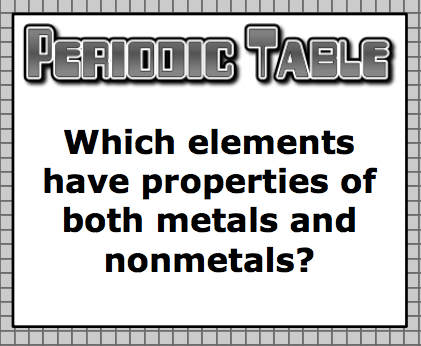
Metalloids
(sometimes called semiconductors or semimetals)
12
Multiple Choice

13
Multiple Choice
14
Multiple Choice
15
Multiple Choice
16


Groups of the Periodic Table
•
Elements are organized into groups (1-18).
•
Elements in the same group have similar properties.
17


Alkali Metals (Group 1):
Soft and shiny. Extremely reactive with water
Alkaline Earth Metals (Group 2):
Hard, shiny metals. Very reactive.
Alkali Metals
Alkaline Earth
Metals
18

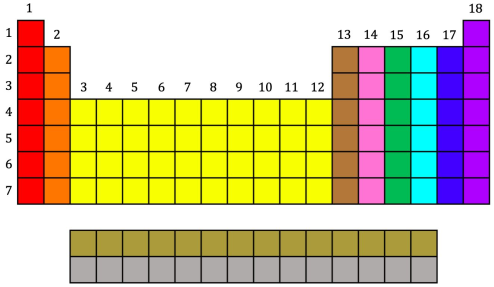


Transition Metals (Group 3-12):
Transition Metals
Strong metals that are ductile and malleable.
Used to make common items like coins and tools.
19
Multiple Choice
Elements in a .................. have similar chemical properties.
period
group
row
20
Multiple Select
Elements in the same group have : (2 correct answers)
Similar chemical properties
Similar names
Same number of outer (valence) electrons)
The same number of protons
21
Multiple Choice
22
Multiple Choice
Name this group: These metals are the second most reactive.
23
Multiple Choice
Name this group: These metals are the second most reactive.
24


Boron Family (Group 13)
Carbon Family (Group 14)
Nitrogen Family (Group 15)
Oxygen Family (Group 16)
Carbon
Nitrogen
25


Halogens (Group 17):
Extremely reactive elements that can form salts.
Noble Gases (Group 18):
Non-reactive group of non-metals.
Noble Gases
Halogens
Neon
26
Multiple Choice
Which group of the periodic table is composed of inert (not reactive) gases?
answer choices
alkali metals
alkaline earth metals
halogens
noble gases
27
Multiple Choice
28
Explanation Slide...
Semiconductors, metalloids, semimetals all refer to the same elements. They have properties of both metals and nonmetals. They are used in all of your electronic devices.

29


Lanthanides (Elements 57-70)
Actinides (Elements 89-102)
Also known as the Rare Earth Metals.
All metals, all solids, all radioactive.
Lanthanides
Actinides
30
Multiple Select
Find these groups: Locate Lanthanides and Actinides.
The Periodic Table:
Groups and Periods
Show answer
Auto Play
Slide 1 / 30
SLIDE
Similar Resources on Wayground

25 questions
1.2 Modeling Chemical Reactions Notes
Presentation
•
10th Grade
21 questions
Exploring Atomic Emission Spectra
Presentation
•
10th Grade
20 questions
Type 1 Ionic Compound Nomenclature
Presentation
•
10th Grade
21 questions
Angle Pair Relationships
Presentation
•
10th Grade
21 questions
Scientific Method
Presentation
•
10th Grade
23 questions
Quick Chem Quiz 5 - Periodic Table
Presentation
•
10th Grade
23 questions
Chemical Equations-Counting Atoms(TEK 7C)
Presentation
•
10th Grade
26 questions
Atoms Ions and Isotopes
Presentation
•
9th - 10th Grade
Popular Resources on Wayground
6 questions
PRIDE Always and Everywhere
Presentation
•
12th Grade
20 questions
Lab Safety Quiz

Quiz
•
6th Grade
26 questions
KOR Review Kahoot Questions
Quiz
•
8th Grade
21 questions
Continents and Oceans
Quiz
•
6th Grade
12 questions
Unit Zero lesson 2 cafeteria
Presentation
•
9th - 12th Grade
20 questions
Parts of Speech
Quiz
•
5th Grade
10 questions
Riddles Riddles fun Riddles
Quiz
•
6th - 12th Grade
16 questions
Subject & Predicate
Quiz
•
5th Grade
Discover more resources for Chemistry
21 questions
Lab Safety
Quiz
•
10th Grade
20 questions
Scientific Method
Quiz
•
10th - 12th Grade
20 questions
Lab Safety
Quiz
•
10th Grade
12 questions
Significant figures
Quiz
•
9th - 12th Grade
20 questions
COUNTING ATOMS
Quiz
•
10th Grade
40 questions
26-27 Unit 1 Density and Metric Conversions
Quiz
•
10th Grade
20 questions
12.2 Scientific Notation and Significant Figures
Quiz
•
10th Grade
5 questions
Atomic Theory Intro Video

Interactive video
•
10th Grade