

Unit 4 Lesson 3: Energy and its Forms

Presentation
•
Science
•
9th Grade
•
Hard
+2
Standards-aligned

James Pickert
Used 7+ times
FREE Resource
14 Slides • 6 Questions
1

Energy and Work
●In order to define energy, you need to return to the definition
of a related topic, work. Recall that work is done when a force moves an
object through a distance. Energy is the ability to do work.
In other words, energy is transferred by a force moving an object through a
distance.
●Work and energy are closely related. When work is done on an object, energy
is transferred to that object. Work is a transfer of energy. Both work and
energy are typically measured in joules (J).
don't tell on yourself
2

Energy can be divided into two types: Potential and Kinetic
Types of Energy
You DO NOT need to copy down the entire chart. Just list the examples of kinetic and potential energy.
3
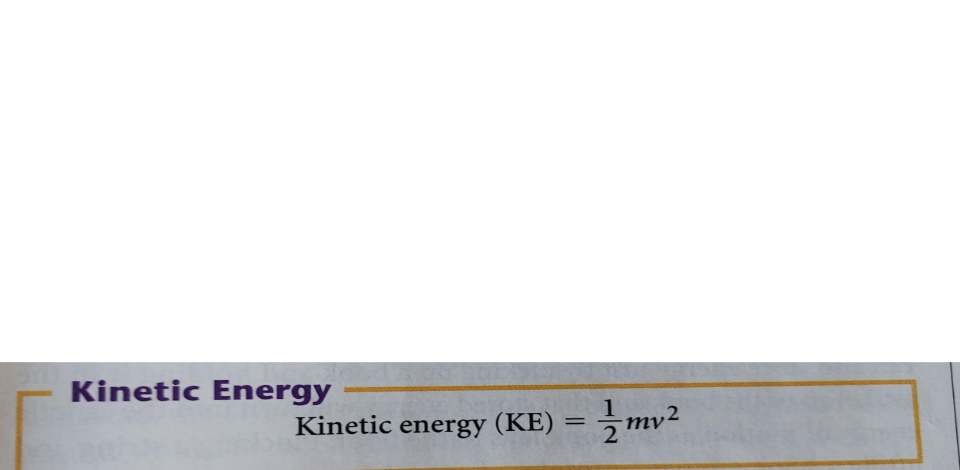
Kinetic Energy
●The energy of motion is called kinetic energy.
Notice that velocity is squared! Speed has a much bigger impact on your kinetic energy than mass does!
4
Multiple Choice

If your velocity tripled, how much bigger would your kinetic energy get?
3x the energy
4.5x the energy
6x the energy
9x the energy
5
DON'T ERASE YOUR BOARD UNTIL INSTRUCTED!
If your group gets the right answer, hold up your board!
You're going to use this to show your work. Take note of the measurements given in the problem and use them to find the solution!
Grab a whiteboard and marker!
6
Fill in the Blanks
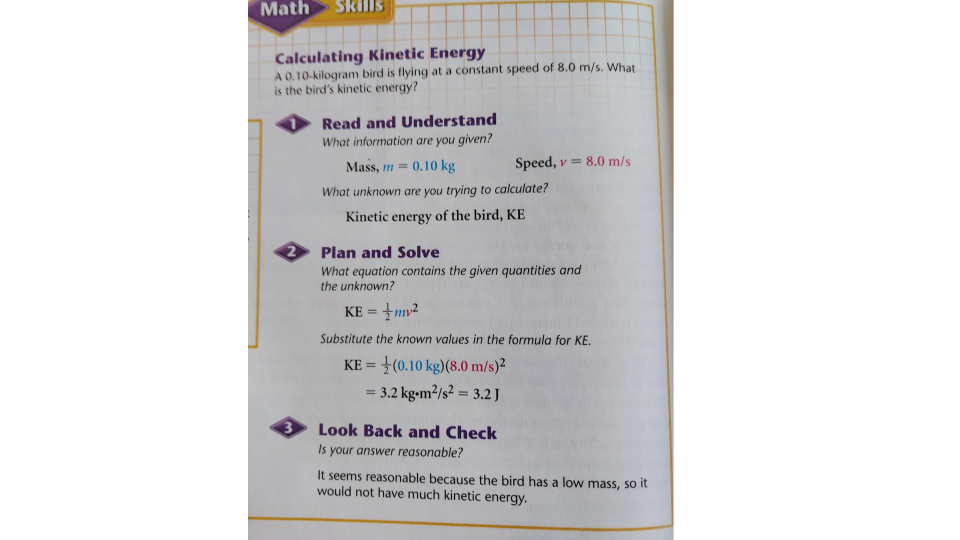
A 0.1 kg bird is flying at 8 m/s. What is the bird's kinetic energy? Include units in your answer!
Type answer...
7
8
Fill in the Blanks
A 1400 kg car moves at 25 m/s. What is the car's kinetic energy? Include units in your answer!
Type answer...
9

Potential Energy
●Potential Energy is energy that is stored as a result of position or shape.
●Two forms of potential energy are
gravitational potential energy
elastic potential energy
10

Gravitational Potential Energy
●When you lift your bag up to leave class at the end of the block, you do work
to increase the potential energy of your bag.
Potential energy that depends upon an object’s height is called
gravitational potential energy. This type of potential energy increases when
an object is raised to a greater height.
11
Fill in the Blanks
Suppose a diver at the top of a 10.0 m high diving platform has a mass of 50.0 kilograms. What is their gravitational potential energy? (Include units of measurement!)
Type answer...
12

Gravitational Potential Energy Cont.
●Suppose a diver at the top of a 10.0 m high diving platform has a mass of
50.0 kilograms. You can calculate their potential energy relative to the ground
as follows.
○PE = mgh
○PE = (50.0 kg)(10 m/s^2)(10.0 m)
○PE = 5000 kg x m^2/s^2 = 5000 J
13

Elastic Potential Energy
●The potential energy of an object that is stretched or compressed is known as
elastic potential energy. Something is said to be elastic if it springs back to
its original shape after it is stretched or compressed. Think of a rubber band
that you stretch and then it comes back to its original shape.
●Elastic potential energy can also be stored in objects that are compressed,
such as springs. Drop a slice of bread on the floor and it does not bounce
noticeably. The bread is not very elastic.
●Drop a basketball on the floor and the basketball bounces back up. The
compressed air in the ball forces the ball to spring back into shape after hitting
the ground, propelling the ball back up.
14

Mechanical Energy
●The energy associated with the motion and position of everyday object is
mechanical energy. Mechanical energy is not just limited to machines.
Mechanical energy is the sum of an object’s potential energy and kinetic
energy. Speeding trains, bouncing balls, and sprinting athletes all have
mechanical energy.
15

Energy Conversion
●Energy can be converted from one form to another. The process of changing
energy from one form to another is energy conversion.
Conservation of Energy
●When energy changes from one form to another, the total energy remains
unchanged even though many energy conversions may occur. This is one of
the most important concepts in science: the law of conservation of energy.
The law of conservation of energy states that energy cannot be created or
destroyed.
16

Energy Conversions
●One of the most common energy conversions is between potential energy
and kinetic energy. The gravitational potential energy of an object is converted
to the kinetic energy of motion as the object falls.
●Conversions between kinetic and potential energy can happen in both
directions, that is, from kinetic to potential energy, or from potential to kinetic
energy.

17
Match
Match the following vocab terms!
Energy
Gravitational Potential Energy
Kinetic Energy
Energy Conversion
Elastic Potential Energy
the ability to do work
Potential Energy that depends upon an object's height
the energy of motion
The process of changing energy from one form to another
potential energy of an object that is stretched or compressed
the ability to do work
Potential Energy that depends upon an object's height
the energy of motion
The process of changing energy from one form to another
potential energy of an object that is stretched or compressed
18

Conservation of Energy Cont.
●According to the law of conservation of energy, energy can be converted from
one form to another. However, in a closed system, the amount of energy
present at the beginning of a process is the same as the amount of energy at
the end. (In a closed system, nothing can enter or leave.)
19
Open Ended
You know that if you stop pedaling when you’re riding a bike on a flat path, the bike will eventually come to a stop. Where did the kinetic energy go from the moving bike?
20
Conservation of Energy Cont.
●According to the law of conservation of energy, energy can be converted from
one form to another. However, in a closed system, the amount of energy
present at the beginning of a process is the same as the amount of energy at
the end. (In a closed system, nothing can enter or leave.)
The bike slowed down due to friction forces and the energy was converted into thermal energy. Your bike is not part of a closed system because friction was doing work to slow you down!
Energy and Work
●In order to define energy, you need to return to the definition
of a related topic, work. Recall that work is done when a force moves an
object through a distance. Energy is the ability to do work.
In other words, energy is transferred by a force moving an object through a
distance.
●Work and energy are closely related. When work is done on an object, energy
is transferred to that object. Work is a transfer of energy. Both work and
energy are typically measured in joules (J).
don't tell on yourself
Show answer
Auto Play
Slide 1 / 20
SLIDE
Similar Resources on Wayground

16 questions
Ecological Stability: Cause and Effect
Presentation
•
9th Grade
14 questions
Galaxies
Presentation
•
9th Grade
16 questions
9th Grade Biology
Presentation
•
9th Grade
17 questions
Renewable & Non-Renewable Resources
Presentation
•
9th Grade
13 questions
Ecosystems & Energy
Presentation
•
9th Grade
15 questions
Chemical Reactions Review
Presentation
•
9th Grade
12 questions
Electricity and Magnetism
Presentation
•
9th Grade
13 questions
Water Cycle
Presentation
•
9th Grade
Popular Resources on Wayground
10 questions
How much do you know about our Portrait of an Eagle?

Quiz
•
10th Grade
10 questions
Fast Food Slogans
Quiz
•
6th - 8th Grade
21 questions
Continents and Oceans
Quiz
•
6th Grade
20 questions
Parts of Speech
Quiz
•
5th Grade
16 questions
Subject & Predicate
Quiz
•
5th Grade
25 questions
Multiplication Facts
Quiz
•
5th Grade
12 questions
Map Skills
Quiz
•
3rd Grade
22 questions
Continents and Oceans
Quiz
•
5th Grade
Discover more resources for Science
10 questions
Exploring Chemical and Physical Changes

Interactive video
•
6th - 10th Grade
20 questions
Atomic Structure
Quiz
•
9th Grade
10 questions
Decoding the Periodic Table of Elements
Interactive video
•
6th - 10th Grade
10 questions
Exploring the Periodic Table
Interactive video
•
6th - 10th Grade
22 questions
Periodic Table Review
Quiz
•
9th - 12th Grade
20 questions
Observation vs. Inference
Quiz
•
7th - 9th Grade
10 questions
Exploring the States of Matter
Interactive video
•
6th - 10th Grade
10 questions
Exploring Physical and Chemical Changes
Interactive video
•
6th - 10th Grade