Search Header Logo
Cell Biology (Unit 4: Biology)

Cell Biology (Unit 4: Biology)

Assessment

Presentation

Science

9th Grade

Medium

Created by

Sarah Scerba

Used 28+ times

FREE Resource

3 Slides • 72 Questions

1

Multiple Choice

Which organelle is only found in a plant cell? 
1

nucleus

2

chloroplast

3

mitochondria

4

cell membrane

2

Multiple Choice

Where is DNA stored in a cell? 
1

Lysosomes

2

Golgi Complex

3

Ribosomes

4

Nucleus

3

Multiple Choice

Question image

If one strand of a DNA molecule has the following order of bases, what will be the correct order of bases on the complementary (matching) strand?

AATTGGCC

1

AATTGGCC

2

TTAACCGG

3

GGCCAATT

4

GACTGACT

4

Multiple Choice

Why is DNA important?

1

It gives each cell instructions on how to make proteins.

2

It is what the cell membrane is made of.

3

It helps the cell use water.

4

It is food for the cell.

5

Multiple Choice

During osmosis
1
water moves from high to low concentration
2
large or oddly shaped molecules move across a cell membrane
3
water moves when energy is used
4
proteins are built

6

Multiple Choice

In the given scenario what will happen?  An egg is placed in pure water for 48 hours.
1
The egg will gain water and swell.
2
Water will move in and out of the cell equally, and the cell with neither shrink nor swell.
3
The egg will lose water and shrink.

7

Multiple Choice

Question image
The picture below is an example of _________________.
1
osmosis
2
isotonic
3
diffusion
4
active transport

8

Multiple Choice

Passive transport requires no
1
concentration gradients
2
osmosis
3
motion
4
energy

9

Multiple Choice

Question image
Osmosis
1
diffusion of water molecules through a semi-permeable mebrane from an area of low concentration to an area of high concentration
2
the diffusion of particles from an area of high concentration to an area of low concentration
3
diffusion of water molecules through a semi-permeable membrane from an area of high concentration to an area of low concentration
4
the diffusion of particles from an area of low concentration to an area of high concentration

10

Multiple Choice

Question image
The cell below is in a _________ solution.
1
Hypotonic
2
Hypertonic
3
Isotonic

11

Multiple Choice

Question image
Which way will the water molecules move during osmosis?
1
Out of the cell, so the cell shrinks.
2
Out of the cell, so the cell swells.
3
Into the cell, so the cell shrinks.
4
Into the cell, so the cell swells.

12

Multiple Choice

What is diffusion?
1
when molecules move 
2
when molecules move from a high concentration to a low.
3
no movement 
4
molecules move everywhere

13

Multiple Choice

What type of cellular transport uses energy?
1
Passive Transport
2
Active Transport

14

Multiple Choice

What is the fluid inside a cell called? 
1

Endoplasimic Reticulum

2

Orange Juice

3

Water

4

Cytoplasm

15

Multiple Choice

This organelle helps plants keep their rigid structure. 
1
Cell wall
2
Cell membrane
3
Chloroplast
4
Nucleus

16

Multiple Choice

The green pigment in plants is due to the presence of 
1
chlorophyll
2
Chlorine
3
Chlorophyta
4
chromatophores

17

Multiple Choice

Controls what enters and leaves the cell
1
Cell Membrane
2
Ribosome
3
Chloroplast
4
Vacuole

18

Multiple Choice

Osmosis is the movement of _____ across a membrane.
1
food
2
energy
3
oxygen
4
water

19

Multiple Choice

Permeable means
1
things can pass through
2
the concentration levels are different
3
it is permanent
4
things are stuck

20

Multiple Choice

If there is 5 percent water inside a cell and 5 percent water outside a cell
1
more water will move inside the cell
2
more water will move outside the cell
3
There will be no movement of water cells

21

Multiple Choice

A group of the same type of cells that work together for a purpose are called -
1
 a tissue
2
an organ
3
an organ system
4
an unicellular organism

22

Multiple Choice

A group of different tissues working together is - 
1
an organ
2
an organ system
3
a   prokaryote
4
a cell

23

Multiple Choice

The levels of organization from the simplest to the most complex are
1
Cells, tissues, organs, organ systems, organism
2
Organisms, organs, tissues, cells, organ systems
3
Cells, organs, organ systems, tissues, organism
4
Tissues, cells, organs, organism

24

Multiple Choice

Two examples of organ systems in the human body are - 
1
digestive system and respiratory system
2
circulatory system and fluid system
3
blood system and food system
4
nervous system and stomach system

25

Multiple Choice

Which statement is correct?
1
A group of organs work together to form an organ system
2
Tissues that have the same function form an organ system
3
Cell that have the same function form an organ
4
Organ systems working together form a tissue

26

Multiple Choice

Question image
Which instrument is credited for helping scientists develop cell theory?
1
 the microscope
2
a hand lens
3
an electronic balance
4
a thermometer

27

Multiple Choice

Question image
Which of these can only be found in a plant cell?
1
 A nucleus
2
A vacuole
3
A chloroplast
4
A mitochondrion

28

Multiple Choice

Question image
Every organ is made up of one or more: 
1
Organ Systems
2
Tissues
3
Muscles
4
Bones

29

Multiple Choice

which is NOT an example of an organelle?

1

mitochondrion

2

nucleus

3

heart

4

cell membrane

30

Multiple Choice

The spherical object within a cell that controls its activity is the _____.

1

mitochondria

2

nucleus

3

ribosome

4

membrane

31

Multiple Select

All prokaryotes are single-celled organisms. Compare prokaryotes and eukaryotes. Select the characteristics that only apply to prokaryotes.

1

These cells have DNA in a region called the nucleoid

2

Some of these cells have structures like flagella and microvilla

3

These cells have cell walls made of polypeptides and polysaccharides

4

These cells have cell walls made of cellulose

5

These cells have DNA contained in a nucleus

32

Multiple Choice

Plants have a large ______________ for storing water.

1

mitochondria

2

nucleus

3

vacuole

4

golgi body

33

Multiple Choice

Which is true of prokaryotic and eukaryotic cells?
1
Prokaryotic cells are larger than eukaryotic cells.
2
Eukaryotic cells do not have nucleus, and prokaryotic cells do have nuclei.
3
Prokaryotic cells lack membrane-bound organelles, and eukaryotic cells contain membrane-bound organelles.
4
Eukaryotic cells are simpler than prokaryotic cells.

34

Multiple Choice

Question image
Examine the cell diagrams shown. Which of the following choices identifies the eukaryotic cell for the correct reason?
1
Cell A, because it is a single cell
2
Cell A, because a nuclear membrane contains the cell’s DNA
3
Cell B, because it is much smaller
4

Cell B, because it contains genetic material

35

Multiple Choice

In cell biology, the nucleus is a membrane-enclosed organelle found in eukaryotic cells. Eukaryotes usually have a single nucleus, but a few cell types, such as mammalian red blood cells, have no nuclei, and a few others have many. Which is the role of nucleus in eukaryotes?
1
Structure that organizes motion of chromosomes. 
2
Structure that contains DNA and directs the cell 
3
Membrane that surrounds and protects the cell 
4
Stack of membranes that packages chemicals

36

Multiple Choice

The levels of organization from the simplest to the most complex are
1
Cells, tissues, organs, organ systems, organism
2
Organisms, organs, tissues, cells, organ systems
3
Cells, organs, organ systems, tissues, organism
4
Tissues, cells, organs, organism

37

Multiple Choice

True or False - Prokaryotes and Eukaryotes both contain cytoplasm?

1

True

2

False

38

Multiple Select

Animal cells contain........

1

Chloroplast

2

A nucleus

3

A cell membrane

4

Ribosomes

39

Multiple Choice

Which organelle captures energy from sunlight and converts it to chemical energy?

1

Nucleus

2

Cell wall

3

Golgi apparatus

4

Chloroplast

40

Multiple Choice

Which of the following is not found in an animal cell?

1

Cell membrane

2

Large permanent vacuole

3

Ribosomes

4

Nucleus

41

Nucleus

Cytoplasm

Cell membrane

Ribosome

Mitochondrion​

Animal Cell

media

42

Nucleus

Cytoplasm

Cell membrane

Ribosome

Mitochondrion​

Cell wall

Vacuole

Chloroplast​

Plant Cell

media

43

Multiple Choice

What is the function of the cell membrane?

1

Controls the cell activities

2

Where chemical reactions take place

3

Controls what enters and leaves the cell

4

Where aerobic respiration takes place

44

Multiple Choice

Which the these is NOT found in an animal cell?

1

Cell Wall

2

Nucleus

3

Cell membrane

4

Cytoplasm

45

Multiple Choice

Where does aerobic respiration take place?

1

Ribosome

2

Mitochondrion

3

Nucleus

4

Chloroplast

46

Multiple Choice

Where does protein synthesis take place?

1

Ribosome

2

Mitochondrion

3

Nucleus

4

Chloroplast

47

Multiple Choice

The shape of the DNA molecule is a double __________________?
1
"S"
2
helix
3
rope
4
curve

48

Multiple Choice

What is DNA

1

donuts need algea

2

did no algebra

3

do not answer

4

deoxyribonucleic acid

49

Multiple Choice

Where is DNA found???

1

Cell membrane

2

Nucleus

3

Cell wall

4

Auditorium

50

Multiple Choice

What does the structure of DNA resemble?

1

an airplane propeller

2

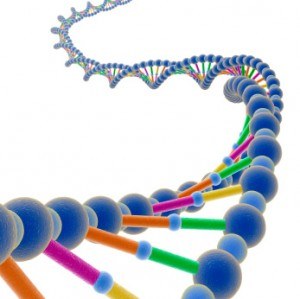
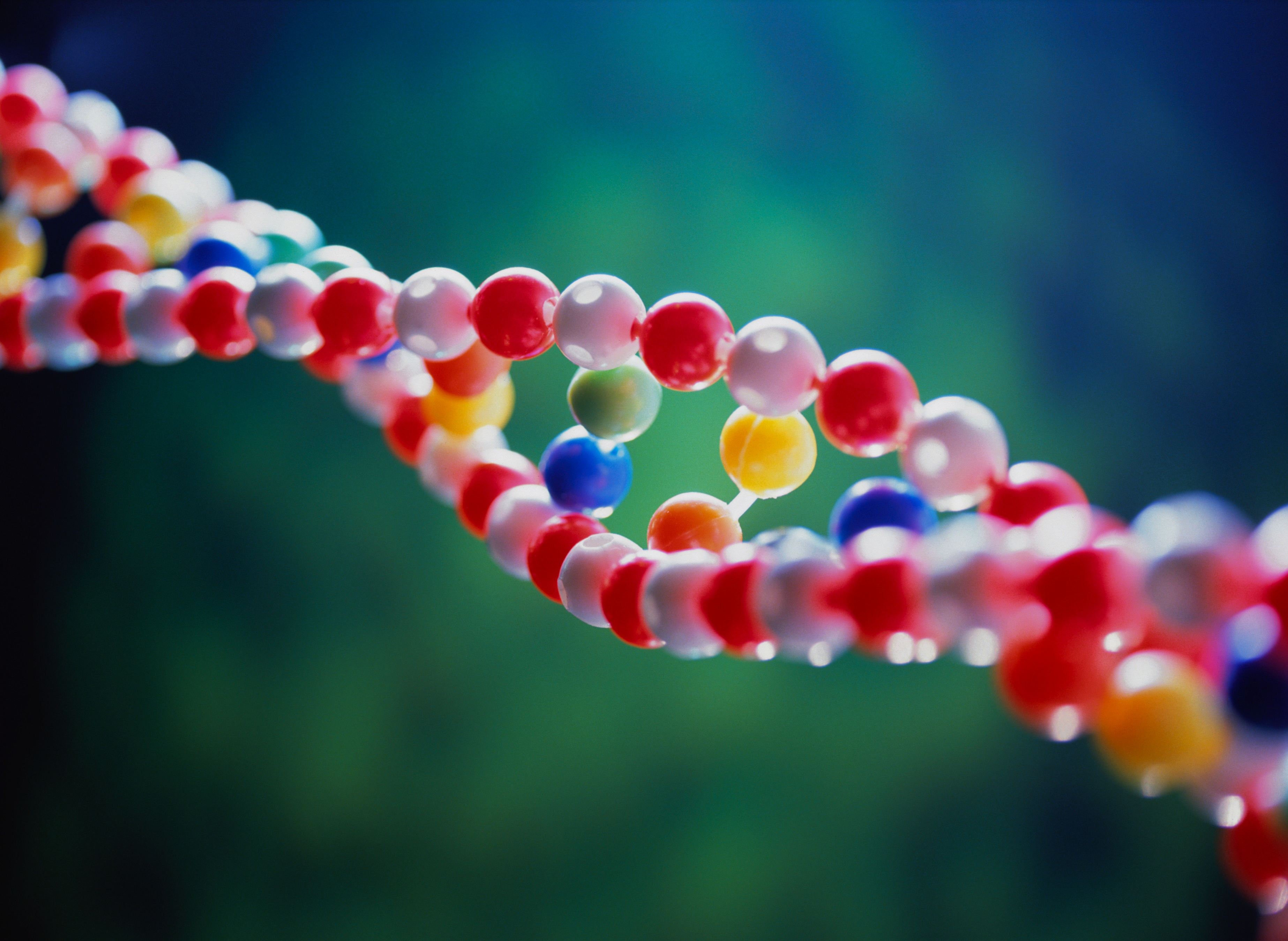
a twisted ladder

3

a twisted Christmas tree

4

a hippo in a tutu

51

Multiple Choice

What are the name of structures which contain DNA???

1

Zoneosomes

2

Colonsomes

3

Bromosomes

4

Chromosomes

52

Multiple Choice

What does DNA do?
1
a.  It carries genetic codes from parents to offspring.
2
a.  It carries oxygen from the lungs to the body.
3
a.  It tells you who you are.
4
a.  It defines the organism.

53

Multiple Choice

Question image

What makes up the SIDES of a DNA ladder?

1

nitrogen bases

2

sugars & phosphates

3

genes & chromosomes

4

RNA

54

Multiple Choice

Question image

What makes up the rungs (steps) of a DNA ladder?

1

sugars & phosphates

2

nitrogen bases

3

sugars

4

genes & chromosomes

55

Multiple Choice

Question image
Which of the following best describes a DNA molecule?
1
double helix
2
contains ribose
3
made of amino acids
4
contains Uracil

56

Multiple Choice

Question image
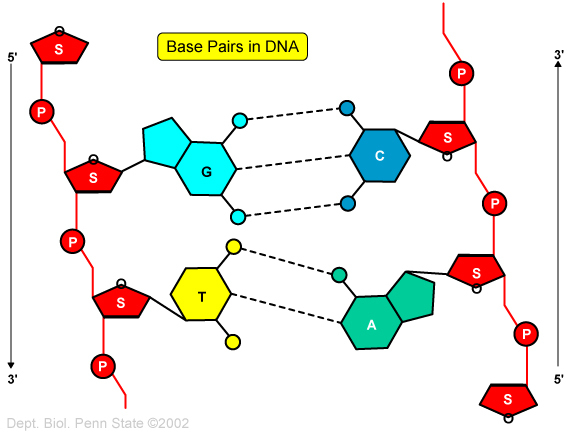
Nitrogenous bases are joined by which type of bond?
1
polar bonds
2
ionic bonds
3
covalent bonds
4
hydrogen bonds

57

Multiple Choice

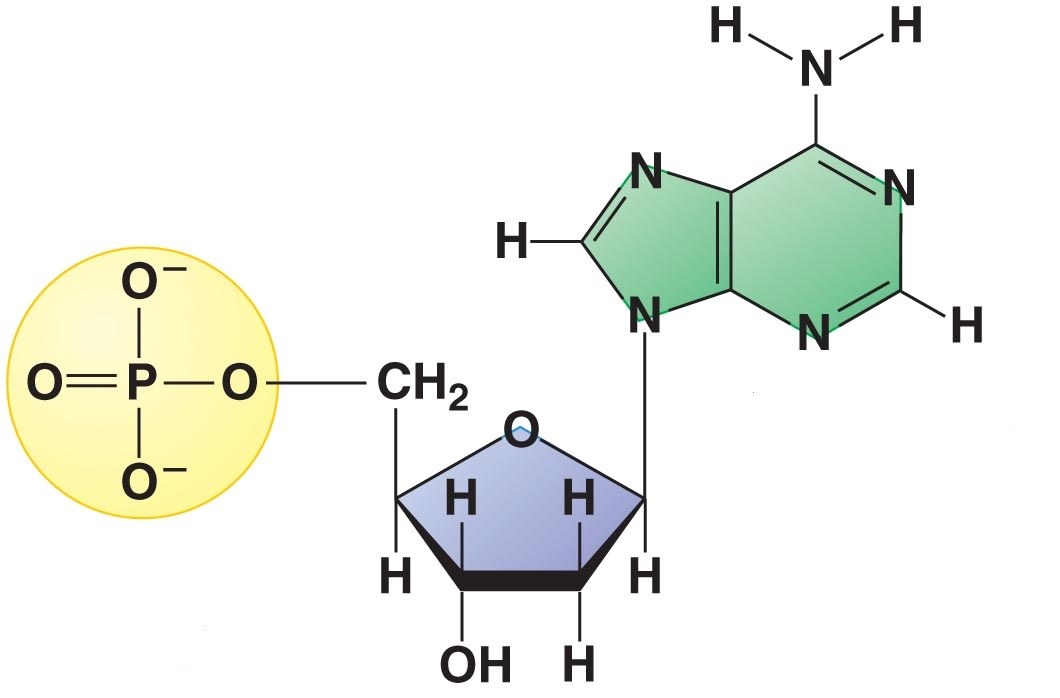
What are the three components of a nucleotide?
1
sugar, hydrogen, nitrogen base
2
sugar, oxygen, nitrogen base
3
sugar, phosphate, nitrogen base
4
sugar, phosphate, protein

58

Multiple Choice

Cytosine always pairs with
1
Adenine
2
Thymine
3
Uracil
4
Guanine

59

Multiple Choice

Question image
Name this structure
1
double helix
2
nucelotide
3
twisted ladder
4
hydrogen bond

60

Multiple Choice

Guanine bonds with ______________.
1
Adenine
2
Guanine
3
Cytosine
4
Thymine

61

Multiple Choice

What are the nucleotides made of?
1
Sugar, Phosphate, nitrogen base
2
Phosphate, Adenine, nitrogen base
3
Thymine, Adenine, Cytomine
4
Phosphate, Nitrogen, Adenine

62

Multiple Choice

What are the 4 nitrogen bases?
1
adenine, thymine, cytoplasm, and guanine
2
adenine, thymine cytosine, and guanine
3
adenine, thymine, cytosine, and gylcerol
4
adenine, thymine, cytosine, and glucose

63

Multiple Choice

Question image
Why is DNA important?
1
it is very small and very complicated
2
it's in everything
3
it serves as the blueprint for traits of all living things
4
because we eat it every day for energy

64

Multiple Choice

Which organelle is DNA usually found in?
1
cell membrane
2
vacuole
3
chloroplast
4
nucleus

65

Multiple Choice

Question image

What is a section of DNA that codes for a specific protein called?

1

RNA

2

replication

3

gene

4

protein

66

Multiple Choice

Question image

What does DNA stand for?

1

Deoxyribonucleic acid

2

Diribose nutride acidosis

3

Dinitro acid

4

Deoxynitrogenic acid

67

media

Each nucleotide contains a Phosphate, sugar, and nitrogenous base.

Some text here about the topic of discussion.

What is a nucleotide?

68

Multiple Choice

Guanine will bond with...

1

Thymine

2

Cytosine

3

Adenine

4

Uracil

69

Multiple Choice

Question image
In a molecule of double-stranded DNA, the amount of Adenine present is always equal to the amount of
1
cytosine
2
guanine
3
thymine
4
uracil

70

Multiple Choice

Which 2 molecules form the sides (backbone) of the DNA ladder?
1
deoxyribose sugar and adenine
2
deoxyribose sugar and a hydrogen bond
3
deoxyribose sugar and the nucleus
4
deoxyribose sugar and phosphate

71

Multiple Choice

The twisted ladder shape of DNA

1

double helix

2

chromatin

3

nucleotide

4

anitparallel

72

Multiple Choice

What are the proper complementary base-pairs?

1

A--T and G--C

2

G--T and A--C

3

A--G and C--T

4

A--C and T--G

73

Multiple Choice

If there is combined 60% for Cytosine and Guanine in a strand of DNA, what is the combined % for Adenine and Thymine in the same strand of DNA?

1

60

2

20

3

40

4

10

74

Multiple Choice

How many nucleotide bases are there?

1

1

2

2

3

6

4

4

75

Multiple Choice

Which 2 molecules form the sides (backbone) of the DNA ladder?
1
deoxyribose sugar and adenine
2
deoxyribose sugar and a hydrogen bond
3
deoxyribose sugar and the nucleus
4
deoxyribose sugar and phosphate
Which organelle is only found in a plant cell? 
1

nucleus

2

chloroplast

3

mitochondria

4

cell membrane

Show answer

Auto Play

Slide 1 / 75

MULTIPLE CHOICE