

Rock and Rock Cycle

Presentation
•
Science
•
6th - 8th Grade
•
Medium
Standards-aligned

Donald Mesier
Used 33+ times
FREE Resource
11 Slides • 7 Questions
1


Rock
And
Rock
Cylce
Lesson 1.2 and Lesson 1.3
2


IGNEOUS
form when hot, molten rock
crystallizes and solidifies
METAMORPHIC
High Pressure and High Temperature
SEDIMENTARY
are types of rock that are formed by the
accumulation or deposition of mineral or
organic particles at Earth's surface,
followed by cementation
There are THREE large classifications of rocks:
Igneous
Metamorphic
Sedimentary
Each type of rock is formed differently and can
CHANGE from one type to another over time
Rock is a naturally occurring solid mixture of
minerals or grains. The individual particle in a rock
are called grains.
Geologists classify igneous rocks according to texture
and mineral composition. For rocks, texture refers to
grain size and how the grains are arranged.
3

Igneous Rock
LIFESTYLE
BY SAWYER
If cooling is RAPID above the surface then the igneous rock is EXTRUSIVE ROCK
Forms when molten rock (magma) cools and hardens
If cooling is SLOW beneath the surface then the igneous rock is INTRUSIVE ROCK
Molten rock is called magma when it is inside Earth. Molten rock that erupts onto Earth's
surface is called lava. As magma or lava cools, mineral crystals begin to form.
4

Sedimentary Rock
LIFESTYLE
BY SAWYER
-Forms from the COMPACTION or CEMENTATION of rock pieces,
mineral grains, or shell fragments called sediments
Sediments are formed through the processes of weathering and erosion of rocks exposed at Earth's
surface
Sedimentary rocks can also form from the chemical depositing of materials that were once
dissolved in water
Lithification is the process through which sediment turns into rock.
Natural processes break down rocks. Rock and mineral fragments that are loose or suspended in
water are called sediment.
5
Multiple Choice
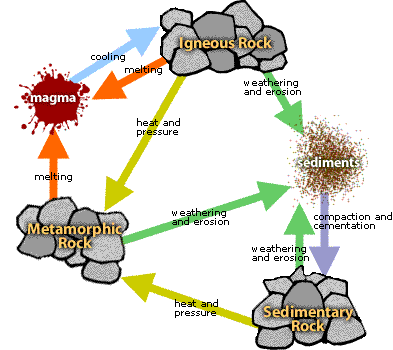
Sedimentary
Metamorphic
Extrusive Igneous
Intrusive Igneous
6
Multiple Choice

Compaction
Cementation
Weathering
Erosion
7
Multiple Choice

Granite is an example of...
Igneous
Metamorphic
Sedimentary
8

Metamorphic Rock
Metamorphic rocks form when rocks are subjected to high heat, high pressure
Foliation(foh lee AY shun) results when pressure causes flat minerals to line up, giving the rock a layered
appearance.
Crystals form in a variety of shapes. Minerals with flat shapes, such as mica, produce a foliated
texture.
Eventually distinct bands of light and dark minerals form. Foliation is the most obvious
characteristic of metamorphic rocks.
The calcite crystals that make up marble became blocklike and square when exposed to high
temperatures and pressure. Marble has a nonfoliated texture.
Marble, another type of metamorphic rock, is not foliated. The grains in marble are not flattened like
the grains in gneiss. The grains in nonfoliated rocks have a random, interlocking texture.
9


10


PROCESS OF THE ROCK CYCLE
The rock cycle has continuous, with no beginning or
end. Process on Earth's surtace, such as weathering
erosion, deposition, compaction, and cementation,
Other processes, such as those that involve extreme
temperature, pressure, and melting, take place deep
beneath Earth’s surface.
ROCK CYCLE
The series of process that continually change one
rock type into another
DIFFERENT FORMS
As materials move through the rock cycle,
they can take the torm of igneous rocks
sedimentary rocks, or metamorphic rocks. At times
the material might not be rock at all. It might be
sediment, magma, or lava.
11

When lava cools and crystallizes on
Earth's surface, the igneous rock that
forms is called extrusive rock.
When magma cools and crystallizes
inside Earth, the igneous ck that forms is
called intrusive rock.
Uplift is the process that moves large
amounts of rock up to Earth's surface and to
higher elevations. Uplift is driven by Earth's
tectonic activity and often is associated
with mountain building. This process forces
rocks onto Earth's surface.
Cooling and
Crystallization
The forming of Igneous rock
12


WEATHERING AND EROSION
Glaciers, wind, and water, along with the activities of some organisms, start to break
down exposed rocks called weathering . The same glaciers, wind, and water also carry
sediment to low-laying areas, called basins, by the process of erosion.
DEPOSITION
The process of laying down sediment in a new location is called deposition. Deposition forms
layers of sediment. As time passes, more and more layers aredeposited.
COMPACTION AND CEMENTATION
The weight of overlying layers of sediment pushes the grains of the bottom layers
closer together. This process is called compaction. Sedimentary rocks have tiny
spaces, called pores, between the grains. Pores sometimes contain water and
dissolved minerals. When these minerals crystallize, they cement the
grains together, process is called cementation
13


Metamorphism occurs when rocks are
subjected to high temperature and
pressure. This usual occurs far below
Earths surface
Temperature
and Pressure
The rocks slate, phyllite, schist, and gneiss
form from shale with increasing temperature
and pressure. If the temperature is high
enough, the rock melts and becomes magma.
Shale
Slate
Phyllite
Schist
Gneiss
Increasing temperature and pressure
Temperature and Pressure
14


Plates tectonics states that Earth's surface is broken into
rigid plates. The plates move as a result of Earth's internal
thermal energy and convection in the mantle.
The theory explains the movement of continents. It also
explains earthquakes, volcanoes, and the formation of
new crust. These events occur at plate boundaries,
where tectonic plates interact.
Rock and Plate Tectonics
Processes within Earth that move tectonic
plates also drive parts of the rock cycle,
The theory explains the movement of
continents. It also explains earthquakes,
volcanoes, and the formation of new crust.
These events occur at plate boundaries, where
tectonic plates interact.
15
Multiple Choice

Which process is best illustrated by the diagram?
igneous rock formation
sedimentary rock formation
igneous rocks changing into metamorphic rocks
sedimentary rocks changing into metamorphic rocks
16
Multiple Choice

erosion
weathering
sediments
17
Multiple Choice
This type of rock forms from other rocks that have been changed by heat or pressure
Igneous
Basalt
Sedimentary
Metamorphic
18
Multiple Choice
A metamorphic rock changes into an igneous rock by what two processes?
Melting and cooling
Extreme heat and pressure
Compaction and cementation
Weathering and erosion
Rock
And
Rock
Cylce
Lesson 1.2 and Lesson 1.3
Show answer
Auto Play
Slide 1 / 18
SLIDE
Similar Resources on Wayground

14 questions
Homologous Structures and Superposition
Presentation
•
6th - 8th Grade
14 questions
Pangaea Introduction
Presentation
•
6th - 8th Grade
13 questions
Geology of Mars
Presentation
•
6th - 7th Grade
15 questions
Listening to Earth
Presentation
•
7th Grade
16 questions
Human Impact on Water
Presentation
•
7th Grade
12 questions
Geologic Time
Presentation
•
7th Grade
12 questions
Weathering and Erosion: B.H
Presentation
•
6th - 8th Grade
12 questions
Matter and Energy in the Earth's System
Presentation
•
6th - 8th Grade
Popular Resources on Wayground
10 questions
How much do you know about our Portrait of an Eagle?

Quiz
•
10th Grade
10 questions
Fast Food Slogans
Quiz
•
6th - 8th Grade
21 questions
Continents and Oceans
Quiz
•
6th Grade
20 questions
Parts of Speech
Quiz
•
5th Grade
16 questions
Subject & Predicate
Quiz
•
5th Grade
25 questions
Multiplication Facts
Quiz
•
5th Grade
12 questions
Map Skills
Quiz
•
3rd Grade
22 questions
Continents and Oceans
Quiz
•
5th Grade
Discover more resources for Science
17 questions
7.6D Aqueous Solutions
Quiz
•
7th Grade
20 questions
Scientific Method and Variables
Quiz
•
8th Grade
20 questions
Scientific method and variables
Quiz
•
8th Grade
27 questions
Counting Atoms - Subscripts
Quiz
•
8th Grade
10 questions
6.6D - Relative Density Review
Quiz
•
6th Grade
20 questions
Claim, Evidence and Reasoning (CER)
Quiz
•
6th - 8th Grade
18 questions
Counting Atoms
Quiz
•
7th - 8th Grade
20 questions
Density
Quiz
•
6th Grade