Search Header Logo
Earth and Season

Earth and Season

Assessment

Presentation

Science

9th Grade

Medium

NGSS
MS-ESS1-1, MS-ESS2-6, MS-PS2-4

+1

Standards-aligned

Created by

Meredith Wilson

Used 3+ times

FREE Resource

17 Slides • 15 Questions

1

media

Earth Motions and Tilt

2

Multiple Choice

Question image

What is the tide with the LEAST DIFFERENCE between high and low tide?

1

Neap Tide

2

Tides

3

Lake

4

Spring tide

3

Multiple Choice

Question image

Wobbling around the processional axis

1

Revolution

2

Tide

3

Nutation

4

Universe

4

Multiple Choice

Question image

What angle is earths tilt at

1

23.5

2

6

3

990

4

29.6

5

Multiple Choice

Question image

Keplers laws explained

1

gravity

2

planets motion

3

mass

4

medicine

6

media
media

Earth’s Circumference

Erastosthenes determined the earth’s

circumference was 46,250 km

At the equator = 40,074 km
At the poles = 40,007 km

7

media
media

Earth’s Shape

Oblate spheroid
Spherical: slightly

flattened at the poles
and bulges at the
equator.

As Earth rotates, the

sphere is distorted by
centrifugal force.
Causes objects to move

outwards from the
center

Greatest at the equator

8

media
media

Axis

An imaginary line that runs through the

earth from the north pole to the south
pole.

The earth rotates (spins) on its axis.

9

media
media

Tilt

The earth is tilted at

23.5°

10

media
media

Coordinate system- a system of intersecting lines
used to determine locations on the Earth’s surface

11

media

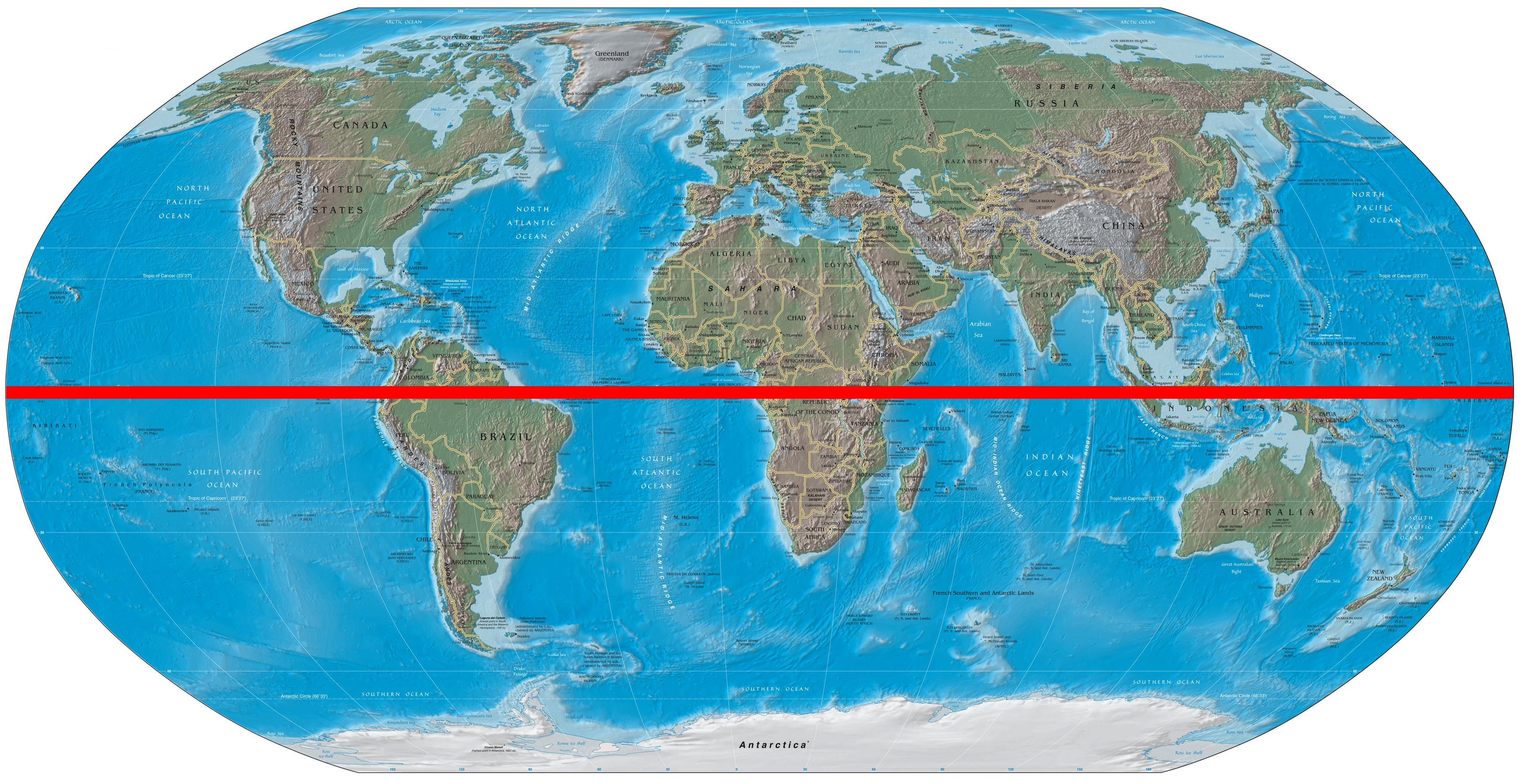
Latitude

Latitude: Measures distance North and South

of the Equator

Parallels: imaginary lines that run E to W

12

media

13

media

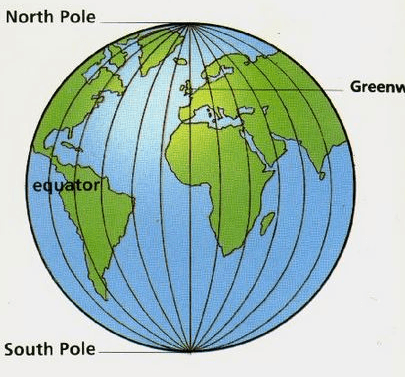
Longitude

Longitude: Measures distance in degrees east

and west of the Prime Meridian.

Meridians: lines of longitude

14

Multiple Choice

Question image
Europe, Asia and North America are in what hemisphere?
1

Northern

2

Southern

3

Western

4

Eastern

15

Multiple Choice

Question image
What is the name of this line at 0 degrees latitude?
1

Prime Meridian

2

Equator

3

North Pole

4

South Pole

16

Multiple Choice

Question image
1

The map show the lines of longitude.

2

The map shows the lines of latitude.

17

Multiple Choice

The invisible line at 0 degrees longitude is called the _________.
1

International Date Line

2

Prime Meridian

3

Equator

4

Antarctic Circle

18

Multiple Choice

Latitude and Longitude lines are measured in __________.
1

inches

2

miles

3

degrees

4

ounces

19

Multiple Choice

To locate the exact places on Earth, one must look at: 
1

latitude lines only

2

the intersecting lines of latitude and longitude

3

longitude lines only

4

a neighboring area to describe the location

20

media

21

media
media
media

Earth’s Movement

Rotation: spinning

motion of the earth.
24 hours for one
rotation (1 day).

Revolution:

movement of the
earth around the sun.
365 1/4 days (1 year)

22

media

EARTH 'Movement Part 2

Precession:The slight movement of Earth’s

axis over 26,000 years.

Diurnal motion of stars: It is the motion of

the sky due to Earth's daily rotation. Stars
and other celestial bodies appear to move
from east to west. The axis of this apparent
motion coincides with Earth's axis of rotation.

23

media

Earth’s Movement Part 3

Nutation

–the wobble

Change in the angle of the axis (1/2 degree)

Barycenter
The point between two objects where they balance each other.

24

media
media

Reason #1: # of daylight hours

The amount of sunlight varies throughout the

year. The tilt of the earth means no two
latitudes get the same amount each day.

In the summer you have more hours of

sunlight and fewer in the winter.

25

Multiple Choice

Why do we experience the changing of the season on the earth?
1

distance from the sun

2

rotation of the earth

3

change in solar output

4

tilt of the earth's axix

26

Multiple Choice

What does the rotation of the earth cause us to experience?
1

seasons

2

year

3

day & night

4

eclipse

27

Multiple Choice

What season is when the north pole is tilted toward the sun?
1
summer
2
winter
3
fall
4
spring

28

Multiple Choice

When is the winter solstice?
1

December

2

June

3

March

4

September

29

Multiple Choice

Because of the direction that the Earth rotates on it's axis, what direction does the sun rise every day?
1

north

2

south

3

east 

4

west

30

media
media

Reason #2: Angle of sunlight

The angle of the sun’s rays cause different

intensities, this is also caused by the tilt of the
earth.

31

media

Equinoxes

Vernal Equinox: March 21-22
Autumnal Equinox: Sept. 21-22
12 hours of daylight/12 hours of darkness
The sun is directly overhead at the equator

32

media

Solstices

Summer Solstice

June 21-22
Longest day of the year in the N. Hemisphere
The sun is directly overhead at the Tropic of

Cancer.

Winter Solstice

December 21-22
Shortest day of the year in the N. Hemisphere
The sun is directly overhead at the Tropic of

Capricorn.

media

Earth Motions and Tilt

Show answer

Auto Play

Slide 1 / 32

SLIDE