Search Header Logo
Unit 4 Lesson 2 - Plate Tectonics

Unit 4 Lesson 2 - Plate Tectonics

Assessment

Presentation

Science

6th Grade

Medium

NGSS
MS-ESS1-2, MS-ESS2-3, MS-ESS2-2

+19

Standards-aligned

Created by

Jesse Jayne

Used 34+ times

FREE Resource

23 Slides • 33 Questions

1

Unit 4 Lesson 2: Plate Tectonics

media

By the end of this lesson, you will be able to explain the theory of plate tectonics, describe how tectonic plates move, and identify geologic events that occur because of tectonic plate movement.

What is plate tectonics?

2

Multiple Choice

True or False: Earth's surface is all one piece.

1

True

2

False

3

Multiple Choice

True or False: Scientists think the continents once formed a single landmass.

1

True

2

False

4

Multiple Choice

True or False: The sea floor is smooth and level.

1

True

2

False

5

Multiple Choice

True or False: All tectonic plates are the same.

1

True

2

False

6

Plate Tectonics Vocabulary

-Convergent Boundary

-Divergent Boundary

-Transform Boundary

-Convection

-Pangea

-Sea-Floor Spreading

-Plate Tectonics

-Tectonic Plates

​What connections can you make from these words or their parts?

7

8

9

Open Ended

What causes earthquakes?

10

  • Alfred Wegner - Continental Drift

  • Common Fossil Species

  • Mountain Ranges and Climactic Conditions

What evidence suggests that continents move?

media

11

The Theory of Continental Drift

In 1915, a German scientist named Alfred Wegener (VAY-guh-ner) proposed the theory of continental drift. According to this theory, the landmasses once were joined into a supercontinent called Pangaea. The landmasses then slowly drifted to their current positions.


media
media

12

13

Open Ended

How did North America form from Pangea?

(Hint: page 203)

14

media

-Wegner's ideas initially dismissed.

-Mapping of sea floor lead to the discovery of mid-ocean ridges.

-This brought validity to the theory of plate tectonics.

-Revealed the youngest rock is closest to the ridge and the oldest was farther away.

What discoveries support the idea of Continental Drift?

15

Open Ended

Why would many scientists not accept the hypothesis of continental drift?

16

-Scientists discover magnetic patterns on sea floor match equidistant on the ridge from both sides.

-This proposed the idea of sea-floor spreading.

-As the sea floor moves moves, so do the continents on the same piece of crust.

media

17

18

Open Ended

Question image

Why is Earth not getting larger if the sea floor is spreading?

19

What about the Old Ocean Floor?

  • Old ocean floor moves edges of continents

  • Trenches push ocean floor back to mantle

  • RECYCLED!

  • SUBDUCTION: crust pushing down into the mantle

media

20

21

Open Ended

Question image

What is true about the ages of rocks on either side of a mid-ocean ridge?

22

The lithosphere is broken into Tectonic Plates

  • The lithosphere is made from the crust and the uppermost part of the mantle

  • The lithosphere is rigid, brittle rock

  • These plates float on the asthenosphere

media

23

What Causes the Plates to Move on the Asthenosphere?

  • Heat from within the mantle rises, cools as it reaches the top, and falls back down.

  • This concept, Convection, slowly moves the plates on top to move.

media

24

media

25

Earth Sciences: Plate Boundaries

In the theory of plate tectonics, the earth's crust is broken into plates that move around relative to each other. As a result of this movement, three types of plate boundaries are formed: divergent, convergent, and transform boundaries.

media

26

media

27

Divergent Boundaries

Divergent boundaries are boundaries where plates pull away from each other, forming mild earthquakes and volcanoes as magma comes to the surface.

media

28

Convergent Boundaries

Convergent boundaries are boundaries where two plates are pushing into each other. They are formed when two plates collide, either crumpling up and forming mountains or pushing one of the plates under the other and back into the mantle to melt.

media

29

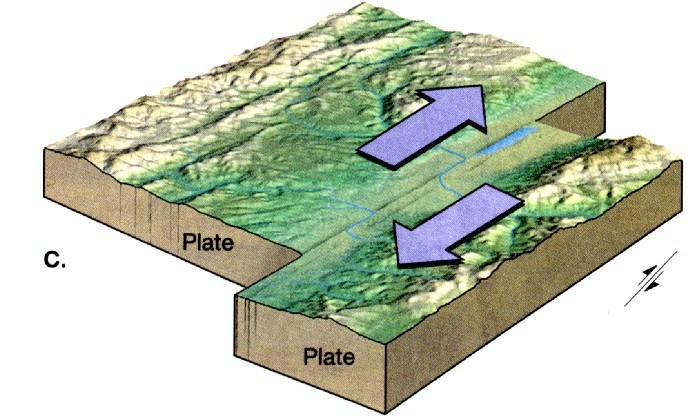
Transform Boundaries

The third type is transform boundaries, or boundaries where plates slide past each other, forming strong earthquakes. All of this crashing, banging, and erupting are one reason why the surface of the earth has such a variety of landforms and features.

media

30

Ridge Push

force created by rising mantle of ocean ridges that creates potential for plates to move away from the ridge

media

31

Slab Pull

force created by sinking of a plate, or slab, that pulls on the rest of the plate

media

32

Let's Review!!!

33

Multiple Choice

Wegener had evidence to support his Theory of Continental Drift.  Which of these are pieces of evidence he had:

1

The continents seem to fit together like puzzle pieces (matching coastlines)

2

The similar rocks and rock layers on the coasts of continents that match up

3

all of these

4

Fossils records also support similar species found on matching coastlines

34

Multiple Choice

Question image

The Wegener's theory that the continents have not always been in their present locations but have moved there over millions of years

1

Continental Drift Theory

2

Plate Tectonics

3

Alfred Wegener

4

Lystrasaurus

35

Multiple Choice

Scientists hypothesize that a super continent existed 200 million years ago.  This continent is called
1

America

2

Super Earth

3

Pangea

4

Eurasia

36

Multiple Choice

What are the two types of crust
1

continental and oceanic

2

ocean and upper

3

lower and upper

4

pizza and subway

37

Multiple Choice

Question image

A block of lithosphere that consists of the crust and the rigid, outermost part of the mantle.

1

tectonic plate

2

continent

3

crust

4

mantle

38

Multiple Choice

Question image
What type of plate boundary is this?
1

Transform

2

Convergent

3

Divergent

4

Plate

39

Multiple Choice

What are the two types of crust
1

continental and oceanic

2

ocean and upper

3

lower and upper

4

pizza and subway

40

Multiple Choice

Question image

What geologic feature/event would you most likely to find at a divergent boundary between two pieces of oceanic crust?

1

Rift Valley

2

Mid-Ocean Ridge

3

Island Arc

4

Flat land

41

Multiple Choice

Subduction:
1

Divergent

2

Convergent

3

Transform

42

Multiple Choice

Moves away from:
1

Divergent

2

Convergent

3

Transform

43

Multiple Choice

Moves together:
1

Divergent

2

Convergent

3

Transform

44

Multiple Choice

Can produce earthquakes
1

Divergent

2

Convergent

3

Transform

4

Actually, all of them

45

Multiple Choice

Sliding past:
1

Divergent

2

Convergent

3

Transform

4

Actually, all of them

46

Multiple Choice

Creates volcanoes on land:
1

Divergent

2

Convergent

3

Transform

4

Actually, all of them

47

Multiple Choice

Recycles old crust:
1

Divergent

2

Convergent

3

Transform

4

Actually, all of them

48

Multiple Choice

Upwelling of magma:
1

Divergent

2

Convergent

3

Transform

4

Actually, all of them

49

Multiple Choice

The Pacific is getting wider due to this plate boundary:

1

Convergent

2

Divergent

3

Transform

4

Subduction

50

Multiple Choice

Question image
When two tectonic plates are moving toward each other, the boundary between them is called...
1

Divergent boundary

2

Convergent boundary

3

Transform boundary

4

Subduction

51

Multiple Choice

Question image
When two tectonic plates slide past each other, neither crashing together, nor pulling apart, the boundary between them is called...
1

Divergent boundary

2

Convergent boundary

3

Transform boundary

4

Subduction

52

Multiple Choice

Question image
Sometimes, when two tectonic plates collide, one is pushed below the other; this action at the convergent boundary is called...
1

Divergent boundary

2

Convergent boundary

3

Transform boundary

4

Subduction

53

Multiple Choice

Question image

When convergent plates collide, if both plates are pushed upward, this forms.

1

Fissures

2

Mountain Ranges

3

Volcanoes

4

Rock Cycle

54

Multiple Choice

Question image

The area where two or more plates meet is called a __________________.

1

fault

2

plate boundary

3

plate edge

4

ring of fire

55

Multiple Choice

The Himalayan mountains and Mt. Everest can be found at this plate boundary.
1

Convergent

2

Divergent

3

Transform

56

Multiple Choice

Question image

What are the 3 kinds of plate boundaries?

1

convergent. divergent, constructive

2

transform, destructive,

convergent

3

convergent, destructive, divergent

4

transform, divergent, convergent

Unit 4 Lesson 2: Plate Tectonics

media

By the end of this lesson, you will be able to explain the theory of plate tectonics, describe how tectonic plates move, and identify geologic events that occur because of tectonic plate movement.

What is plate tectonics?

Show answer

Auto Play

Slide 1 / 56

SLIDE