

Plate tectonics

Presentation
•
Science
•
4th Grade
•
Practice Problem
•
Hard
+4
Standards-aligned

Turkan Mahmudova
Used 17+ times
FREE Resource
18 Slides • 29 Questions
1

2
The system of ideas behind plate tectonics theory suggests that Earth's outer shell (lithosphere) is divided into several plates that glide over the Earth's rocky inner layer above the soft core (mantle)

3
Our earth moves! We have many pieces of evidence for this some we can even feel; like earthquakes. So what is causes the movement? Magma! Deep in the Earth, molten rock churns as it heats and cools in convection currents. This moves the crustlike plates on top, and even creates and new and destroys old plates. *VIDEO TIME*

4
5

6
The crust is the thinnest & least dense layer: oceanic crust is THINNER but MORE DENSE than continental crust! The crust is made of igneous rock containing a lot of silicon and oxygen.
The Mantle is the middle layer. It is hot softened rock containing iron and magnesium.
The outer core is a very hot liquid. It is made of iron and nickel.
The inner core is also made of iron and nickel, but solid

7
Lithosphere - crust + uppermost part of mantle = cool, brittle, solid rock. Broken into pieces called tectonic plates
Asthenosphere: Hot softened rock with areas of melt. Moves slowly: a solid that behaves like a liquid! "Plasticity"
Mesosphere - lower part of the mantle
Outer Core - hot liquid that churns - this generates electrical currents that in turn create Earth's magnetic field!
Inner Core - spinning solid: most dense layer!

8
The lithosphere is broken into tectonic plates
These plates are not connected - they move slowly around the surface of the earth
The plates float on top of the asthenosphere

9
Multiple Choice
The lithosphere includes the _____ and part of the _____.
core, crust
mantle, core
crust, core
crust, mantle
10
Multiple Choice

As you travel from the inner core to the crust, how would temperature, pressure and density of the material change?
The would all increase
The would all decrease.
Nothing, the layers are made of the same material throughout
Temperature would decrease, but pressure and density would increase
11
Multiple Choice
outer core
inner core
mantle
crust
12
Multiple Choice
solid rock
solid metal
melted rock
melted metal
13
Multiple Choice
inner core
outer core
mantle
crust
14
Multiple Choice
Mesosphere
Asthenosphere
Mantle
Lithosphere
15
Multiple Choice
Crust
Mantle
Outer Core
Inner Core
16
17
Multiple Choice
What is the name of the 225 million year old super continent?
Pancake
Pangea
Super Continent Sam
Albert Einstein
18
Multiple Choice
How first identified the theory of plate tectonics and Pangea?
Albert Einstein
Patrick Henry
Alfred Wegener
Mr. Harris
19
20
Multiple Select
What are two pieces of evidence that support the theory of plate tectonics?
Matching rocks/fossils on different continents
Landscapes that look alike
The same species live in different areas today
Seafloor Spreading
21
22
Multiple Choice
The lithosphere is one smooth, solid shell around the Earth.
True
False
23
24
Multiple Choice
In convection currents, hot material ______ and then cool material _____.
1) Rises
2) Sinks
1) Sinks
2) Rises
25
26
Multiple Choice
Convergent boundaries occur when:
Two plates pull apart
Two plates collide
Two plates scrape/slide past each other
27
Multiple Choice
Divergent boundaries occur when:
Two plates pull apart
Two plates collide
Two plates scrape/slide past each other
28
Multiple Choice
Transform boundaries occur when:
Two plates pull apart
Two plates collide
Two plates scrape/slide past each other
29
30
Multiple Choice
Subduction zones occur when:
Two plates collide at and convergent boundary and one sinks
Two plates collide at a convergent boundary and they push each other up
Two plates pull apart at a divergent boundary
31
Multiple Choice
Seafloor spreading occur when:
Two plates collide at and convergent boundary and one sinks
Two plates collide at a convergent boundary and they push each other up
Two plates pull apart at a divergent boundary
32
Multiple Choice
Mountain building occurs when:
Two plates collide at and convergent boundary and one sinks
Two plates collide at a convergent boundary and they push each other up
Two plates pull apart at a divergent boundary
33
34
Multiple Choice
Alfred Wegener's Theory of Plate Tectonics was laughed at initially, but is now believed by the scientific community.
True
False
35
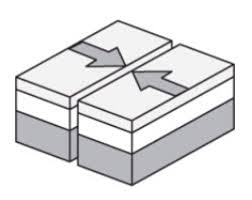
Collide (crash into eachother)
Create mountains, trenches, volcanoes
Destroys crust during subduction

36
At a convergent boundary, plates collide. Heavier (more dense) oceanic crust goes under and melts into the mantle. This destroys the crust.

37
Multiple Choice
How do plates move at CONVERGENT boundaries?
Collide (together)
Move apart
Slide past each other
38
Multiple Choice
How do CONVERGENT boundaries affect the crust?
They create crust
They destroy crust
They don't destroy or create
39
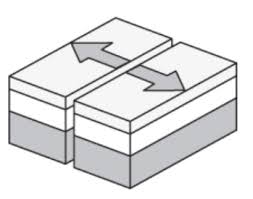
Plates move apart
Creates mid - ocean ridges and rift valleys
Creates new crust through Seafloor Spreading

40
Multiple Choice
How do plates move at DIVERGENT boundaries?
Collide (together)
Move apart
Slide past each other
41
Multiple Choice
How do DIVERGENT boundaries affect the crust?
They create crust
They destroy crust
They don't destroy or create
42
Multiple Choice
What type of boundary occurs when two tectonic plates separate?
divergent
convergent
transform
43
Multiple Select
Which tectonic plate(s) can cause earthquakes? Choose all that would.
Converging
Diverging
Transforming
44
Multiple Choice
45
Multiple Choice

what is this ????
transform
divergent
convergent
46
Multiple Choice
47
Multiple Choice
Show answer
Auto Play
Slide 1 / 47
SLIDE
Similar Resources on Wayground

38 questions
Author's Purpose Review
Presentation
•
5th Grade
43 questions
Living Things in the Biosphere
Presentation
•
6th Grade
42 questions
Chapter 9 Science Test Study Guide
Presentation
•
6th Grade
40 questions
Earthquakes
Presentation
•
4th Grade
43 questions
Science SOL Review
Presentation
•
4th - 5th Grade
42 questions
5th Grade Planets Lesson
Presentation
•
5th Grade
38 questions
Unit 2 Lesson 1 Amplify Science
Presentation
•
5th Grade
47 questions
Q1: Weather Review
Presentation
•
5th Grade
Popular Resources on Wayground
10 questions
How much do you know about our Portrait of an Eagle?

Quiz
•
10th Grade
10 questions
Fast Food Slogans
Quiz
•
6th - 8th Grade
21 questions
Continents and Oceans
Quiz
•
6th Grade
20 questions
Parts of Speech
Quiz
•
5th Grade
16 questions
Subject & Predicate
Quiz
•
5th Grade
25 questions
Multiplication Facts
Quiz
•
5th Grade
12 questions
Map Skills
Quiz
•
3rd Grade
22 questions
Continents and Oceans
Quiz
•
5th Grade
Discover more resources for Science
10 questions
Mixtures and Solutions
Quiz
•
4th Grade
20 questions
Force and Motion
Quiz
•
3rd - 4th Grade
14 questions
Scientific Method
Quiz
•
4th Grade
10 questions
Mixtures and Solutions
Quiz
•
4th Grade
10 questions
Identifying Physical and Chemical Changes

Interactive video
•
1st - 5th Grade
22 questions
Properties of Matter
Quiz
•
4th Grade
11 questions
Energy Transferring
Quiz
•
4th Grade
10 questions
Discovering the Properties of Matter
Interactive video
•
1st - 5th Grade