Climate Test Remediation
Presentation
•
Science
•
6th Grade
•
Medium
+4
Standards-aligned
LYDIA COTE
Used 8+ times
FREE Resource
11 Slides • 34 Questions
1
2
3
Multiple Choice
1. The map illustrates winter conditions in Washington state. Which of the following MOST likely describes climate conditions at POINT X?
A. Dry Weather
B. Frequent Rainfall
C. High Winds & Clear Skies
D. Extreme Cold and Low Humidity
4
Multiple Choice
This side of the mountain is where the wind originates and evaporation occurs
windward
leeward
rain shadow
prevailing winds
5
Multiple Choice
What landform causes the rain shadow effect?
Mountains
Lakes
Plains
Valleys
6
Multiple Choice
On the leeward side of a mountain, you might find _____.
Heavy rainfall
Desert
More vegetation
More snow
7
8
Multiple Choice
7. Which of these best explains the cause of convection currents in Earth's atmosphere?
A. Heat from Earth's core heats the land only at the equator.
B. Glaciers movign from the poles cool Earth unevenly.
C. Sunlight is more concentrated in some places on Earth than others.
D. The light and heat reflected from the Moon varies as the Moon changes phases.
9
10
Multiple Choice
8. Fill in the blank: Unequal heating of the Earth creates Convection Currents due to Earth's ____________.
Rotation
Revolution
Tilt
Longitude
11
12
Multiple Choice
Where can we find convection currents happening on Earth?
Ocean and Land Currents
Atmospheric & Wind Currents
Land and Atmospheric Currents
Atmospheric & Water Currents
13
Multiple Choice
Convection currents occur when ______________________ energy transfers between a fluid.
potential
kinetic
thermal/heat
electric
14
Multiple Choice
Heat flow (convection current) in the ocean and the atmosphere is...
cool flows down - warm flows up
cool flows up - warm flows down
cool flows up - warm flows up
cool flows down - warm flows down
15
Multiple Choice
Ocean currents are created by
Dense cold water sinking
Dense cold water rising
Less dense water sinking
Less dense warmer water rising and more dense cold water sinking
16
Multiple Choice
conduction current
radiation
condition current
convection current
17
Multiple Choice
All locations on the planet do NOT heat evenly.
Where would we expect to find warmer areas on Earth?
Near the equator
Near the poles
18
Multiple Choice
What parts of the planet would be cooler?
Near the equator
Near the poles
19
20
Multiple Choice
11. In the centers of North America and Asia, large regions of land have relatively dry climates. This lack of rainfall results mainly from which factor?
The centers of these continents have too few lakes and rivers for effective evaporation.
The centers of these continents receive little heat from sunlight over most of the year.
The rate of air mass movement over the centers of these continents are relatively low.
The distance from oceans prevents moist air from reaching the centers of these continents.
21
22
Multiple Choice
18. St. Augustine, Florida and San Antionio, Texas are located near the equator near the same latitude. However, average winter temperatures in St. Augustine are higher than in San Antionio. What most influences the milder temperatures of St. Augustine, Florida.
Increased cloud cover
Reduced solar radiation
Distance North of Equator
Nearness to ocean currents
23
24
Multiple Choice
The map shows temperatures on an October day in the United States. Which best explains why Florida has warmer temperatures, on average, than other locations.
Florida is closer to sea level than inland areas.
Sunlight shines more directly on Florida for more hours each day.
Heat energy is transferred to land becuase ocean currents pass so close to Florida.
Season change takes place later in the year becuase Florida is closer to the equator.
25
26
Multiple Choice
Which statement best explains an aspect of differential heating of Earth's surface by the Sun?
Liquids and solids absorb and store heat differently.
Photons interact differentlu with solids and liquids.
The atmosphere over the ocean is different than the atmosphere over land.
Photosynthesis in the oceans uses more solar energy than photosynthesis on land.
27
28
Multiple Choice
The oceans cover more of Earth's surface than land does, and that partially explains why Earth's surface is not uniformly heated by the Sun. Which statement accuratly explains how oceans and land absorb and retain Sun's energy?
Alhtough land absorbs energy faster, oceans store more energy than land.
More energy is absorbed and stored by land than by oceans.
Although oceans absorb more energy than land, land stores more energy than oceans.
Although land absorbs energy slower, oceans store more energy than land.
29
Multiple Choice
What is the source of energy that heats our planet's atmosphere and oceans?
the weather
the wind
the Sun
the Earth's core
30
Multiple Choice
Why does the Earth experience unequal heating?
The oceans are not equally distributed around the Earth.
The Earth's revolution brings it closer to the Sun at certain points during the year.
The Earth's axis is tilted.
The atmosphere is not equally distributed around the Earth.
31
Multiple Choice
What causes convection cells in the Earth's atmosphere?
Different amounts of direct sunlight at each latitude
The spinning of Earth
Being closer to or farther away from the sun
Different amounts of living things below the atmosphere
32
Multiple Choice
Which statement about Earth's heating patterns is TRUE?
The rate of cooling depends on the season.
Large bodies of water cool more quickly than land.
Land heats and cools more quickly than large bodies of water.
Land and large bodies of water cool at the same rate.
33
Multiple Choice
warmer
cooler
coolest
warmest
34
Multiple Choice
Patterns of winds moving around the globe created by unequal heating of the Earth’s surface
Wind
Land Breeze
Global Winds
Jet Stream
35
Multiple Choice
Ocean currents are created by
Dense cold water sinking
Dense cold water rising
Less dense water sinking
Less dense warmer water rising and more dense cold water sinking
36
37
Multiple Choice
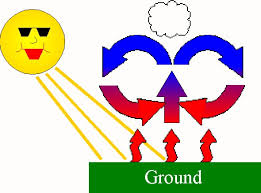
What is this modeling?
Conduction
Convection Currents
Radiation
Coriolis Effect
38
Multiple Choice
What is this modeling?
Conduction
Convection Currents
Radiation
Coriolis Effect
39
Multiple Choice
What is this modeling?
Conduction
Convection Currents
Radiation
Coriolis Effect
40
Multiple Choice
What is this modeling?
Conduction
Convection Currents
Radiation
Coriolis Effect
41
Multiple Choice
Convection
Electromagnetic waves
Radiation
Conduction
42
Multiple Choice
conduction
convection
radiation
Insolation
43
Multiple Choice
conduction
convection
radiation
44
Multiple Choice
conduction
convection
radiation
45
Multiple Choice
conduction
convection
radiation
Show answer
Auto Play
Slide 1 / 45
SLIDE

Similar Resources on Wayground
40 questions
Unit 3: Watersheds Review
Presentation
•
6th Grade
40 questions
Potential and Kinetic Energy
Presentation
•
7th Grade
40 questions
5th Science - Matter
Presentation
•
5th Grade
40 questions
7U4L4a Renewable Resources
Presentation
•
7th Grade
38 questions
Severe Weather
Presentation
•
6th Grade
39 questions
Limiting Factors
Presentation
•
6th - 7th Grade
36 questions
Chemistry Foundations OL Review
Presentation
•
6th Grade
38 questions
#4 Methods of Heat Transfer Lesson
Presentation
•
6th Grade
Popular Resources on Wayground
19 questions
Naming Polygons
Quiz
•
3rd Grade
10 questions
Prime Factorization
Quiz
•
6th Grade
20 questions
Math Review
Quiz
•
3rd Grade
15 questions
Fast food
Quiz
•
7th Grade
20 questions
Main Idea and Details
Quiz
•
5th Grade
20 questions
Context Clues
Quiz
•
6th Grade
20 questions
Inferences
Quiz
•
4th Grade
19 questions
Classifying Quadrilaterals
Quiz
•
3rd Grade
Discover more resources for Science
16 questions
Interactions within Ecosystems
Presentation
•
6th - 8th Grade
20 questions
Rocks and The Rock Cycle
Quiz
•
6th Grade
20 questions
Moon Phases and Eclipses
Quiz
•
6th - 8th Grade
20 questions
Human Body Systems
Quiz
•
6th Grade
22 questions
6th & 8th Grade Science Material SOL Review
Quiz
•
6th - 8th Grade
15 questions
Punnett Squares
Quiz
•
6th Grade
20 questions
Cells! Cell Theory and Characteristics of Eukaryotes/Prokaryotes
Quiz
•
6th Grade
35 questions
Amplify Weather Patterns Unit Review
Quiz
•
6th Grade