

Electricity Review

Presentation
•
Physics
•
11th Grade
•
Medium
+2
Standards-aligned

Thomas Pickett
Used 3+ times
FREE Resource
33 Slides • 32 Questions
1

Unit 6
2
3
Charge is a property of matter
positive -- protons
negative -- electrons
neutral -- neutrons
Like charges repel.
Unlike charges attract.
All charged objects are attracted to neutral objects.
4
Electricity is the motion of electrons
Static electricity is the motion of electrons all at once
Current electricity is the continuous motion of electrons.
5
Conductors -- allow electrons to flow easily
usually metals
Best: silver
Others: copper, gold, aluminum
6
Insulators
Insulators do not allow charge to flow. Any charge added stays on the surface.
Examples: rubber, styrofoam, plastics
7
Conduction
To charge by conduction, use friction to physically remove electrons from one object and move to the other object.
Examples: rubbing a balloon on your head, rubbing the rod with rabbit fur.
8
Polarization
Charged objects are attracted to neutral conductors as the unlike charges attract and the ones on the surface of the neutral object will be compelled toward the charged object; thus making the neutral object polarized with the like charges away from the charged object and the unlike charges near the charged object.
9
Induction
Only works with conductors.
Charge one conductor with polarization.
Bring another conductor to the first conductor and touch them together.
The "like charges" will move to the second conductor, as the "unlike" charges are still attracted to the charged insulator.
Now separate the two conductors. Each now has a net charge.
10
Multiple Choice

What causes the shock you receive when you touch a doorknob?
Electrons being pulled from one surface to another
Protons being pulled from one surface to another
Neutrons being pulled from one surface to another
11
Multiple Choice
Negatively charged subatomic particles
Positively charged subatomic particles
neutrally charged subatomic particles
charged atoms
12
Multiple Choice
Rubber conducts electrons; most metals conduct protons
Rubber is a good conductor; most metals are good insulators
Rubber is a good power source; most metals are good conductors
Rubber is a good insulator; most metals are good conductors
13
Multiple Choice

True/False: Opposite charges repel one another.
False
True
14
Multiple Choice
the charging of an object by the contact of a charged object to a neutral object (like touching a door knob)
induction
conduction
polarization
15
16
voltage is the energy per unit charge
Voltage is the amount of energy in each charge carrier. The more carriers you have, the more total energy you have.
One can have the same amount of total energy with a different number of charge carriers by having each carrier hold a different amount of stored energy.
17
capacitors store energy
A capacitor is a device that will hold charge on it until it cannot hold any more. A good example is a cloud in a thunderstorm. The water vapor becomes charged by friction as the wind blows the vapor around. When the cloud can hold no more, the energy is released as a lightning strike. Cloud-to-cloud lightning is also common.
18
where the charge lies
In any object being charged, since the charges are all "like" and they will repel, they want to be as far away as possible. Thus, they all stay on the surface of the object. You are safe in your car during a lightning storm!
19
batteries separate charge chemically
Unlike capacitors, batteries use chemical means to separate charges in an electrolyte (like lemon juice) and create different charges on dissimilar metals (like zinc and copper). This difference of charge is called the electric potential. Also Volts.
20
Multiple Choice
nonconductors
conductors
semiconductors
insulators
21
Multiple Choice
The amount of electric potential energy per one coulomb of charge
The amount of 1 coulomb of charge per unit of potential energy
The number of volts per coulomb
The amount of electric potential energy per volt
22
Multiple Choice
Electrons leave the copper electrode and transfer them to the zinc electrode
Electrons leave the zinc electrode and transfer them to the copper electrode
The electrons don't flow once the terminals become positive or negative
The electrons flow back and forth but more electrons are attached to the zinc electrode which is why it is negative
23
Multiple Choice
A gas that allows electrons to flow freely
A substance that allows electricity to flow
The two ends of a battery (positive and negative)
What separates the charges inside a battery
24
25
Current is the flow of electrons
26
Direction of current flow
Even though it is electrons that carry the energy, we define current to be from positive to negative.
So, the opposite direction of the actual electrons.
27
Resistance inhibits current flow
Resistance slows the current down.
A resistor is a device that is designed to convert the energy from the charge and turn it into other forms -- light, motion, heat, etc. These are the everyday devices that we use.
28
Circuits direct current flow
A circuit is a complete loop of wires and devices that allow current to flow and energy to go through devices. Circuits begin and end with a battery.
A short circuit has very little resistance and the current is uncontrolled.
An open circuit does not make a complete loop and current will not flow.
29
As the voltage increases, the current increases.
As the resistance increases, the current decreases.
V = voltage; energy! Measured in Volts
I = current; measured in Amps
R = resistance; measured in Ohms, Ω
V = IR
30
Multiple Choice
In a closed circuit, how does battery voltage affect current?
As voltage increases, current increases.
As voltage increases, current decreases.
Voltage has no affect on current.
If voltage exceeds current, a short circuit circuit will develop.
31
Multiple Choice
Which of the following correctly states relationship between voltage, resistance, and current in a circuit?
Current is directly related to voltage but inversely related to resistance.
Current is directly related to both voltage and resistance.
Current is inversely related to both voltage and resistance.
Current is directly related to voltage but is not affected by resistance.
32
Multiple Choice
An electrical circuit is powered by a 12-volt battery and contains a light bulb. The current flowing in the circuit is 20 amps. What is the resistance of the light bulb? HINT: V = IR
0.6 Ohms
240 Ohms
1.67 Ohms
12 Ohms
33
Multiple Choice
An electrical circuit is powered by a battery and contains a light bulb producing 1.5 Ohms of resistance. The circuit is flowing at 4 amps of current. What is the voltage of the battery?
HINT: V = IR
6.0 volts
1.5 volts
9.0 volts
12.0 volts
34
Multiple Choice
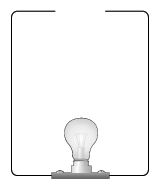
resistance
source of electric current
conductor
ammeter
35
Multiple Choice
resistance
voltage
current
source of electric current
36
Multiple Choice
resistance
voltage
current
source of electric current
37
Multiple Choice

Battery
Light bulb
Wire
All of them
38
Multiple Choice
In order for electricity to flow through a circuit, the circuit must be a closed, complete:
Path, so that the electricity can make a complete circle.
Donut, because circuits get hungry.
Wire, made out of rubber.
Solar panel, because circuits only work with the sun.
39
A circuit diagram is a sketch that depicts the elements in a circuit. Symbols are used to depict devices.

40
Devices are connected in parallel when they are connected head-to-head and tail-to-tail.
The electrons can choose which device to go through.
Parallel
Devices are connected in series when they are connected head-to-tail.
There is only ONE PATH for the electrons to follow.
Series
41

Voltmeters measure the energy "dropped" across a device.
It measures the energy difference between two points.
Voltmeters are connected in parallel across a device.
Voltmeters
42

Ammeters measure current.
They "count" the electrons going through a device.
Therefore, an ammeter must be connected in SERIES with the device.
Ammeters
43
44

A series curcuit is one in which the devices are connected in series.
As more resistors are added, the total resistance increases and the current decreases.
The current is the same throughout.
The battery voltage is distributed across each resistor.
The voltages will add to the battery voltage.
Series circuits
45
46
Multiple Choice

Solve for the total resistance of the circuit shown
50 V
1970 ohms
705 K ohms
20 Amps
47
Multiple Choice

Solve for the voltage drop at resistor 1
38 volts
60 Kvolts
50 volts
25 volts
48
Multiple Choice
With three 10 resistors connected in series with a 30 volt power supply, the total circuit current will equal ____.
300 amps
1 amp
150 amps
1 millamp
49
Multiple Choice
Total series circuit wattage is equal to source voltage ____.
multiplied by the voltage value going through any resistor
multiplied by the current value going through any resistor
divided by the current value going through any resistor
divided by the voltage applied to the circuit and the total resistance of the circuit
50
Multiple Choice
When a resistor in a series circuit is replaced by another resistor with an increased resistance value, the total circuit current will __________.
stay the same
decrease
increase
double in value
51
Multiple Choice
__________ remains the same in a series circuit.
Resistance
Voltage
Current
Power
52
Multiple Choice

The potential difference across the 8.0-Ω resistor is ---.
1.5 V
12 V
0.4 V
3.2 V
53
Multiple Choice

The voltage drop across R1 is ______________________________ V.
20
30
40
50
54
55

In a parallel circuit, the elements are connected in parallel. Each "loop" can be thought of as its own circuit.
As more loops/resistors are added, the resistance decreases and the current increases.
The voltage across each resistor equals the battery voltage.
The currents in each loop are different. They will add to the total current.
Parallel Circuits
56
57
Multiple Choice
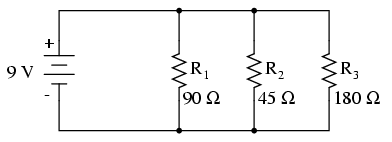
Series
Parallel
Open
Dihexihedral
58
Multiple Choice
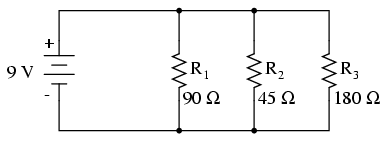
0.05 amps
0.2 amps
0.1 amps
5 amps
59
Multiple Choice
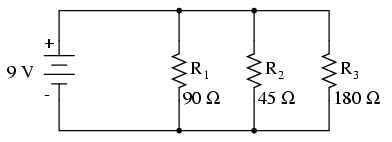
25.7 ohms
315 ohms
324 ohms
90 ohms
60
Multiple Choice

61
Multiple Choice
Voltage
Current
Resistance
Charge
62
Multiple Choice
increase
decrease
stay the same
63
Direction of the current changes
Using AC instead of DC means that there is less overall resistance since the electrons only move back and forth and aren't pushed through the entire circuit.
64
Coils create magnetic fields.
Alternating currents create magnetic fields that change direction.
This will induce a current in any nearby coils.
Transformers use conservation of energy. The energy in each coil will be the same.
More current ==> Less voltage
Less current ==> More voltage
65
Decreases voltage, increases current.
Used to create safe voltages inside homes.
Used to power devices that only need a small voltage (cell phones, etc).
Step Down
Increases the voltage, decreases current.
Used to go from the power station to transport electricity across a long distance (BIG LINES)
Used to power devices that need more voltage.
Step Up
Unit 6
Show answer
Auto Play
Slide 1 / 65
SLIDE
Similar Resources on Wayground

57 questions
L'Imparfait lesson
Presentation
•
11th Grade
61 questions
Civil War Westward Expansion
Presentation
•
11th Grade
61 questions
22. Centripetal Motion
Presentation
•
11th Grade
61 questions
LIGHT
Presentation
•
KG
60 questions
Los Colores
Presentation
•
10th Grade
59 questions
U2 Periodic Trends
Presentation
•
11th Grade
60 questions
MKTG Week 15 Market Segments
Presentation
•
11th Grade
62 questions
PENGUKURAN
Presentation
•
10th Grade
Popular Resources on Wayground
10 questions
Safety Day 2026 – Student Review

Quiz
•
9th Grade
21 questions
Continents and Oceans
Quiz
•
6th Grade
20 questions
Parts of Speech
Quiz
•
5th Grade
16 questions
Subject & Predicate
Quiz
•
5th Grade
25 questions
Multiplication Facts
Quiz
•
5th Grade
12 questions
Map Skills
Quiz
•
3rd Grade
22 questions
Continents and Oceans
Quiz
•
5th Grade
15 questions
Rounding Decimals
Quiz
•
5th Grade
