

Respiratory system

Presentation
•
Science
•
7th Grade
•
Medium
+7
Standards-aligned

STEPHANIE SLUSS
Used 32+ times
FREE Resource
20 Slides • 18 Questions
1

Respiratory System
Structure and Function
2

What body systems are involved in
taking oxygen into the body and
delivering that oxygen to cells?
What wastes are produces by
respiration?
Accessing Prior Knowledge
3


During respiration …
◼ Glucose molecules are broken
down to release ATP energy
◼ Site- mitochondria
4

Cellular Respiration
◼
Glucose + oxygen -------> carbon dioxide + water + ATP energy
reactants Products
CO2 builds up In the cell. How does this cell get rid of this wastes?
5
Multiple Choice
the Earth
the moon
the sun
the food we eat/make
6
Multiple Choice
Cell Membrane
Nucleus
Mitochondria
Vacuole
7
Multiple Choice
to break down food
to create energy in the body
to release energy from food
there is none; it's a waste of time
8
Multiple Choice

you breathe in oxygen for
photosynthesis
fermentation
mitosis
cellular respiration
9
Multiple Choice
The mitochondria is responsible for ...
photosynthesis
cellular respiration
10
Multiple Choice

Protein
Oxygen
Carbon dioxide
Glucose
11

Today I will…
identify the structure of the respiratory
system.
describe the functions of each part of
the respiratory system.
describe how the respiratory system
works.
12


Function
• Allows us to breathe, known as
respiration.
• Transports oxygen (O2) from
outside the body to cells and
tissues. Transports carbon
dioxide (CO2) and waste from
cells to the environment. This
process is called gas exchange
• Protects the body against foreign
invaders.
13
Multiple Choice

What is the function of the respiratory system?
Gas exchange
protects us from from foreign invaders
allows us to breath (respiration)
All of these are functions of the respiratory system
14


Organ overview
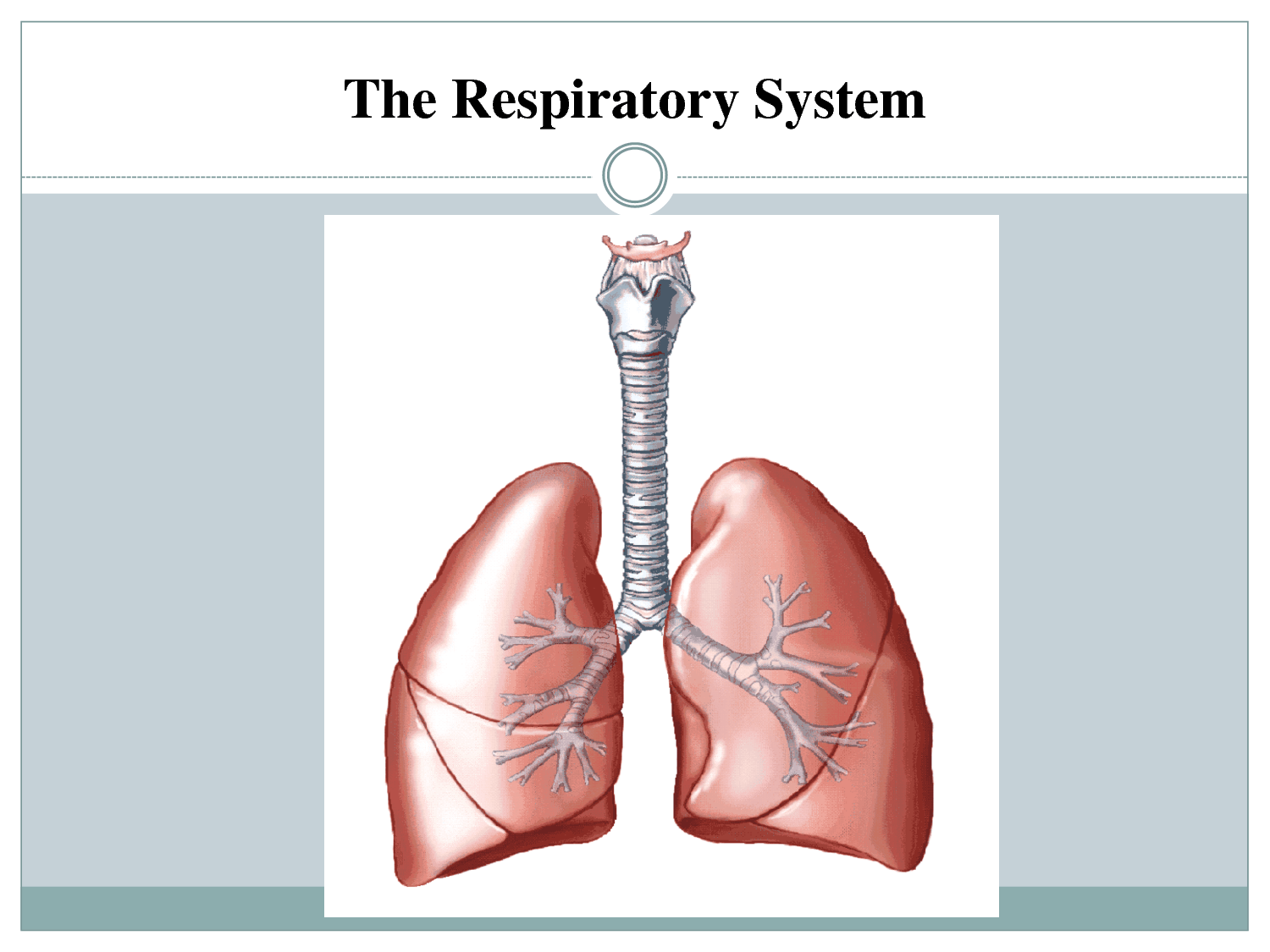
• The respiratory system is
composed of numerous
organs used to carry air
into and out of the lungs
• These main organs include:
• Nose/Mouth
• Pharynx
• Larynx
• Trachea
• Lungs
• Bronchial tree
15


Respiratory System Organs
NOSE
LARYNX
LUNG(S)
PHARYNX
TRACHEA
BRONCHIAL
TREE
16

Nose/Mouth
• Air enters and exits.
• Hair and mucus lining
the nasal cavity warm,
moisten, and filter dust
and microorganisms
NASAL CAVITY
17

Pharynx
• Also known as the
throat.
• Air moves from the
nose/mouth into the
pharynx.
• Food and drink also
travel through the
pharynx.
PHARYNX
18
Multiple Choice

When we breathe in...................enters our lungs and passes into the blood.
oxygen
carbon dioxide
19

Larynx
• The part of the throat
that contains the vocal
cords.
• When air flows between
the vocal cords they
vibrate and make
sound.
VOCAL
CORDS
LARYNX
20

Trachea
• Also known as the
windpipe.
• Carries air from the larynx
to the bronchial tree.
• The tube is held open by
C-shaped cartilage rings
LUNGS
TRACHEA
CARTILAGE RINGS
21
Multiple Choice

The windpipe is also called
trachea
alveoli
22

Lungs
• Soft, spongy tissue;
they contain no
muscle.
• Fill up most of the
chest.
23
Multiple Choice

They are two sacks protected by the ribs.
alveoli
lungs
24

Bronchial Tree
Bronchi (bronchus)
• Main airway into the lungs.
• Lined with mucus cells to
capture foreign particles,
including: viruses,
bacteria, fungi, bits of dust
and debris.
BRONCHIAL TREE
BRONCHI
BRONCHIOLES
ALVEOLI
25

Alveoli
• microscopic air sacs at the
ends of the bronchioles.
• where the lungs and blood
capillaries exchange O2 and
CO2 during gas exchange
• gases can easily pass
through by diffusion
BRONCHI
BRONCHIOLES
ALVEOLI
CAPILLARIES
26
Multiple Choice

Inside the lungs there are lots of little sacks called.......
Here, oxygen passes into the blood and carbon dioxide leaves the blood.
lungs
alveoli
27
Multiple Choice

When we ................... carbon dioxide leaves our body.
breathe in
breathe out
28
Multiple Choice
to provide oxygen and remove carbon dioxide from the body
to bring oxygen to the body
to break down food and absorb nutrients
to remove oxygen from the body and deliver carbon dioxide
29

Diaphragm
• Major domelike shape
muscle of the respiratory
system
• Contraction creates a
vacuum, which pulls air into
the lungs.
BRONCHI
BRONCHIOLES
ALVEOLI
CAPILLARIES
30


Gas Exchange in the Alveoli
•At the alveoli, O2 in the
alveolar air sac diffuses into
the bloodstream across the
respiratory membrane
•Diffusion occurs since the
blood is low in O2 while the
alveolar sac is high in O2
•Meanwhile, CO2 in the
bloodstream diffuses into
the alveolar air sac
•Diffusion occurs since the
blood is high in CO2 while the
alveolar sac is low in CO2
O2
O2
CO2
CO2
BLOODSTREAM IN CAPILLARIES
CO2 DIFFUSES FROM BLOOD INTO AIR
O2 DIFFUSES FROM AIR INTO BLOOD
ALVEOLAR AIR SACS
31


Review: Organs and Functions
A
B
C
D
E
F
NOSE
LARYNX
LUNGS
PHARYNX
TRACHEA
BRONCHIAL TREE
32


Breathing Pathway
NOSE / MOUTH
1
1
PHARYNX
2
2
LARYNX
3
3
TRACHEA
4
4
LUNGS
5
5
BRONCHIAL TREE
6
6
ALVEOLI
7
7
33
Multiple Choice
Which is not a job of the respiratory system?
takes in oxygen
gets rid of carbon dioxide
moistens air
makes ATP
34
Multiple Choice
Which best explains the effects of exercise on the respiratory system?
Exercise increases breathing rate which makes the lungs stronger.
Exercise increases breathing rate which makes the bones stronger.
Exercise decreases breathing rate which sends more oxygen to the brain.
Exercise decreases breathing rate which produces more wastes for the kidneys to process.
35
Multiple Choice
Which best compares the respiratory system to the circulatory system?
The respiratory system transports oxygen to cells, while the circulatory system provides oxygen for cells.
The respiratory system provides oxygen for cells, while the circulatory system transports oxygen to cells.
The respiratory system breaks down food for cell energy, while the circulatory system rids the body of waste.
The respiratory system rids the body of waste, while the circulatory system breaks down food for cell energy.
36
Multiple Choice
Identify the correct organs for the Respiratory System:
Mouth, Esophagus, Stomach, Small and Large Intestines
Nose, Trachea, Lungs
Heart, Veins, Arteries
37
Multiple Choice
Identify the correct organs for the Circulatory System:
Mouth, Esophagus, Stomach, Small and Large Intestines
Nose, Trachea, Lungs
Heart, Veins, Arteries
38
if they are ...... Return to canvas to play review games.....
Respiratory System
Structure and Function
Show answer
Auto Play
Slide 1 / 38
SLIDE
Similar Resources on Wayground

33 questions
Unit 6 Cells & Cell Processes TCAP Review
Presentation
•
7th Grade
33 questions
Ecosystems
Presentation
•
7th Grade
33 questions
Plant Systems
Presentation
•
7th Grade
31 questions
Reactions
Presentation
•
7th Grade
31 questions
asexual and sexual reproduction
Presentation
•
7th Grade
30 questions
FORMULATING THE HYPOTHESES
Presentation
•
7th Grade
34 questions
Chromosomes, DNA, and Genes Review
Presentation
•
7th - 8th Grade
30 questions
Photosynthesis
Presentation
•
7th Grade
Popular Resources on Wayground
10 questions
Safety Day 2026 – Student Review

Quiz
•
9th Grade
21 questions
Continents and Oceans
Quiz
•
6th Grade
20 questions
Parts of Speech
Quiz
•
5th Grade
16 questions
Subject & Predicate
Quiz
•
5th Grade
25 questions
Multiplication Facts
Quiz
•
5th Grade
12 questions
Map Skills
Quiz
•
3rd Grade
22 questions
Continents and Oceans
Quiz
•
5th Grade
15 questions
Rounding Decimals
Quiz
•
5th Grade
Discover more resources for Science
10 questions
Exploring Chemical and Physical Changes

Interactive video
•
6th - 10th Grade
14 questions
Week 1 Falcon Flex Fast and Curious
Quiz
•
7th Grade
42 questions
Explore Plate Tectonics and Boundaries
Quiz
•
7th Grade
21 questions
Waves and Wave Properties
Quiz
•
6th - 8th Grade
16 questions
Photosynthesis and Cellular Respiration Review
Quiz
•
7th Grade
20 questions
Food Webs + Energy Pyramids
Quiz
•
7th Grade
9 questions
Biology: Cell Structure
Interactive video
•
7th Grade
8 questions
Diffusion and Osmosis Review
Presentation
•
6th - 8th Grade