

Specific Heat & Local Winds

Presentation
•
Science
•
6th - 8th Grade
•
Medium
+11
Standards-aligned

Jessica Beal
Used 38+ times
FREE Resource
12 Slides • 21 Questions
1

Today’s Learning Outcome:
Students will be able to explain that the movement of air is due to the uneven heating of the Earth in order to model local wind patterns.
2


Wind
• Wind = differences in air pressure cause
the air to move
• The difference in air pressure is caused by
unequal heating of the Earth from the sun
3

The Sun is Earth’s heat source. The heat energy is transferred by radiation, conduction and convection. However, not all areas of Earth are heated evenly. The equator receives the most direct sunlight year-round and is also the hottest area on Earth. Depending on Earth’s tilt, certain areas/hemispheres will receive more or less direct light and therefore different amounts of heat.
4
Multiple Choice
Think back to learning about heat transfer...How does heat flow?
Always from cold to warm
Always from warm to cold
Both warm to cold & cold to warm
It depends on the temperature
5

Temperature affects air pressure and density, causing air to sink or rise in specific areas
6


Temp
affects air
pressure
7

Uneven Heating of the Earth’s surface
causes Convection Currents which
causes differences in Pressure
which causes WINDS. Air always moves
from High to Low pressure areas.
8
Multiple Choice
Sun and it warming Earth's atmosphere
Sun and Moon
Moon's gravity
Potential Energy
9
Multiple Choice
When air particles gain energy and rise into the atmosphere, how does this affect the air pressure on the earth's surface?
It causes the air pressure to rise creating high pressure.
It does not affect the air pressure on the earth's surface.
It causes 8th grade students to forget to do their homework.
It causes the air pressure to drop creating low pressure
10
Multiple Choice
Cold air is less dense than warm air.
True
False
11
Multiple Choice

Warm air is more dense than cooler air.
Warm air has more pressure than cooler air.
Warm air is less dense than cooler air.
Warm air has a higher dew point than cooler air.
12
Multiple Choice

They would slow down
They would stop moving
They would speed up
There would be no effect
13
Multiple Choice

Air moves from _______ pressure to ________ pressure.
high to low
low to high
high to high
low to low
14
Imagine you are at the beach…Your toes felt nice and cool in the ocean on a summer day. Then, you decided to walk barefoot to the ice cream truck. The sand was much warmer than the ocean. The last part of the walk was the paved parking lot. Ouch! That black asphalt was hot.

15
Sand and asphalt, on the other hand, have lower specific heats. This means that their temperatures change more quickly. When the summer sun shines down on them, they quickly become hot. But, when the sun goes down, they also become colder more quickly.
Water has a very high specific heat. That means it needs to absorb a lot of energy before its temperature changes. That is why it takes months for the water temperature to rise and fall at the beach with seasonal temperature changes.
16
Multiple Choice
Specific Heat is....
The speed of the particles in a substance
The temperature of the substance
How much energy it takes to heat something up
Heat
17
Multiple Choice
Why does water heat up and cool down VERY SLOWLY?
High Specific Heat
Low Specific Heat
It's solid
It's always cold
18
Multiple Choice
True
False
19
Multiple Choice
It requires less energy to change temperature
It requires more energy to change temperature
It heats up very quickly
20

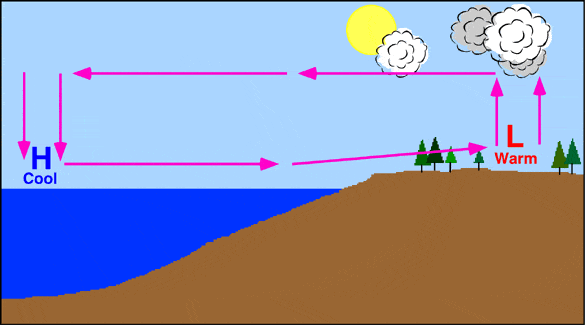
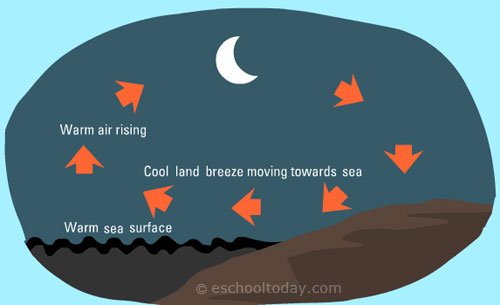
Local Winds
• Occur in small areas (Ex. = at the beach)
• Caused by unequal heating of surfaces (land vs water)
– water has a higher heat capacity than land (so it stays the
same temp day & night)
– Land has a lower heat capacity so it heats up and cools
down quickly
• Sea breezes occur during the day - it is when the wind comes from the sea (from colder area to warmer area)
• At night, flow of air comes from the land = Land breeze
21

Local Winds (are named for where the wind comes from)
• Day
• Night
Land is colder
Ocean is warmer
Ocean is colder
Land is warmer
wind
wind
22


Sea Breeze During The Day
23


Land Breeze At Night
24
Multiple Choice
From east to west
From west to east
From the land to the ocean
From the ocean to the land
25
Multiple Choice
land breeze
sea breeze
26
Multiple Choice
land
ocean
sky
beach
27
Multiple Choice
Day
Night
28
Multiple Choice
Land cools off slower than water, so the air above water is cooler.
Water cools off faster than land, so the air above land is warmer.
Land heats up slower than water, so the air stays cooler during the day.
Water cools off slower than land, so the air above water is warmer.
29
Multiple Choice
land breeze
sea breeze
30
Multiple Choice
hotter
larger
cooler
warmer
31
Multiple Choice

In which direction will air currents most likely move?
from the land toward the sea
from the sea toward the land
32
Multiple Choice

What type of heat transfer is responsible for sea breeze and land breeze?
Conduction
Convection
Radiation
33
Multiple Choice
Differences in longitude
Shock waves from clouds
Differences in air temperature and pressure
The rotation of the earth
Today’s Learning Outcome:
Students will be able to explain that the movement of air is due to the uneven heating of the Earth in order to model local wind patterns.
Show answer
Auto Play
Slide 1 / 33
SLIDE
Similar Resources on Wayground

25 questions
Magnetism
Presentation
•
7th - 8th Grade
26 questions
PHYSICAL AND CHEMICAL CHANGES
Presentation
•
6th - 8th Grade
26 questions
Lab Safety
Presentation
•
6th - 8th Grade
27 questions
The Seasons
Presentation
•
6th - 8th Grade
24 questions
02 - SSA 6th Grade - Earth's Spheres
Presentation
•
6th - 8th Grade
26 questions
Electromagnetism Review
Presentation
•
6th - 8th Grade
26 questions
Sound - Hearing
Presentation
•
7th - 8th Grade
23 questions
The Solar System
Presentation
•
6th - 8th Grade
Popular Resources on Wayground
10 questions
Safety Day 2026 – Student Review

Quiz
•
9th Grade
21 questions
Continents and Oceans
Quiz
•
6th Grade
20 questions
Parts of Speech
Quiz
•
5th Grade
16 questions
Subject & Predicate
Quiz
•
5th Grade
25 questions
Multiplication Facts
Quiz
•
5th Grade
12 questions
Map Skills
Quiz
•
3rd Grade
22 questions
Continents and Oceans
Quiz
•
5th Grade
15 questions
Rounding Decimals
Quiz
•
5th Grade
Discover more resources for Science
20 questions
Newton's Laws of Motion
Quiz
•
8th Grade
20 questions
Elements, compounds, and mixtures
Quiz
•
6th Grade
10 questions
6.6D - Relative Density Review
Quiz
•
6th Grade
15 questions
potential and kinetic energy
Quiz
•
8th Grade
21 questions
Newton's Laws of Motion
Quiz
•
8th Grade
20 questions
Elements, Compounds and Mixtures
Quiz
•
8th Grade
10 questions
Exploring Chemical and Physical Changes

Interactive video
•
6th - 10th Grade
20 questions
CONDUCTION,CONVECTION AND RADIATION
Quiz
•
6th Grade