
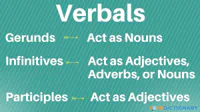
Verbals

Presentation
•
English
•
11th Grade
•
Practice Problem
•
Hard

Paola Llompart
Used 16+ times
FREE Resource
21 Slides • 0 Questions
1


Verbals
Distinguishing Between Participles and Gerunds and
Infinitives
2

Verbal Phrases:
Verbals are verbs used as a different
part of speech. Verbals keep some of
the characteristics of verbs, yet never
function as the main verb that works
with the subject to form the core of a
complete sentence! The three types of
verbals are: Participles and Gerunds
and Infinitives
3

The decaying skeleton sat in a corner.
(adjective)
Sleeping on the job is foolish.
(noun)
His ambition is to fly.
(to + verb)
4

Participles
Participles are forms of verbs that act as
adjectives. They are broken into three
variations:
Present Participles
Usually end with
-ing
Past Participles
Usually end with
-ed
Present Perfect
Participles begin
with variation of
‘has’
The surfacing
whale looked
gigantic.
Confused, Carlos
returned to his
interrupted project.
Having decided,
Diana made the
call.
Chris has worked
here for five years.
5

Verb or participle?
Remember: Verbs show an action, condition, or
the fact that something exists. A participle
modifies a noun or pronoun, much like an
adjective!
The dog is growling at the intruder.
The growling dog attacked the intruder.
The clown terrified the child.
The terrified child wanted to go home.
6

Your turn:
She was stirring the soup.
He gave a moving speech.
The finished artwork was auctioned off.
Our summer cabin has running water in the
bathroom now.
The dreaming student stared out the window.
7

Your turn:
She was stirring the soup.
(if it can logically be apart of the verb phrase, in
this case was stirring, then it is NOT a
participle)
He gave a moving speech.
The finished artwork was auctioned off.
Our summer cabin has running water in the
bathroom now.
The dreaming student stared out the window.
8

Participle Phrases
A Participle Phrase is a participle modified by
an adverb or adverbial phrase or accompanied
by a complement. The entire participle phrase
acts as an adjective.
9

With an adverb:
Traveling quickly, we arrived on time.
With an adverbial phrase:
Traveling at breakneck speed, we arrived on
time.
With a complement:
Avoiding delays, we arrived on t ime
10

Essential and nonessential
participles
Nonessential participles are set off with
commas.
Essential participles are necessary to identify
the noun and are not set off with commas.
Painted in 1597, the canvas is a masterpiece.
The canvas painted in 1597 is a masterpiece.
11

Combining Sentences with
Participles
We were exhausted by the climb up the
mountain.
We rested by the side of the trail.
Exhausted by the climb up the mountain, we
rested by the side of the trail.
Drinking coffee, we shared stories about our
lives.
12

Participles Practice
ID Participles and/or Verbs:
1. Randi lectured her team.
2. Locked in a case, the coins were safe from
thieves.
3. The award thrilled DaShonda.
4. Sprinting across the finish line, Leslie
gasped for breath.
13

Gerunds
Remember: a VERBAL is a VERB acting as
another part of speech.
A gerund is a VERB ending in
-ing and acting as a NOUN.
14

Functions of Gerunds:
Subject →Swimming is my favorite activity.
Direct Object → The English population makes
visiting England a pleasure.
Indirect Object → Mrs. Kay’s lecture gave
travelling a new perspective.
Object of a Preposition → Their puppy showed
signs of extensive training.
Appositive → Anne’s profession, snowboarding,
is hard work.
15

Verb or Gerund?
Unlike VERBS ending in ‘-ing’, gerunds do NOT
have helping verbs.
(be, have, do, can, may. . .)
Xuan is fighting robots.
vs.
Fighting robots is Xuan’s favorite activity.
16

Participle or Gerund?
Unlike participles ending in ‘-ing’, gerunds do
NOT act as ADJECTIVES.
The sleeping girl was very tired.
vs.
Sleeping is healthy, but not always possible.
17

Gerunds can also be phrases!
The baby’s constant smiling is adorable!
(adjectives)
Acting quickly is not always a good idea.
(adverb)
Many places prohibit walking dogs on the track.
(prepositional phrase)
Rob was incapable of completing the sentence.
(direct object)
The English teacher never tried giving his
students praise. (indirect and direct object).
18

Important note about
Gerunds and pronouns:
Always use the possessive form of a personal
pronoun in front of a gerund.
We never listened to him complaining.
NO!
We never listen to his complaining.
Which is correct below?
Their refusing to wear seatbelts is dangerous.
Them refusing to wear seatbelts is dangerous.
19

Infinitives
An infinitive is a VERBAL that generally
appears with the word to in front of it and acts
as a noun, adjective, or adverb.
20

Infinitives as a Noun:
To understand grammar requires reading and
studying. (subject)
The militia decided to rebel. (direct object)
The prisoner's only option was to surrender.
(predicate nominative).
I have no goal except to dance. (obj of
preposition)
You only have one choice, to go. (appositive)
21

Infinitives as modifiers:
Adjective: The allies showed a willingness to
cooperate.
Adverb: Some animals were unable to fight.
Verbals
Distinguishing Between Participles and Gerunds and
Infinitives
Show answer
Auto Play
Slide 1 / 21
SLIDE
Similar Resources on Wayground

16 questions
Wear the Mask (Unit 4: Living the Dream)
Presentation
•
11th Grade
16 questions
Counterargument Practice
Presentation
•
11th Grade
14 questions
Personal Letter
Presentation
•
11th Grade
14 questions
be going to
Presentation
•
11th Grade
14 questions
Camel Racing
Presentation
•
10th - 11th Grade
16 questions
COMPARATIVE ADJECTIVES
Presentation
•
4th Grade
16 questions
Personal Narrative Essay
Presentation
•
10th Grade
15 questions
diagnostico
Presentation
•
10th Grade
Popular Resources on Wayground
10 questions
How much do you know about our Portrait of an Eagle?

Quiz
•
10th Grade
10 questions
Fast Food Slogans
Quiz
•
6th - 8th Grade
21 questions
Continents and Oceans
Quiz
•
6th Grade
20 questions
Parts of Speech
Quiz
•
5th Grade
16 questions
Subject & Predicate
Quiz
•
5th Grade
25 questions
Multiplication Facts
Quiz
•
5th Grade
12 questions
Map Skills
Quiz
•
3rd Grade
22 questions
Continents and Oceans
Quiz
•
5th Grade
Discover more resources for English
10 questions
Exploring Narrative Writing Techniques

Interactive video
•
11th Grade
19 questions
Understanding the Circle of Control
Quiz
•
9th - 12th Grade
15 questions
ACT English Practice
Quiz
•
11th - 12th Grade
31 questions
AP Vocab Group 5
Quiz
•
9th - 12th Grade
22 questions
Topic Vs Theme
Quiz
•
3rd - 12th Grade
20 questions
Vocab Group 5
Quiz
•
9th - 12th Grade
12 questions
RI.8.5/RL.8.5
Quiz
•
5th - 12th Grade
20 questions
The Crucible Act 1
Quiz
•
11th Grade