Motors & Generators
Presentation
•
Physics
•
9th - 12th Grade
•
Medium
Standards-aligned
Leslie Dunham
Used 39+ times
FREE Resource
10 Slides • 6 Questions
1

Motors and Generators
2
3
Motors: Electrical Energy Mechanical Energy
Electrical energy is used to create a current in an armature (the coil)
The armature is in a magnetic field and has its own magnetic field due to the current flowing through it
The armature turns so that its magnetic field lines up with the magnetic field of the magnet
4
5
A moving magnetic field causes a voltage to be created/induced
If there is a complete circuit, this voltage will result in a current flowing
Electromagnetic Induction
6
N pole into the coil = positive voltage induced
Magnet at rest in coil = no voltage induced (because magnetic field isn't changing!)
Move magnet backwards out of coil = negative voltage induced
Electromagnetic Induction
Generators typically produce alternating current (AC)
7
8
Using a stronger/bigger magnet
Moving the magnetic field faster
More windings/loops in the coil
Induced voltage can be increased by...
9
Generators: Mechanical Energy Electrical Energy
Mechanical energy is used to turn a rotor attached to an armature (coil)
The armature is in a magnetic field
As the wire is turned, it experiences a changing magnetic field
This results in a voltage and current
10
Input: Electrical energy (battery)
Output: Mechanical energy (coil turns)
Motor parts: battery
Motors only
Input: Mechanical energy (turn the coil)
Output: Electrical energy (voltage and current)
Motor parts: device to be powered
Generators only
Parts:
Magnet
Armature
Both
11
Multiple Choice
chemical; mechanical
mechanical; electrical
electrical; mechanical
potential; kinetic
12
Multiple Choice
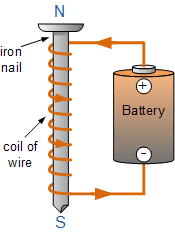
Electromagnet
Generator
Electron Magnet
Motor
13
Multiple Choice
electrical; mechanical
mechanical; electrical
chemical; potential
mechanical; kinetic
14
Multiple Choice
What two forces are required for generators and electric motors to work?
magnetism and thermal
electricity and thermal
electricity and magnetism
magnetism and radiant
15
Multiple Choice
16
Multiple Choice
Increase the number of coils
Decrease the number of coils
Flip the magnet around
Nothing, the amount of electricity cannot be increased
Motors and Generators
Show answer
Auto Play
Slide 1 / 16
SLIDE

Similar Resources on Wayground
11 questions
IB Physics
Lesson
•
10th - 12th Grade
10 questions
Momentum
Lesson
•
10th - 12th Grade
14 questions
Calorimetry A
Lesson
•
10th - 12th Grade
12 questions
Mechanisms of Evolution
Lesson
•
9th - 12th Grade
10 questions
Wave Frequency and Period Vocab Review
Lesson
•
9th - 12th Grade
12 questions
Unit 6 Extra Credit
Lesson
•
9th - 12th Grade
14 questions
Power and Work
Lesson
•
10th - 12th Grade
12 questions
Food Web
Lesson
•
9th - 12th Grade
Popular Resources on Wayground
10 questions
5.P.1.3 Distance/Time Graphs
Quiz
•
5th Grade
10 questions
Fire Drill
Quiz
•
2nd - 5th Grade
20 questions
Equivalent Fractions
Quiz
•
3rd Grade
15 questions
Hargrett House Quiz: Community & Service
Quiz
•
5th Grade
20 questions
Main Idea and Details
Quiz
•
5th Grade
20 questions
Context Clues
Quiz
•
6th Grade
20 questions
Inferences
Quiz
•
4th Grade
15 questions
Equivalent Fractions
Quiz
•
4th Grade
Discover more resources for Physics
28 questions
Lenses
Quiz
•
10th Grade
25 questions
Newton's Laws of Motion
Quiz
•
9th Grade
20 questions
Unit 10 - Acceleration Mini-Test
Quiz
•
9th Grade
10 questions
E-M Wave Formation
Quiz
•
11th Grade
14 questions
Work and Energy intro
Interactive video
•
8th - 10th Grade
19 questions
Refraction
Quiz
•
10th Grade
15 questions
Kepler's Laws of Planetary Motion
Quiz
•
9th - 12th Grade
14 questions
Bill Nye Waves
Interactive video
•
9th - 12th Grade