

Unit 4 Lesson 5 - Earthquakes

Presentation
•
Science
•
6th Grade
•
Medium
+9
Standards-aligned

Jesse Jayne
Used 40+ times
FREE Resource
18 Slides • 15 Questions
1
Earthquakes

By the end of this lesson, you should be able to describe the causes of earthquakes and to identify when earthquakes happen.
Why do Earthquakes happen?
2
3
Multiple Choice
Each year there are approximately _________ earthquakes detected around the world.
50
500
5000
500,000
4
Multiple Choice
In the United States. the state with the most earthquakes on average is ___________.
California
Alaska
Hawaii
Oregon
5
Multiple Choice
Every year, earthquakes cause ___________ dollars of damages in the United States.
Thousands
Millions
Billions
Trillions
6
Multiple Choice
Most earthquakes only last for several _________ of time.
seconds
minutes
milliseconds
hours
7
Fault
Deformation
Elastic Rebound
Earthquake
Focus
Epicenter
Tectonic Plate Boundary
8

-Ground movements when blocks of rock in Earth move suddenly and release energy.
-Energy is released as waves that travel through the ground
What is an Earthquake?
9
10
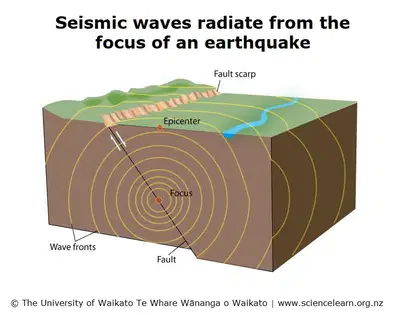
Focus - the place within Earth along a fault at which the first motion of an earthquake occurs.
Epicenter - Directly above the focus on the surface.
Fault - A break in Earth's crust along which blocks of rock move.
Key Parts of an Earthquake
11
Multiple Choice
Which is an earthquake's point of origin on the surface of the Earth?
focus
epicenter
seismic wave
fault line
12
Multiple Choice
focus
epicenter
seismic moment
fault line
13
Multiple Choice

Which letter indicates the fault line?
A
B
C
14
Near the boundaries of tectonic plates!
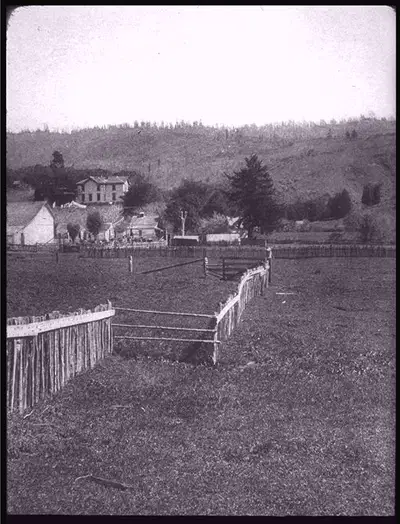
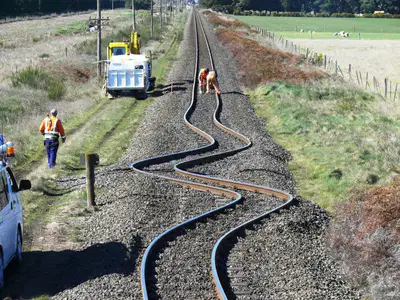
As the plates move they do not slide past each other smoothly - they get caught up (Their edges are not smooth!). Pressure builds up along these faults at the edges of plates until they can not hold on any longer and they snap. This snap is called elastic rebound.
15
16
17
Multiple Choice
ability of a deformed material body to return to its original shape and size when the forces causing the deformation are removed.
kinetic energy
potential energy
elasticity
18


19
Multiple Choice

Which plate boundary is displayed?
Convergent
Divergent
Transform
Hot Spot
20
Multiple Choice

Which plate boundary is displayed?
Convergent
Divergent
Transform
Hot Spot
21
Multiple Choice

Which plate boundary is displayed?
Convergent
Divergent
Transform
Hot Spot
22
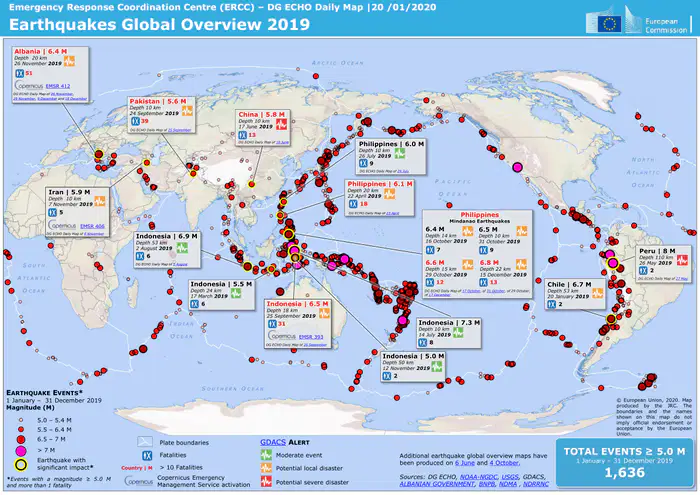
- Most earthquakes occur at or near tectonic plate boundaries.
- Three types of tectonic plate boundaries.
- Divergent / Convergent / Transform
23


-Plates pull apart causing the crust to stretch (tension)
-Earthquakes are shallow
-No more than 20 km deep
-Occur along normal faults
Divergent Boundary
-Plates collide causing rock to squeeze (compression)
-Causes the formation of reverse faults (subduction)
-Some of the strongest earthquakes
-depths up to 700 km
Convergent Boundary
-Plates slide past each other horizontally (shear stress)
-Strike slip faults
-Shallow earthquakes in upper 50 km of crust.
-Common along transform boundaries.
Transform Boundary
24
Multiple Choice

What do the lines on this map represent?
volcanoes
easrthquakes
plate boundaries
travel routes
25
Multiple Choice

Which of these natural disasters happen on these plate boundaries?
earthquakes
volcanos
both of these
none of these
26
Multiple Choice
Why do so many earthquakes and volcanos happen along plate boundaries?
bad weather in these areas
coincidence
plates move and shift
none of these
27
Multiple Choice
A ____________________ is where two or more tectonic plates meet.
Plate edge
Plate ridge
Tectonic plate boundary
Tectonic plate focus
28
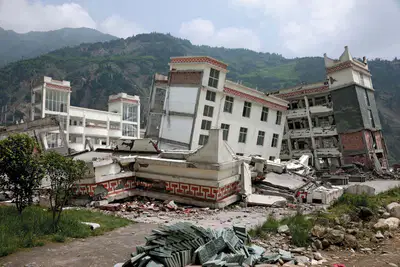
Many of the earthquakes that occur do not cause any damage - many don't even feel them.
Strong earthquakes can cause billions of dollars in damage, injuries, and loss of life.
What are some effects of earthquakes?
29
30
31
32
33
Earthquakes
By the end of this lesson, you should be able to describe the causes of earthquakes and to identify when earthquakes happen.
Why do Earthquakes happen?
Show answer
Auto Play
Slide 1 / 33
SLIDE
Similar Resources on Wayground

27 questions
Abiotic vs Biotic Factors
Presentation
•
6th Grade
27 questions
Ocean Tides and Eclipses
Presentation
•
6th Grade
25 questions
Air masses and fronts
Presentation
•
6th Grade
24 questions
Unit 2 Lesson 1 Age of Earth's Rocks
Presentation
•
6th Grade
24 questions
Human Impact on Ecosystems
Presentation
•
6th Grade
28 questions
Engineering Types: Day 1
Presentation
•
6th Grade
26 questions
Human Impact on Biodiversity
Presentation
•
6th Grade
27 questions
Microorganisms On and In the Human Body
Presentation
•
6th Grade
Popular Resources on Wayground
10 questions
How much do you know about our Portrait of an Eagle?

Quiz
•
10th Grade
10 questions
Fast Food Slogans
Quiz
•
6th - 8th Grade
21 questions
Continents and Oceans
Quiz
•
6th Grade
20 questions
Parts of Speech
Quiz
•
5th Grade
16 questions
Subject & Predicate
Quiz
•
5th Grade
25 questions
Multiplication Facts
Quiz
•
5th Grade
12 questions
Map Skills
Quiz
•
3rd Grade
22 questions
Continents and Oceans
Quiz
•
5th Grade
Discover more resources for Science
10 questions
6.6D - Relative Density Review
Quiz
•
6th Grade
20 questions
Claim, Evidence and Reasoning (CER)
Quiz
•
6th - 8th Grade
20 questions
Density
Quiz
•
6th Grade
10 questions
Exploring Chemical and Physical Changes

Interactive video
•
6th - 10th Grade
20 questions
Food Chains & Food Webs
Quiz
•
5th - 7th Grade
18 questions
Interpreting Distance/Time Graphs
Quiz
•
6th Grade
10 questions
Decoding the Periodic Table of Elements
Interactive video
•
6th - 10th Grade
15 questions
Potential and Kinetic Energy
Quiz
•
6th Grade