Search Header Logo
  1. Resource Library
  2. Science
  3. Physics
  4. Orbital Motion
  5. Kepler's Laws
Kepler's Laws

Kepler's Laws

Assessment

Presentation

Science

8th Grade

Practice Problem

Medium

NGSS
MS-ESS1-1, MS-ESS1-2, MS-PS2-4

+3

Standards-aligned

Created by

Sarah Dang

Used 46+ times

FREE Resource

6 Slides • 19 Questions

1

Kepler's Laws

Ms. Dang

media
media

2

How do Kepler’s laws describe Earth’s orbit?


3

Beginnings

Johannes Kepler, working with data painstakingly collected by Tycho Brahe (from 1576-1601) without the aid of a telescope, developed three laws which described the motion of the planets across the sky. 

media

4

Kepler’s First Law

Law of Orbits: All planets move in elliptical orbits, with the sun at 1 focus.

An ellipse is an oval shape centered on 2 points instead of 1 point.

The orbital period of a planet is how long it takes for it to travel a complete orbit around the Sun… a year!

Perihelion

Aphelion

media

5

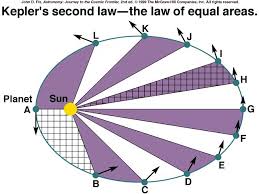
Kepler’s Second Law

Law of Areas: A line that connects a planet to the Sun sweeps out equal (=) areas in equal (=) times.

Earth sweeps out a longer path when it is closer to the Sun.

Earth moves fastest when it is closest to the Sun


media

6

Kepler’s Third Law

Law of Periods: The square of the orbital period of any planet is proportional to the cube of the semi major axis of its orbit. 

T² = a³ If you know the distance of a planet to the Sun, you would be able to figure out its… orbital period. Basically… The closer a planet is to the Sun, the shorter its orbital period is. 

media

7

Multiple Choice

Planets orbit the Sun in a shape called a(n)
1

circle

2

ellipse

3

focus

4

perihelion

8

Multiple Choice

An ellipse is drawn around two points called
1
aphelion
2
perihelion
3
foci
4
axis

9

Multiple Choice

When a planet orbits the Sun, one of the foci of the elliptical orbit is 
1
the axis
2
the perihelion
3
the center
4
the Sun

10

Multiple Choice

The place where a planet is closest to the Sun as it orbits the Sun is called the
1
perihelion
2
aphelion

11

Multiple Choice

The place where a planet is farthest away from the Sun in its orbit around the Sun is called the
1
aphelion
2
perihelion

12

Multiple Choice

Question image
Where is the planet moving faster
1
Position A to B
2
Position B to C
3
Position H to I
4
Position I to J

13

Multiple Choice

Question image
What is true about the area between points A, B and the Sun, and the area between points H, I and the Sun?
1
The area between A, B and the Sun is the largest.
2
The area between H, I and the Sun is the largest
3
Both areas are equal in size
4
There is not enough information to determine the areas

14

Multiple Choice

What has an eccentricity of zero
1
a straight line
2
a large ellipse
3
a circle
4
a small ellipse

15

Multiple Choice

A planet moves __________ when it is farthest from the sun.
1
faster
2
slower

16

Multiple Choice

Kepler's first law states that the orbits of the planets are oval in shape or 
1
ellipses
2
perfect circles

17

Multiple Choice

The path a planet travels around the sun is called its 
1
orbit
2
ellipse
3
barycenter
4
precession

18

Multiple Choice

When do planets move the fastest?
1
Close to the sun
2
Far away from the sun

19

Multiple Choice

Which is NOT one of Kepler's laws?
1
Planets travel in an ellipse
2
Planets closest to the sun travel faster
3
The farther a planet is from the sun, the longer it takes to orbit
4
Planets revolve around the Earth

20

Multiple Choice

What is at the middle of a Heliocentric system?

1

Mars

2

Moon

3

Sun

4

Earth

21

Multiple Choice

Who proposed the Heliocentric system?

1

Copernicus

2

Ptolemy

3

Aristotle

4

Galileo

22

Multiple Choice

What does the Geocentric system look like?

1
2
3
4

23

Multiple Choice

Question image
Complete the following statement: The farther away two planets are the _______ the gravitational force between them.
1
greater
2
same
3
zero
4
less

24

Multiple Choice

Which term describes when the Earth spins on its axis.
1
Rotation
2
Revolution
3
Kepler's Laws
4
Precession

25

Multiple Choice

The period of the earth's orbit around the sun is ____.
1
1 day
2
1 year
3
24 hours
4
364 hours

Kepler's Laws

Ms. Dang

media
media

Show answer

Auto Play

Slide 1 / 25

SLIDE