Evolution Review
Presentation
•
Science
•
9th - 12th Grade
•
Medium
+7
Standards-aligned

Kelan Williams
Used 20+ times
FREE Resource
25 Slides • 22 Questions
1
2
3
4
Fill in the Blanks
Type answer...
5
6
7
8
Multiple Choice
Anaerobic means
with oxygen
without oxygen
9
Multiple Choice
Aerobic means
with oxygen
without oxygen
10
11
12
Multiple Choice
The cells that came first were simple _____ cells.
prokaryotic
eukaryotic
muticellular
13
Multiple Choice
Over time these simple cells evolved to use oxygen then became more complex ________ cells.
prokaryotic
eukaryotic
unicellular
14
15
16
17
18
19
20
Multiple Choice
Fossils show how the sizes of certain animals has changed drastically over millions of years
Fossils show that some species have gone extinct
Fossils show how life forms present today are different than those from the past
Different sedimentary rock layers provide evidence for how the environment has changed over time
21
Multiple Choice
vestigial structures
analogous structures
homologous structures
fossil structures
22
Multiple Choice
Which of the following can be determined by observing the embryos shown in the diagram
The organisms share a common ancestry.
The organisms belong to the same genus.
The organisms are native to the same geographic areas.
The organisms will grow into anatomically similar adults.
23
Multiple Choice
The function of these bones is the same in all animals
They live in similar environments
They have a common ancestor
All organisms resemble humans
24
Multiple Choice
The best evidence for evolution is
fossils
DNA
homologous structures
embryology
25
Multiple Choice
Vestigial structures
structures that perform a similar function but are not similar in origin
remnants of once-important structures that have slowly lost all or most of their function
features found in different organisms that share structural similarities but may have very different functions
preserved remains of an organism
26
Multiple Choice
1
2
3
4
27
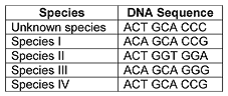
Multiple Choice
Species I
Species II
Species III
Species IV
28
Sin cambio no puede haber evolución
29
30
31
Multiple Choice
What do we call all of the genetic information found in a population.
Cómo llamamos a toda la información genética que se encuentra en una población.
population
genetic drift
evolution
gene pool
32
Las mutaciones genéticas son esenciales para la supervivencia y evolución de las poblaciones
33
Multiple Choice
Mutations are a change in what?
¿Las mutaciones son un cambio en qué?
DNA
tRNA
protein
rRNA
34
Multiple Choice
This is the process that ultimately creates new variations and changes in DNA; leads to the creation of new alleles
Este es el proceso que finalmente crea nuevas variaciones y cambios en el ADN; conduce a la creación de nuevos alelos
Mutation
Microevolution
Natural selection
Gene flow / genetic drift
35
36
El flujo de genes ocurre cuando los individuos entran o salen de una población. Esto generalmente resulta en una mayor variación genética.
37
Multiple Choice
What is gene flow?
¿Qué es el flujo de genes?
The addition or removal of genes in a population due to individuals entering or leaving one population for another
A change in genes frequencies when a new population arises from only a few individuals
A reduction in population caused by natural disasters, disease, hunting, etc.
A change in the gene pool due to chance
38
39
40
Multiple Choice
Genetic drift is driven by chance, not natural selection
La deriva genética es impulsada por el azar, no por la selección natural
true
false
41
42
43
Multiple Choice
If a trait HELPS an organism survive, what may happen to it?
It dies and its DNA is not passed on
It changes its traits to adapt and survive
It survives and its DNA is passed on
44
45
Multiple Choice
The _________________ _________________ occurs when there is a reduction in population due to natural disasters, over hunting or disease.
founder effect
gene flow
bottleneck effect
genetic drift
46
Multiple Choice
Gene flow
Gene drift
Mutation
Adaptation
47
Multiple Choice
The new seal population is genetically less diverse than the original population
The new seal population is genetically more diverse than the original population
There is equal genetic variety compared to the original population
None of the answers
Show answer
Auto Play
Slide 1 / 47
SLIDE

Similar Resources on Wayground
42 questions
EngineeringFundamentalsReview_ Toughest Questions
Presentation
•
9th - 12th Grade
42 questions
Lesson #2 Analyzing Information in Science
Presentation
•
9th - 12th Grade
42 questions
Seasons Moons Tides
Presentation
•
9th - 12th Grade
40 questions
Introduction to Environmental Science Lesson
Presentation
•
9th - 12th Grade
38 questions
Succession
Presentation
•
10th - 12th Grade
45 questions
Evolution PreTest
Presentation
•
9th - 12th Grade
42 questions
Earth's Materials Quizizz PPT Lesson Review
Presentation
•
9th - 12th Grade
40 questions
Equine 1 Obj. 8.01 - Bits
Presentation
•
9th - 12th Grade
Popular Resources on Wayground
20 questions
"What is the question asking??" Grades 3-5
Quiz
•
1st - 5th Grade
20 questions
“What is the question asking??” Grades 6-8
Quiz
•
6th - 8th Grade
10 questions
Fire Safety Quiz
Quiz
•
12th Grade
20 questions
Equivalent Fractions
Quiz
•
3rd Grade
34 questions
STAAR Review 6th - 8th grade Reading Part 1
Quiz
•
6th - 8th Grade
20 questions
“What is the question asking??” English I-II
Quiz
•
9th - 12th Grade
20 questions
Main Idea and Details
Quiz
•
5th Grade
47 questions
8th Grade Reading STAAR Ultimate Review!
Quiz
•
8th Grade
Discover more resources for Science
20 questions
Cell Biology and Biochemistry Quiz
Quiz
•
9th Grade
20 questions
Human Impact on the Environment Review #2
Quiz
•
9th Grade
20 questions
Balancing Chemical Equations
Quiz
•
9th Grade
26 questions
Cell Cycle and Cancer Retest
Quiz
•
9th Grade
20 questions
Mendelian Genetics Review
Quiz
•
9th Grade
10 questions
Exploring Light and Waves Concepts
Interactive video
•
6th - 10th Grade
10 questions
Evolution Review
Presentation
•
10th Grade
10 questions
Exploring Plant Structures and Adaptations
Interactive video
•
6th - 10th Grade