Search Header Logo
  1. Resource Library
  2. Science
  3. Chemistry
  4. Properties Of Water
  5. Properties Of Water
Properties of Water

Properties of Water

Assessment

Presentation

•

Science

•

9th - 12th Grade

•

Medium

•
NGSS
MS-PS1-4, MS-ESS2-4, MS-PS1-1

+1

Standards-aligned

Created by

Carl Green

Used 45+ times

FREE Resource

20 Slides • 24 Questions

1

Properties of Water

2

media

3

media

4

media

5

6

media

7

media

8

Multiple Choice

Question image
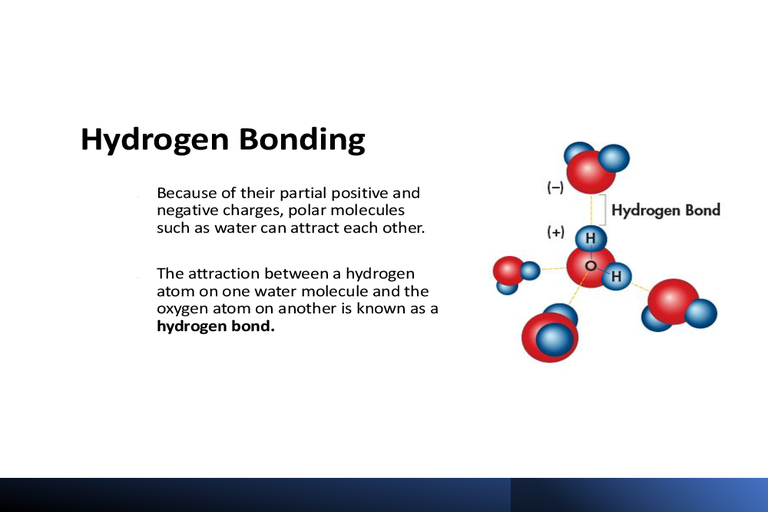
Which end of the water molecule has a slightly positive charge?
1

the oxygen end

2

the hydrogen end

3

both ends are slightly positive

4

neither end is positive

9

Multiple Choice

The term that describes the idea the hydrogen atoms of a water molecule has the positive charges and oxygen atom has a negative charge. These charges are opposite which is why the water molecule is able to stay bonded.
1

Polarity

2

Surface Tension

3

Specific Heat

4

Heat of Vaporization

10

media

11

media

12

Multiple Choice

Question image
Which statement explains why water molecules stick together?
1

both sides are negative

2

one side has a positive charge and the other side has a negative charge

3

one side has a negative charge adn the other side has a neutral charge

4

both sides are positive

13

Multiple Choice

Question image
When a molecule has an opposite electrical charge on each end, it is known as what?
1

cohesion

2

polar molecule

3

hydrogen bond

4

solution

14

Multiple Choice

True or False: Hydrogen bonds are very weak, which allows for many of the chemical characteristics found in water.

1

True

2

False

15

media

16

media

17

Multiple Choice

Question image

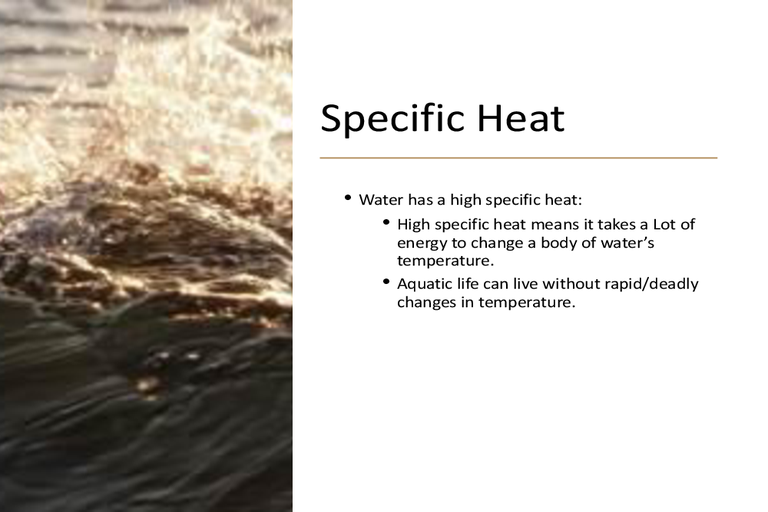
Water has a high specific heat capacity. This means that

1

it takes a lot of energy to change the temperature of water

2

water changes temperature very quickly and easily

3

water temperature doesn't change at all

18

Multiple Choice

Question image
Large bodies of water, such as lakes and oceans, do not quickly fluctuate in temperature. What is the reason for this phenomenon?
1

Water is an acid.

2

Water is a versatile solvent.

3

Water has a high heat capacity.

4

 Water acts as a buffer.

19

media

20

Multiple Choice

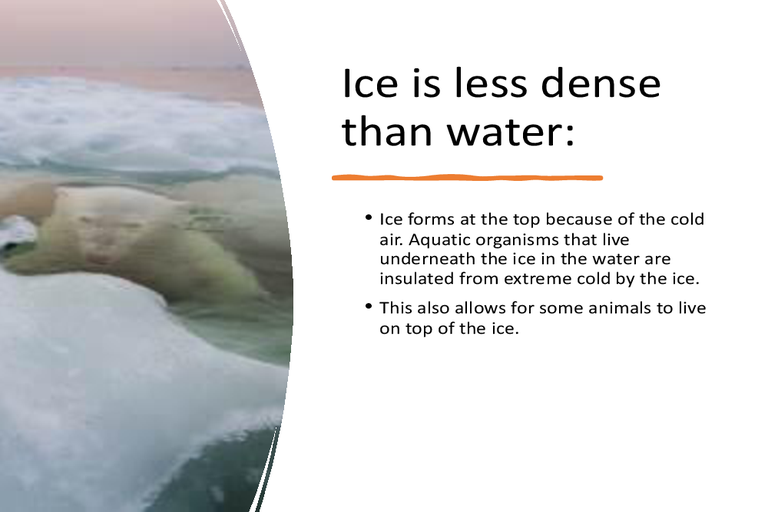
Why does ice stay at the top of oceans instead of sinking to the bottom?
1

 Ice is colder than liquid water.

2

Ice is less dense than liquid water.

3

Ice is more dense than liquid water.

4

Ice is warmer than liquid water.

21

Multiple Choice

Question image
The fact that ice floats on liquid water is due to the fact that water's solid is ___________ than it's liquid form
1

less polar

2

more polar

3

less dense

4

more dense

22

media

23

media

24

Multiple Choice

What is cohesion?
1

Water's ability to stick to itself

2

Water's ability to stick to other substances

3

The strength of the cohesion of all the water molecules combined

4

Tape, glue and other adhesives

25

Multiple Choice

Question image
When water molecules stick easily to other water molecules, this is called what?
1

cohesion

2

adhesion

3

solution

4

polar molecule

26

media

27

Multiple Choice

Question image
What word describes when water is attracted to other substances?
1

cohesion

2

adhesion

3

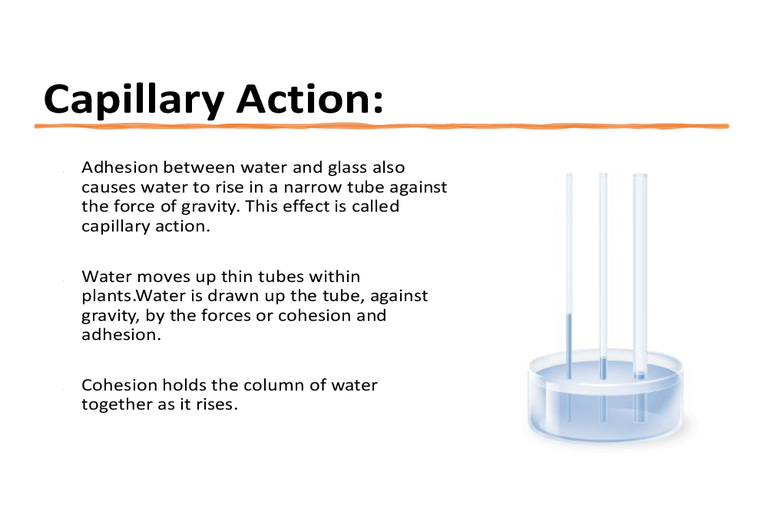
capillary action

4

surface tension

28

media

29

Multiple Choice

Question image

A combination of cohesion & adhesion that allows water to climb tubes

1

capillary action

2

surface tension

30

media

31

Multiple Choice

Question image
Water is a universal solvent because it...
1

It can be found anywhere

2

It freezes when it gets cold

3

floats when frozen

4

Dissolves most substances

32

media

33

Multiple Choice

Question image

The ability of water molecules to stick to each other, creating surface tension is called:

1

Cohesion

2

Adhesion

3

Insulation

4

Ph

34

Multiple Choice

Question image
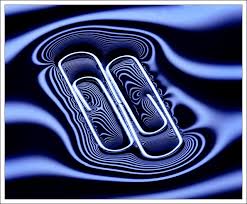
The tightness across the surface of water that enables paper clips to float is ____________.
1

adhesion

2

capillary action

3

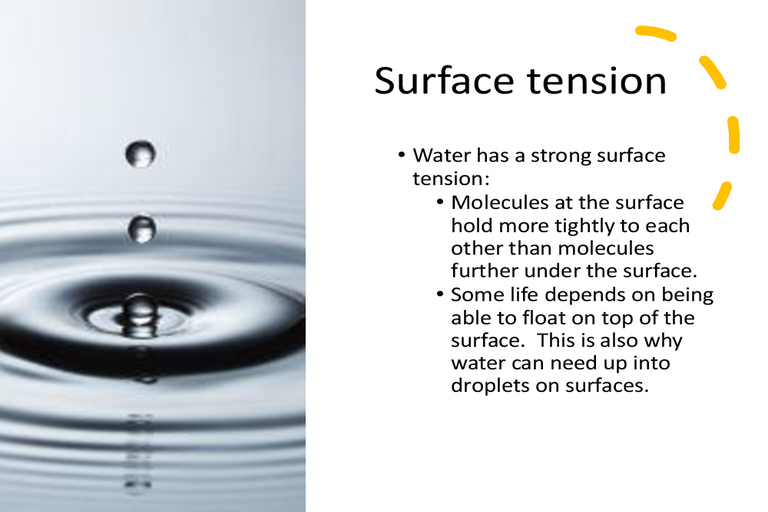
surface tension

4

polarity

35

media

36

37

Multiple Choice

Question image

What is cohesion?

1

The ability of a molecule to "stick" to itself

2

The ability of a molecule to "stick" to other molecules

3

Large amounts of energy are required to change the temperature of a substance

4

A well-organized and efficient team

38

Multiple Choice

Question image

What characteristic is shown in the image?

1

Polarity

2

Hydrogen Bonds

3

Cohesion

4

Adhesion

39

Multiple Choice

Question image

What property of water allows for water to act as a temperature regulator for the world?

1

Cohesive Behavior

2

Expansion Upon Freezing

3

High Specific Heat

4

Universal Solvent

40

Multiple Choice

Question image
Why does ice float?
1

As water freezes, it expands and its density decreases.

2

As water freezes, it takes up more hydrogen from the atmosphere, causing it to have a greater buoyancy.

3

As water freezes, air becomes trapped between the hydrogen bonds of water molecules.

4

As water freezes, it takes up more oxygen from the atmosphere, causing it to have a greater buoyancy.

41

Multiple Choice

Question image

The fact that water can stick to other substances is called:

1

Ph

2

Adhesion

3

Cohesion

4

Insulation

42

Multiple Choice

Question image

The "skin" that forms on water due to cohesion is called

1

surface tension

2

capillarity

3

adhesion

43

Multiple Choice

The property that allows water (and other substances) to stick to other objects is:
1

Adhension

2

Cohesion

3

Surface Tension

4

Specific Heat

44

Multiple Choice

Water is a universal solvent because it...
1

It can be found anywhere

2

It freezes when it gets cold

3

floats when frozen

4

Dissolves most substances

Properties of Water

Show answer

Auto Play

Slide 1 / 44

SLIDE