Search Header Logo
  1. Resource Library
  2. Science
  3. Physics
  4. Waves
  5. Properties Of Waves Quizizz Lesson W/questions
Properties of Waves Quizizz Lesson w/Questions

Properties of Waves Quizizz Lesson w/Questions

Assessment

Presentation

Science

10th Grade

Practice Problem

Easy

NGSS
HS-PS4-1, MS-PS4-1

Standards-aligned

Created by

T Greenleaf-Littsen

Used 3+ times

FREE Resource

14 Slides • 14 Questions

1

media

Properties of Mechanical Waves

Target 1: What determines the frequency of a wave?
Target 2: How are frequency and wavelength related?

1

2

Open Ended

How many "Targets" is this PowerPoint focusing on?

3

media
media

Properties of Waves

? What determines the frequency of a
wave?

Any periodic motion has a frequency,
which is the number of complete cycles
in a given period of time.

A waves frequency equals the frequency
of the vibrating source producing the
wave.

2

4

Multiple Choice

Any periodic motion has frequency.

1

This is a FALSE statement.

2

This is a TRUE statement.

5

Dropdown

Question image
A waves frequency ​
the frequency of the vibrating source.

6

media

Properties of Waves

Any motion that repeats itself at regular time intervals is called periodic
motion.

The time required for one cycle is called the period.

Frequency is the number of complete cycles in a given time.

Frequency is measured in cycles per second, or hertz (Hz).

3

7

Match

Match the following

periodic motion

frequency

hertz (Hz)

period

any motion that repeats itself at regular intervals

is the NUMBER of complete cycles in a given time

Frequency is measured in

the TIME required for one cycle

8

media
media
media

Properties of Waves

A wave vibrating at one cycle per second has
a frequency of 1.0 Hz.

A wave vibrating at two cycles per second has
a frequency of 2.0 Hz.

Frequency = 1.0 Hz
One cycle per second

Frequency = 2.0 Hz
Two cycle per second

4

9

Multiple Choice

Which of the following images represents HIGH Frequency?

1
2

10

media
media

Properties of Waves

How are frequency and wavelength
related?

Wavelength is the distance between a
point on one wave and the same point
on the next cycle of the wave.

**Increasing the frequency of a wave

decreases the wavelength**

5

11

Multiple Choice

Question image

___ is the distance between a point on one wave and the SAME point on the next cycle of the wave.

1

Amplitude

2

Period

3

Wavelength

4

Frequency

12

Dropdown

the Frequency of a wave decreases the ​
.

13

media
media
media

Properties of Waves

WAVELENGTH

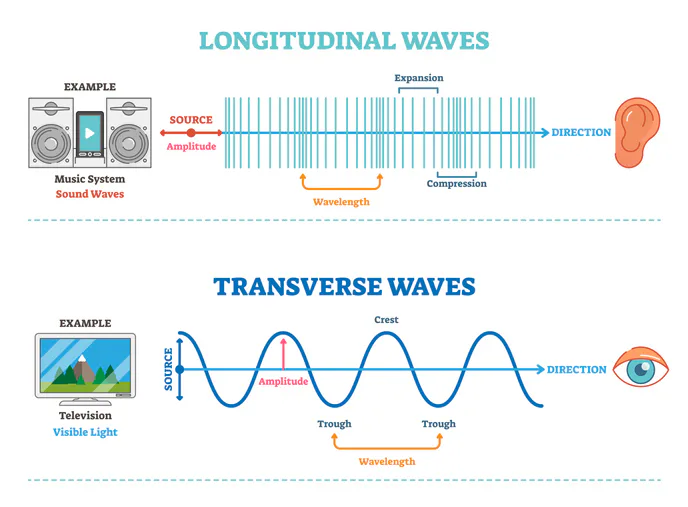
For a transverse wave, wavelength is
measured between adjacent crests or
troughs.

For longitudinal waves, wavelength is
the distance between adjacent
compressions or rarefactions.

6

14

media
media

Properties of Waves

WAVELENGTH

Wavelength can be measured from any point on a wave to the SAME point on
the next cycle of the wave.

Crest to Crest

or

Trough to Trough

7

15

media
media
media

Properties of Waves

How are frequency, wavelength, and speed related?

If you assume that waves travel at a constant speed, then wavelength is
INVERSELY PROPORTIONAL to frequency.

When frequency INCREASES . . . . wavelength DECREASES!

8

16

Dropdown

Wavelength is ​​
proportional to frequency.

17

media
media

Properties of Waves

WAVE SPEED

When the wavelength is in meters, and the frequency is in hertz, the units
for speed are meters per second, m/s.

9

18

Dropdown

Speed = Wavelength ​
Frequency

19

media
media

Properties of Waves

10

Wave speed , m/s

Frequency, Hz

Wavelength, m

20

Labelling

Identify whether you would divide or multiply when using the three equations.

Drag labels to their correct position on the image
multiply
divide

21

media
media

Wave Speed

The speed of a wave can change if it
enters a new medium, or if variables
such as pressure and temperature
change.

For many kinds of waves, the speed of
the wave is roughly constant for a
range of different frequencies.

The wave with the lower frequency
has a longer wavelength.

11

22

Multiple Choice

Question image

Identify which of the following can cause the SPEED of a wave to change.

1

enters a new medium

2

pressure change

3

temperature change

23

media
media
media

Amplitude

How is the amplitude of a wave related to the wave’s energy?

The amplitude of a wave is the maximum displacement of the medium from the
rest position.

The MORE energy a wave has, the GREATER its amplitude.

12

High

Energy

Low

Energy

24

media
media
media
media
media

Amplitude

The amplitude of a transverse wave is the distance from the rest position to
a crest or a trough.

It takes more energy to produce a wave with higher crests and deeper
troughs.

13

The more

energy a wave

has, the greater
the amplitude!

25

media
media

Amplitude

The amplitude of a longitudinal wave is the maximum displacement of a point
from its rest position (*Remember the rest position is VERTICAL!)

The more energy the wave has, the more the medium will be compressed of
displaced.

14

Notice the

compressions
between the
two waves!

26

Drag and Drop

of a wave is associated with the ​
of a wave. This is indicated by the displacement of the ​
from the ​
position.
Drag these tiles and drop them in the correct blank above
Amplitude
energy
medium
rest

27

Multiple Choice

Question image

Diagram is a representation of a longitudinal wave with ___ frequency.

1

low

2

high

28

Multiple Choice

Question image

Diagram is a representation of a longitudinal wave with ___ frequency.

1

low

2

high

media

Properties of Mechanical Waves

Target 1: What determines the frequency of a wave?
Target 2: How are frequency and wavelength related?

1

Show answer

Auto Play

Slide 1 / 28

SLIDE