

Grade 7 elite EOT2 REVIEW

Presentation
•
Science
•
8th Grade
•
Medium

Nisha K
Used 2+ times
FREE Resource
68 Slides • 53 Questions
1

G7 EOT REVIEW
COVERAGE
TERM 2
2

Identify examples of renewable natural resources. (Page 174)
•What are natural resources?
• A natural resource is something on Earth that living things
use to meet their needs. Natural resources can be living or
nonliving.
• Examples are air, soil, timber, water, coal, oil, gas, minerals,
animals, plants.
3

Identify examples of renewable natural resources. (Page 182)
•What are natural resources?
• Natural resources can be renewable or non-renewable.
✓Renewable resources are natural resources that can be replaced
by natural processes in a relatively short amount of time.
Example: solar, geothermal, wind, water and biomass.
✓Non-renewable resources are natural resources that are being
used up faster than they can be replaced by natural processes.
Example: minerals, fossil fuels like coal, oil and natural gas.
4

Identify examples of renewable natural resources. (Page 176-
179)
• Give three examples of natural resources.
1. Energy resources: Energy resources can come from sunlight,
fossil fuels, flowing water or other resources.
2. Land resources: Used to grow food and grazing animals. Wood
is used to make paper, furniture, cardboard. Land is also used
to build houses, parks. Ores that have minerals are obtained
from land.
3. Air and Water: Air is mostly used for breathing. Water is used
for daily activities like bathing, washing and cooking. Water is
also used for transport, industries and recreation.
5

Recognizing the characteristics of an active volcano. (Page 120)
• Define volcano.
• Volcano is a vent in Earth’s crust through which molten rock
flows.
6

Recognizing the characteristics of an active volcano. (Page 121,
123)
• Describe and compare the three types of volcano.
1. Volcanic arc
✓Volcanoes can form in the ocean where oceanic plates
converge and one plate subducts. These volcanoes emerge
as islands.
✓A curved line of volcanoes that form parallel to a plate
boundary is called volcanic arc.
✓Volcanic arcs can also form on land where an oceanic plate
subducts under a continental plate.
7
Multiple Choice
The following is NOT a renewable source of energy
minerals
solar energy
wind
water
8
Multiple Choice
Geothermal energy is an example of
renewable resources
nonrenewable resources
9
Multiple Select
The following are examples of renewable source of energy
wind
coal
biomass
solar
10
Open Ended
Define volcano
11

Recognizing the characteristics of an active volcano. (Page 121,
123)
• Describe and compare the three types of volcano.
2. Pillow Lava
✓Most of the volcanic activity on Earth occurs along the mid-
ocean ridges.
✓As the seafloor slowly spreads apart along mid-ocean ridges,
lava erupts into the rift formed by separating plates.
✓This lava takes the form of giant pillows and are called pillow
lava.
12

Recognizing the characteristics of an active volcano. (Page 121,
123)
• Describe and compare the three types of volcano.
3. Hot Spots
✓Volcanoes that are not associated with plate boundaries are
called hot spots like the Hawaiian islands.
✓The islands sit on top of a hot spot under the Pacific plate.
✓Hot rock in these areas is forced toward the crust where it
melts partially to form hot spot volcanoes.
✓The older islands move away from the stationary hotspot.
13

Differentiate between magma and lava.
What is magma?
✓Molten rocks present inside
the Earth’s crust is called
magma.
What is lava?
✓When the molten rock or
magma comes out to the
Earth’s surface through a
vent, it is called lava.
14
Multiple Choice
Molten rocks present inside the Earth’s crust is called lava whereas When the molten rock or magma comes out to the Earth’s surface through a vent, it is called magma.
True
False
15

To identify the process of how glaciers transport and deposit
sediment. (Page 64)
• How do glaciers transport and deposit sediments?
How is glacier transported?
• A glacier is a large mass of ice that forms on land and moves slowly across Earth’s surface.
• Glaciers carve the land as they move.
• Rocks and smaller stones frozen within the ice create grooves and scratches on the rocks under
the ice.
• As glacier moves down a mountain, it removes rocks from the sides and bottom.
• This forms a smooth land surface underneath the ice.
16

To identify the process of how glaciers transport and deposit
sediment. (Page 64)
• How do glaciers transport and deposit sediments?
How is glacier deposited?
• A glacier carries several types and sizes of rocks and sediments along with it.
• The sediments move along with the glaciers as it moves downhill.
• When glaciers melt, the water produced by the melting of ice does not flow fast enough to carry
the sediment.
• The sediment is deposited where the ice melts.
17

To identify the process of how glaciers transport and deposit
sediment. (Page 64)
• What do you call the leftover rocks when glaciers melt?
• When glaciers melt, the water produced by the melting of ice does not flow fast enough to carry
the sediment.
• The sediment is deposited where the ice melts.
• The mixture of various sizes of sediments deposited by a glacier is called till.
• Deposits of till are poorly sorted, which means they are all different sizes.
18
Multiple Choice

A gigantic mass of moving ice
glacial drift
stratified drift
till
glacier
19
Multiple Choice

unsorted rock material (large and small rocks) deposited directly by a glacier as it melts
glacial drift
stratified drift
till
glacier
20
Multiple Choice

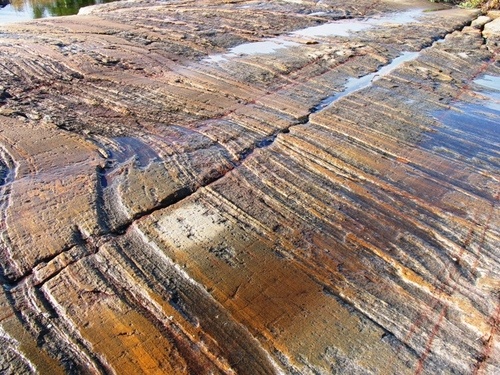
The photograph shows scratched and grooved
bedrock with boulders on its surface. The scratches and grooves were most likely created when
alternating thawing and freezing of water cracked the bedrock
flooding from a nearby lake covered the bedrock
a glacier dragged rocks over the bedrock
rocks from a landslide slid along the bedrock
21

To understand the process and mechanisms of volcanic
eruptions.
• Explain the process of the volcanic eruption. (Page 45)
• The slow and large-scale motion of Earth’s tectonic plates causes the formation of volcanoes and
the rapid and sometimes catastrophic eruptions that result.
• Sometimes lava flows from volcanoes slowly and at other times, volcanoes can erupt explosively.
• Volcanic eruptions can result in large mountains, create new crust, and leave a path of
destruction.
22

To understand the process and mechanisms of volcanic
eruptions.
• Explain the process of the volcanic eruption. (Page 45)
• There are three types of volcanoes.
1.
Volcanic arc (Slide 6)
2.
Pillow lava (Slide 7)
3.
Hotspots (Slide 8)
23

To understand the process and mechanisms of volcanic
eruptions.
MOLTEN ROCK
• Rocks under the ground can melt due to high
temperature and pressure.
• These molten rocks are known as magma.
HOT SPOT
• Volcanoes that are not associated with plate
boundaries are called hot spots like the
Hawaiian islands.
• Hot rock in these areas is forced toward the
crust where it melts partially to form hot spot
volcanoes.
What is the difference between a molten rock and a hot spot?
24
Open Ended
Volcanoes that are not associated with plate boundaries are called
25

Understand the differences between physical and chemical weathering
processes. (Page 54-57)
PHYSICAL WEATHERING
• Physical weathering breaks rocks
into small pieces without
changing the composition or
chemical make up of the rock.
CHEMICAL WEATHERING
• Chemical weathering can be
caused by reactions between
rock and the chemicals in air and
water.
•
What is the difference between physical and chemical weathering?
26

Understand the differences between physical and chemical weathering
processes. (Page 54-57)
CHEMICAL WEATHERING
PHYSICAL WEATHERING
• Animals that live in soil create holes
in the soil where water enters and
causes weathering.
• Animals burrowing through loose
rock can also help to break down
rocks.
• The roots of plants can grow into
cracks in rocks.
• Water can dissolve minerals in
rocks and cause weathering over a
long period of time.
• Water can dissolve minerals and
form caves over time.
•
Give examples of physical and chemical weathering.
27
Multiple Choice
the breaking down of rocks and minerals on earth's surface. Often due to physical and chemical processes
Weathering
Erosion
Earth System
Surface Process
28
Multiple Choice
Involves a reaction; a new substance is created
physical weathering
chemical weathering
29
Multiple Choice

physical weathering: abrasion
chemical weathering: reaction with acid
chemical weathering: oxidation
physical weathering: ice/frost wedging
30
Multiple Choice
Weathering caused by burrowing and digging, exposing rock and soil to the surface is an example of
physical weathering
chemical weathering
31
Fill in the Blanks
Oxidation, acid precipitation, acids in groundwater, acids in living things are examples of
Type answer...
32


Define what Earth's crust is and what it is made of./ Identify the
name of the different layers of the Earth.
• Name the three layers of the earth.
• The Earth’s surface is made up of crust.
• The mantle is made up of semi-molten rock.
• The core is divided and inner core and outer
core.
• The outer core is made up of molten metals
and inner core is the hottest layer.
33
Open Ended
The innermost layer of the earth is
34


Define what Earth's crust is and what it is made of./ Identify the
name of the different layers of the Earth.
• The innermost layer of the earth is _____.
Answer: Core or inner core
35

Give examples of fossil fuels. (Page 177)
• What is fossil fuel?
• The Sun’s energy is stored in plants and animals as chemical energy.
• Over millions of years, the dead remains of these plants and animals
were converted to fossil fuels by several geological processes.
• Fossil fuels are a very concentrated form of chemical energy that
easily transforms into other forms of energy.
36

Give examples of fossil fuels. (Page 198)
• What is fossil fuel?
• The type of fossil fuel formed depends on three factors
✓The type of organic matter
✓The temperature and pressure
✓The length of time that the organic matter was buried.
37


Give examples of fossil fuels. (Page 197)
• Give two examples of fossil fuels?
1. Oil and Natural Gas
• Oil and natural gas formed from the
remains of plankton (small plants and
animals) that lived in ocean.
• Oil deposits can also be found under
land due to movement of tectonic
plates.
• Oil and natural gas is usually trapped
between impermeable rocks. This is
known as geologic trap.
• Natural gas is found above oil deposits.
38

Give examples of fossil fuels. (Page 200)
• Give two examples of fossil fuels?
2. Coal
• The remains of plants that died millions of years ago build up. Sediments will
cover these remains.
• Bacteria breaks down the organic matter. Heat and temperature squeezes
out gas and moisture to form peat.
• As more sediment covers and compresses peat, it changes into harder
substance called coal.
39
Multiple Choice

Fossil fuel is an energy providing material that comes from
long-dead remains of living things.
the center of the Earth.
out space.
the atmosphere.
40
Multiple Choice

Which of the following is NOT a fossil fuel.
coal
carbon dioxide
petroleum oil
natural gas
41
Multiple Choice

The remains that transformed into fossil fuels were buried for
a few hundred years.
millions of years.
less than 20,000 years.
hardly any time at all.
42
Multiple Choice

Heat and _____________ transformed living things into fossil fuels.
pressure
air
gas
water
43
Multiple Choice

There is a limited amount of fossil fuels.
true
false
44
Multiple Choice

Fossil fuels are a _______________________.
renewable resource
unknown resource
nonrenewable resource
new resource
45
Multiple Choice
require expensive equipment
take millions of years to replace
can be found all over
provide all the energy we use
46
Multiple Choice
Hydroelectric
Geothermal
Biofuels
Solar
47
Multiple Choice

True
False
48
Multiple Choice
Natasha has been learning about power plants that use coal to produce electricity and has decided that she would like to do her part to help conserve coal. How can Natasha help conserve coal?
Natasha can ride a bicycle to school instead of having her parents
drive her to school.
Natasha can leave her computer on even when she is not using it.
Natasha can turn off the lights when she leaves a room.
Natasha can plant a flower garden using compost
49
Multiple Choice
gasoline
oil
natural gas
coal
50
Multiple Choice

ocean organisms (plants and animals) buried in sediment millions of years ago
Ocean plants buried in sediment a thousand years ago
swamp plants and animals buried in sediment millions of years ago
organisms buried
51

Define an aquifer. (Page 204)
• What are the sources of groundwater?
• Groundwater resources are a result of past and current geologic
processes.
• The steps of water cycle are important sources of groundwater.
• The rock cycle also plays an important role in the formation and
distribution of groundwater.
• Surface drainage and porosity and permeabilty of rocks below Earth’s
surface or sediment can influence where water collects underground.
52

Define an aquifer. (Page 203)
• What is an aquifer?
• People often bring groundwater to Earth’s surface by drilling wells.
• Wells are usually drilled into an aquifer.
• An aquifer is an area of permeable sediment or rock that holds
significant amount of water
• Porosity: the measure of a rock's ability to hold water.
• Permeability: the measure of the ability of water to flow through rock
and sediment.
53
Multiple Choice
• An--------------------is an area of permeable sediment or rock that holds significant amount of water.
aquifer
hot spot
magma
permeablility
54

Identify simple actions individuals can take to
protect the environment.
• What are the actions people can take to protect the environment?
1. Reduce, reuse, recycle
2. Spread awareness to your friends, family and neighbors.
3. Carpool or use public transport.
4. Plant trees in your surroundings.
5. Compost
6. Save electricity, water, paper and other resources.
Please research this topic in internet while you are studying.
55

Identify simple actions individuals can take to
protect the environment.
• Why is it important to clean, conserve, and protect the
environment?
It is important to keep the environment clean as it allows humans and
animals to live in healthy and safer conditions.
It is important to conserve and protect the environment as it will not
only help our generation survive, but also the future generations. This
is known as sustainability.
Please research this topic in internet while you are studying.
56

57

Students will explore how the continents have moved over time on Earth’s surface. They will
analyze and interpret data and identify patterns of the distribution of fossils and rocks, continental
shapes, landmasses, glacial features, and climate to provide evidence of past plate motions.
• Describe how the evidences supports the hypothesis of continental drift.
(Page 12-15)
1. Evidence from rock formation
✓Wegener reasoned that when Pangaea began to break apart, large geologic
structures like mountains became separated as continents drifted apart.
✓He thought that there should be areas of similar rock types on opposite sides
of the Atlantic Ocean.
2. Evidence from glacial feature.
✓Wegener discovered 290-million-year-old glacial grooves, or deep scratches in
rocks made as glaciers moved across South America, Africa, Australia, and
India.
58

Students will construct explanations about how people depend on Earth's energy, land, water,
and air resources. They will identify resources used to make common items and analyse their
daily use of resources. Students will also recognize the factors that determine whether a resource
is renewable or non-renewable, and model the depletion of a non-renewable resource.
• What are ores? (Page 177)
• Ores are deposits of minerals that are large enough to be mined for
profit.
• Ores are mined from Earth.
• The automobile industry, agriculture and food production; and road
home and building construction use minerals from ores.
59
Multiple Choice
What is the Theory of Continental Drift?
Earth's continents do not move.
Earth's continents moved in the past and continue moving today.
Earth's continents will eventually fall off the planet.
60
Multiple Choice

What is the name for the large landmass of all the continents that formed 175 million years ago?
Pangaea
Laurasia
United Continents
61
Multiple Choice
What piece of evidence for Continental Drift states that the continents fit together like puzzle pieces?
Continent Shape
Fossil/Climate Evidence
Landform/Rock Evidence
Glacial Evidence
62
Multiple Choice
What piece of evidence for Continental Drift states that the same plant and animal fossils are found on continents separated by oceans.
Continent Shape
Fossil/Climate Evidence
Landform/Rock Evidence
Glacial Evidence
63
Multiple Choice
What piece of evidence for Continental Drift states that glacial deposits and glacial scarring are found on continents with warm climates today.
Continent Shape
Fossil/Climate Evidence
Landform/Rock Evidence
Glacial Evidence
64
Multiple Choice
What was Wegener’s continental drift idea?
The continents have moved slowly apart to their current locations.
The continents have always been located at their current locations.
The continents are moving slowly together from their current locations.
None of these
65
Multiple Choice
True or False-Similar fossil records across continents was evidence for continental drift.
True
False
66
Multiple Choice
The remains or traces of ancient life are called ____________.
bones
remanents
fossils
none of the above
67
Multiple Choice
Africa has always been near the equator
Africa was once in an area of the Earth that had a very cold climate
The continents have not moved
sea floor spreading
68
Multiple Choice

What evidence did Wegener use to support his theory?
Continents and fossils fitting together/matching-up like puzzle pieces
glacier scars and other climate evidence from temperature
mountain ranges and rocks line up across continents
all of the above
69
Multiple Choice
the presence of penguins at both the equator and Antarctica
fossils of the same plant have been found on several continents
the presence of glacial features in Antarctica
the presence of volcanic rock in Antarctica
70

71
Open Ended
•The youngest rocks on the ocean floor are located ____.
72

73
Multiple Choice
New ocean crust is continually formed at
mid-ocean ridges
Trenches
subduction zones
ocean basin
74

Students will construct explanations about how people depend on Earth's energy, land, water,
and air resources. They will identify resources used to make common items and analyse their
daily use of resources. Students will also recognize the factors that determine whether a resource
is renewable or non-renewable, and model the depletion of a non-renewable resource.
• How do humans depend on land resources? (Page 177)
• People use land to grow food and grazing animals.
• The wood from trees is used to make furniture, paper and other timber
products.
• We build, live and play on land.
• Land is used to create green spaces and areas of vegetation in urban
landscape.
• Some land is also used for wilderness preserves and national parks.
• Mining of ores also happens on land.
75

Students will construct explanations about how people depend on Earth's energy, land, water,
and air resources. They will identify resources used to make common items and analyse their
daily use of resources. Students will also recognize the factors that determine whether a resource
is renewable or non-renewable, and model the depletion of a non-renewable resource.
• _____ are deposits of minerals that are large enough to be mined for
a profit.
A.Run-offs
B.Metals
C.Ores
D.none of the above
76
Multiple Choice
•_____ are deposits of minerals that are large enough to be mined for a profit.
Run-offs
Metals
Ores
none of the above
77


Students will explore the development of the theory of plate tectonics. They will
analyze and interpret data and identify patterns based on the locations of sea floor
structures and the ages of rocks to provide evidence of past plate motions.
• What pattern did scientists find of the
age of rocks on the ocean floor?
• Rocks near mid-ocean ridges were
youngest and rocks near trenches were
oldest.
• As we move away from the mid-ocean
ridges, the rocks become older.
78
Multiple Choice
Rocks near mid-ocean ridges were youngest and rocks near trenches were oldest
True
false
79

Students will explore the development of the theory of plate tectonics. They will analyse
and interpret data and identify patterns based on the locations of sea floor structures and
the ages of rocks to provide evidence of past plate motions.
• Explain how the new crust is created at mid-ocean ridges. (Page 28-29)
• Seafloor spreading is the process by which new oceanic crust continuously
forms along mid-ocean ridges and is destroyed at ocean trenches.
• Molten rock inside earth is called magma and when it comes to Earth’s
surface it’s called lava.
• As lava cools and crystallizes, it forms new oceanic crust.
• Two halves of the oceanic crust spread apart slowly, and move apart like a
conveyor belt.
• As the seafloor continues to spread apart, the older oceanic crust moves
away from the mid-ocean ridge and sinks at the ocean trenches.
80


Students will explore the processes of weathering, erosion, and deposition, which shape Earth’s
surface. They will construct explanations based on evidence of how these geoscience processes
have changed Earth’s surface at varying time and spatial scales.
• Describe how caves form in limestone.
(Page 57)
• When carbon dioxide in the air mixes
with rainwater, a weak acid forms.
• As acidic rainwater seeps through rocks
and soil, it can pass through layers of
limestone.
• Acidic water dissolves and washes
away the limestone, it forms a cave.
• This process can take tens to thousands
to millions of years.
81

Students will explore the processes of weathering, erosion, and deposition, which shape Earth’s
surface. They will construct explanations based on evidence of how these geoscience processes
have changed Earth’s surface at varying time and spatial scales.
• Predict what might happen to rocks exposed to hydrochloric acid in the
environment over time.
• The rocks would undergo chemical weathering.
• Over time, parts of the rocks would dissolve, and the remaining parts of the
rocks would turn to sediment.
82
Open Ended
•Predict what might happen to rocks exposed to hydrochloric acid in the environment over time.
83

Students will explore how the movement of plates forms mountain ranges and
volcanoes and causes earthquakes. They will construct explanations, develop and use
models, and identify patterns to understand how plates move and interact.
• How do you think large mountain ranges might form? (Page 38)
• Mountain ranges are produced by the slow and large-scale motion of
Earth’s plates.
• There are three type of plate boundaries.
1. When plates move towards each other, it is called convergent
boundary.
2. When plates move away from each other, it is called divergent
boundary.
3. When plates slide horizontally past each other, it is called transform
boundary.
84

Students will explore how the movement of plates forms mountain ranges and
volcanoes and causes earthquakes. They will construct explanations, develop and use
models, and identify patterns to understand how plates move and interact.
• Explain the formation of fold mountains? (Page 40)
• When continental plates collide at convergent plate boundaries, fold
mountains are formed.
• When a denser oceanic plate collides with a continental plate at a
convergent boundary, the denser plate subducts.
• This causes fold mountains to form at the edge of the plate that is
not subducted.
85
Multiple Choice
Plates that diverge or move apart from each other
divergent
transform
convergent
lithosphere
86
Multiple Choice
Cracks or breaks in earth's crust where plates slip past each other
subduction
faults
mid-ocean ridge
san andreas
87
Multiple Choice
Continental plate collides with another continental plate creates
volcanoes
earthquake
trench
folded mountains
88
Multiple Choice
Occurs when a less dense plate slides under a more dense plate
tectonic plates
subduction
continental drift
landmass
89
Multiple Choice

What type of plate boundary is shown in the picture
convergent
divergent
transform
faults
90
Multiple Choice
Plates boundary where plates slide or move past each other
divergent
continental drift
transform
convergent
91
Multiple Choice
The type of geological event that occurs under transform boundaries
folded mountains
earthquakes
volcanoes
tsunamis
92
Multiple Choice

What plate boundary is shown in the picture?
convergent
divergent
transform
neither
93

Students will construct explanations about how people depend on Earth's energy, land, water, and air
resources. They will identify resources used to make common items and analyze their daily use of
resources. Students will also recognize the factors that determine whether a resource is renewable or
nonrenewable, and model the depletion of a nonrenewable resource.
• What is the importance of water resources? (Page 179)
• Water is used for agriculture, transportation, and recreation.
• Freshwater is used for cooking, drinking and cleaning. It is also used
for irrigation. Plants absorb soil from water.
• It is also used for mining, manufacturing and generating power.
• Rivers lakes and oceans are used as means of transport.
• Fish and seafood from lakes, oceans and rivers are sources of protein.
• Water is necessary for our body to function.
94

Students will construct explanations about how people depend on Earth's energy, land, water, and air
resources. They will identify resources used to make common items and analyze their daily use of
resources. Students will also recognize the factors that determine whether a resource is renewable or
nonrenewable, and model the depletion of a nonrenewable resource.
• How might your household water usage change from season to
season?
• During winter, the amount of water used may be less. For example,
you may not use washing machine everyday.
• In warm seasons, outdoor water use may increase because of
watering lawns and gardens and filling swimming pools.
You can research your own points as well.
95

Students will construct explanations about the factors that cause severe weather,
such as hurricanes, tornadoes, droughts, and floods. They will analyze and interpret
data to determine the risk of severe weather in different regions, and use maps to
understand the patterns scientists use to predict the likelihood of future events.
• What causes a drought? (Page 152)
• A drought is an extended period of well-below-average rainfall.
• It is caused by high pressure weather systems that persists for weeks
or months over an area.
• The sinking air in the system blocks moisture from rising and cloud
formation cannot occur.
96

Students will construct explanations about the factors that cause severe weather,
such as hurricanes, tornadoes, droughts, and floods. They will analyze and interpret
data to determine the risk of severe weather in different regions, and use maps to
understand the patterns scientists use to predict the likelihood of future events.
• Where do floods and droughts occur?
• Places which have high precipitation, urbanization or dam failure have
high chances of flood.
• Places with high pressure systems and below average rainfall have
high chances of drought.
97
Multiple Choice
A _______________ occurs when a large volume of water overflows its boundaries
flood
drought
earthquake
volcano
98

Students will construct explanations about the factors that cause severe weather,
such as hurricanes, tornadoes, droughts, and floods. They will analyze and interpret
data to determine the risk of severe weather in different regions, and use maps to
understand the patterns scientists use to predict the likelihood of future events.
• A _______________ occurs when a large volume of water overflows
its boundaries.
Answer: flood
99

Students will analyze and interpret maps and other data to recognize patterns in the distribution of
resources. Students will discover that Earth’s resources, including minerals, soil, fossil fuels, and
groundwater, are distributed unevenly around the planet.
• Which of the following determined the type of fossil fuel formed
from prehistoric organic matter? (Page 198)
A. type of organic matter
B. temperature and pressure
C. length and time the organic matter was buried
D. all of the above
100

Students will analyze and interpret maps and other data to recognize patterns in the distribution of
resources. Students will discover that Earth’s resources, including minerals, soil, fossil fuels, and
groundwater, are distributed unevenly around the planet.
• Why are some regions rich in fossil fuels? (Page 198)
• The existence of fossil fuels in an area depends on the geologic
history of the area.
• Places rich in coal were swamps hundreds of years ago.
• Places rich in oil and natural gas were covered by ancient oceans.
• In case of oil and natural gas, if they were not trapped in geologic
traps (slide 21), they would not be available.
101


Students will analyze and interpret maps and other data to recognize patterns in the distribution of
resources. Students will discover that Earth’s resources, including minerals, soil, fossil fuels, and
groundwater, are distributed unevenly around the planet.
• What do you think is the difference between
weel-sorted sediment and poorly sorted
sediment? (Page 202)
• Well sorted sediment is all about the same size.
Poorly sorted sediments have a wide range of
sizes.
• Which sample has the highest porosity?
Explain. (Page 202)
• The well sorted, large sediment has slightly
higher porosity than the well sorted small
sediment. The unsorted sample in the middle
has lowest porosity as the smaller grains fill the
spaces between the larger grains.
102

Students will analyze and interpret maps and other data to recognize patterns in the distribution of
resources. Students will discover that Earth’s resources, including minerals, soil, fossil fuels, and
groundwater, are distributed unevenly around the planet.
• What is porosity? (Page 20)
• Porosity is the measure of a rock's ability to hold water.
• How do you think the process of cementation (when minerals crystallize
between sediment grains) might affect the porosity of the material? (Page
202)
• Cementation decreases the amount of pore space or porosity of the rocks
because those spaces would be occupied by the minerals that cement the rock
together.
103

Students will learn how humans extract and obtain natural resources. They analyze patterns and
systems to construct explanations about the cause-and-effect relationship between the use of
resources and the distribution and availability of resources.
• What three factors should be considered before mining a newly
found mineral deposit? (Page 212)
1. Population growth increases mineral consumption.
2. More countries are becoming industrialized and consumer
societies.
3. Minerals are non-renewable resources.
104

Students will learn how humans extract and obtain natural resources. They analyze patterns and
systems to construct explanations about the cause-and-effect relationship between the use of
resources and the distribution and availability of resources.
• How does mining affect mineral distribution? (Page 212)
• Since minerals are non-renewable resource, it takes a long time for
them to form again.
• This means that as we mine more minerals, lesser minerals will be
available for human consumption.
105


Students will learn how humans extract and obtain natural resources. They analyze patterns and
systems to construct explanations about the cause-and-effect relationship between the use of
resources and the distribution and availability of resources.
• Page 215 – Investigation
1. About how long is the world’s oil expected to
last? Till 2068 (45 years)
2. About how long is the world’s natural gas
expected to last? Till 2101 (78 years)
3. Coal reserves are projected to last until what
year? Till 2298 (275 years)
4. What might explain why these projections vary?
Coal reserves are more abundant than oil deposits
and natural gas deposits.
106

Students will learn how humans extract and obtain natural resources. They analyze patterns and
systems to construct explanations about the cause-and-effect relationship between the use of
resources and the distribution and availability of resources.
• Why is the conservation of fossil fuels important today?
• It is important to conserve fossil fuels because they are non-renewable
resources. The amount of fossil fuels are limited, and they do not renew as
fast.
• It is also important to conserve fossil fuels because it will help reduce the
pollution in air and help us stay healthy and safe.
107

Students will learn how humans extract and obtain natural resources. They analyze patterns and
systems to construct explanations about the cause-and-effect relationship between the use of
resources and the distribution and availability of resources.
• What are two ways that individuals can conserve fossil fuels?
1. We can use electric cars and bikes which will reduce the use of oil.
2. We can use renewable sources like solar, water, wind and geothermal to
produce electricity instead of fossil fuels.
3. We can reduce the use of plastic, as it is made from fossil fuels.
4. We can save electricity by making sure the switches are off when not in use.
5. We can stop burning fossil fuels.
You can research more points in internet.
108

Students will learn how people use resources and how increased consumption of resources affects
Earth’s systems. They will use evidence to explain how activities and technology can mitigate the
negative impacts on Earth.
• What are the short-term and long-term consequences of clearing an
entire forest?
• Short-term consequences
✓Positive: Increase in paper and fuel products. Land available for living.
✓Negative: Habitat loss, drought and erosion.
• Long-term consequences
✓Extinction of species and decrease in biodiversity.
✓Increase in carbon dioxide which increases the temperature of Earth and
causes climate change.
109

Students will learn how people use resources and how increased consumption of resources affects
Earth’s systems. They will use evidence to explain how activities and technology can mitigate the
negative impacts on Earth.
• Identify the possible negative impacts of deforestation.
✓Habitat loss, drought and erosion.
✓Extinction of species and decrease in biodiversity.
✓Increase in carbon dioxide which increases the temperature of Earth
and causes climate change.
✓Decrease in the rates of photosynthesis and amount of oxygen.
110


Students will construct explanations about the geologic forces that cause earthquakes, including the build-up of stress
along tectonic plate boundaries. They will discover how earthquakes are measured and recognize the factors that affect
the severity of damage caused by an earthquake. Students will analyze and interpret data related to earthquake risk
and use maps to understand the patterns scientists use to predict the likelihood of future events. Students will also
learn about earthquake safety measures, including technologies to mitigate the impacts of an earthquake.
• Page 106
1. What does the graph show?
The graph shows the number of earthquakes per
year, along the locations, effects, and energy
equivalents of major earthquakes.
2. What is the relationship between the magnitude
of an earthquake and the effects it can cause?
The greater the magnitude of an earthquake, the
more damage it can cause.
111

Students will construct explanations about the geologic forces that cause earthquakes, including the build-up of stress
along tectonic plate boundaries. They will discover how earthquakes are measured and recognize the factors that affect
the severity of damage caused by an earthquake. Students will analyze and interpret data related to earthquake risk
and use maps to understand the patterns scientists use to predict the likelihood of future events. Students will also
learn about earthquake safety measures, including technologies to mitigate the impacts of an earthquake.
• Describe and compare the three types of scales used by scientists to measure
and describe earthquakes. (Page 100-102)
1. Richter Magnitude Scale
• It is a numerical scale system that measures the energy or magnitude of the
largest seismic wave produced by an earthquake.
• This scale is based on amplitude (height) of lines on a seismograph.
2. Moment Magnitude Scale
• It is a rating scale that measures energy released by an earthquake, taking into
account the size of the fault that breaks, the motion that occurs along the fault
and strength of rock that breaks during earthquake.
112

Students will construct explanations about the geologic forces that cause earthquakes, including the build-up of stress
along tectonic plate boundaries. They will discover how earthquakes are measured and recognize the factors that affect
the severity of damage caused by an earthquake. Students will analyze and interpret data related to earthquake risk
and use maps to understand the patterns scientists use to predict the likelihood of future events. Students will also
learn about earthquake safety measures, including technologies to mitigate the impacts of an earthquake.
• Describe and compare the three types of scales used by scientists to measure
and describe earthquakes. (Page 100-102)
3. Modified Mercalli Intensity Scale
• It measures earthquake intensity based on description of the earthquake’s
effects on people and structures.
• The scale ranges from I to XII.
• It is not accurate as different people can describe different effects.
113

Students will construct explanations about the geologic forces that cause earthquakes, including the build-up of stress
along tectonic plate boundaries. They will discover how earthquakes are measured and recognize the factors that affect
the severity of damage caused by an earthquake. Students will analyze and interpret data related to earthquake risk
and use maps to understand the patterns scientists use to predict the likelihood of future events. Students will also
learn about earthquake safety measures, including technologies to mitigate the impacts of an earthquake.
• What factors affect the amount of damage caused by an earthquake? (Page
107-109)
1. Structural Damage
• Pancaking: It happens when supporting walls of the ground floor of a building
fail and cause the upper floors to fall and collapse as they hit lower floors.
• Building height: the higher the building, the longer its natural period of
vibration. Seismic waves with the same period as that of a tall buildingcan
cause building to sway and collapse violently.
114

Students will construct explanations about the geologic forces that cause earthquakes, including the build-up of stress
along tectonic plate boundaries. They will discover how earthquakes are measured and recognize the factors that affect
the severity of damage caused by an earthquake. Students will analyze and interpret data related to earthquake risk
and use maps to understand the patterns scientists use to predict the likelihood of future events. Students will also
learn about earthquake safety measures, including technologies to mitigate the impacts of an earthquake.
• What factors affect the amount of damage caused by an earthquake? (Page
107-109)
2. Structural Faiure
• Other than pancaking and building height, local geology can cause structural
damage.
• In areas with loose sediment, ground motion will be very high.
3. Land and Soil Failure
• Liquefaction: Shaking during earthquake can cause wet soil to act as a liquid
and buildings may collapse due to this.
• Lanslide: It is the rapid downhill movement of soil, loose rocks, and boulders.
115

Students will construct explanations about the geologic forces that cause earthquakes, including the build-up of stress
along tectonic plate boundaries. They will discover how earthquakes are measured and recognize the factors that affect
the severity of damage caused by an earthquake. Students will analyze and interpret data related to earthquake risk
and use maps to understand the patterns scientists use to predict the likelihood of future events. Students will also
learn about earthquake safety measures, including technologies to mitigate the impacts of an earthquake.
• What factors affect the amount of damage caused by an earthquake? (Page
107-109)
4. Tsunami
• It is a large ocean wave generated by vertical motion of the seafloor during an
earthquake.
• It can also be caused by underwater earthquake.
116

Students will construct explanations about the geologic forces that cause earthquakes, including the build-up of stress
along tectonic plate boundaries. They will discover how earthquakes are measured and recognize the factors that affect
the severity of damage caused by an earthquake. Students will analyze and interpret data related to earthquake risk
and use maps to understand the patterns scientists use to predict the likelihood of future events. Students will also
learn about earthquake safety measures, including technologies to mitigate the impacts of an earthquake.
• Explain the relationship between worldwide earthquake distribution and
geologic forces. (Page 99)
• Plate boundaries and faults are locations where stress builds up in rocks
because of geologic forces.
• When this stress is released, earthquakes occur.
• Therefore, most earthquakes around the world occur in areas where geologic
forces are present.
117

Students will learn how human population has increased over time. They will investigate the factors
that affect the growth of human populations and engage in scientific arguments about the cause and-
effect relationship between human population growth and increased consumption of resources.
• When do populations increase?
A. when birth rates are smaller than death rates
B. when death rates are higher than birth rates
C. when birth rates are higher than death rates
D. when birth rates and death rates are equal
118


Students will learn how human population has increased over time. They will investigate the factors
that affect the growth of human populations and engage in scientific arguments about the cause and-
effect relationship between human population growth and increased consumption of resources.
• Page 241
119


Students will learn how human population has increased over time. They will investigate the factors
that affect the growth of human populations and engage in scientific arguments about the cause and-
effect relationship between human population growth and increased consumption of resources.
• Page 233
120

Students will learn how human population has increased over time. They will investigate the factors
that affect the growth of human populations and engage in scientific arguments about the cause and-
effect relationship between human population growth and increased consumption of resources.
• Explain what is carrying capacity? (Page 235-238)
• Carrying capacity is the largest number of individuals of a given species
that Earth’s resources can support and maintain for a long period of time.
• If the population is less than carrying capacity, there is enough resources
for each individual.
• If the population is more than carrying capacity, resources are depleted
faster than it can be replaced.
121


Students will learn how human population has increased over time. They will investigate the factors
that affect the growth of human populations and engage in scientific arguments about the cause and-
effect relationship between human population growth and increased consumption of resources.
• Page 234
• Developing countries are growing
rapidly.
• The individuals in the pre-
reproductive state and reproductive
state greatly exceeds those in the
post-reproductive state of the
population.
• In developed countries, although the
population is increasing, it is doing so
at a very slow rate.
G7 EOT REVIEW
COVERAGE
TERM 2
Show answer
Auto Play
Slide 1 / 121
SLIDE
Similar Resources on Wayground

119 questions
GEO Unit 1: Wind, Storms, and Cyclones
Presentation
•
6th - 8th Grade
115 questions
Order of Operations and Evaluating Expressions
Presentation
•
6th - 8th Grade
118 questions
................................................................
Presentation
•
6th - 8th Grade
114 questions
energy and states of matter
Presentation
•
7th Grade
117 questions
G7- Final Review Chapter 2 [Term1]
Presentation
•
7th Grade
121 questions
NMMS 2021 WRITING CAMP - The Conventions Pyramid!
Presentation
•
8th Grade
112 questions
contries all
Presentation
•
8th Grade
115 questions
AC review
Presentation
•
8th Grade
Popular Resources on Wayground
10 questions
Safety Day 2026 – Student Review

Quiz
•
9th Grade
21 questions
Continents and Oceans
Quiz
•
6th Grade
20 questions
Parts of Speech
Quiz
•
5th Grade
16 questions
Subject & Predicate
Quiz
•
5th Grade
25 questions
Multiplication Facts
Quiz
•
5th Grade
12 questions
Map Skills
Quiz
•
3rd Grade
22 questions
Continents and Oceans
Quiz
•
5th Grade
15 questions
Rounding Decimals
Quiz
•
5th Grade
Discover more resources for Science
20 questions
Newton's Laws of Motion
Quiz
•
8th Grade
15 questions
potential and kinetic energy
Quiz
•
8th Grade
21 questions
Newton's Laws of Motion
Quiz
•
8th Grade
20 questions
Elements, Compounds and Mixtures
Quiz
•
8th Grade
10 questions
Exploring Chemical and Physical Changes

Interactive video
•
6th - 10th Grade
20 questions
Physical vs Chemical Changes
Quiz
•
8th Grade
20 questions
Conduction, convection, and Radiation Practice
Quiz
•
8th Grade
21 questions
Waves and Wave Properties
Quiz
•
6th - 8th Grade