Search Header Logo
Unit 4 Practice

Unit 4 Practice

Assessment

Presentation

Mathematics

KG

Practice Problem

Medium

Created by

Hetal Shah

Used 1+ times

FREE Resource

2 Slides • 25 Questions

1

​Vertical Angles

​When two lines intersect, 4 angles are created.

  • ​The angles that are across from each other are always congruent.

  • ​These are called VERTICAL ANGLES.

media

2

media

3

Multiple Choice

Question image
Name the angle relationship.
1

Alternate Interior

2

Alternate Exterior

3

Corresponding

4

Vertical Angles

4

Multiple Choice

Question image

Angle 3 and Angle 7 are...

1

Corresponding Angles

2

Alternate Interior Angles

3

Alternate Exterior Angles

4

Consecutive Interior Angles

5

Multiple Choice

Question image

What angle corresponds to  3\angle3  ?

1

4\angle4  

2

5\angle5  

3

8\angle8  

4

7\angle7  

6

Multiple Choice

Question image

What angle corresponds to  7\angle7  ?

1

4\angle4  

2

5\angle5  

3

8\angle8  

4

7\angle7  

7

Multiple Choice

Question image
∠1 and ∠3 can best be described as -
1

complementary angles

2

supplementary angles

3

vertical angles

4

adjacent angles

8

Multiple Choice

Question image
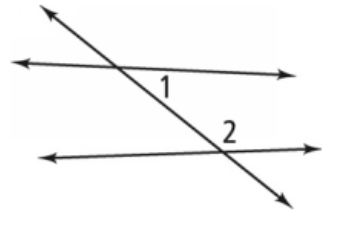
Name the angle relationship.
1

Alternate Interior

2

Alternate Exterior

3

Corresponding

4

Vertical Angles

9

Multiple Choice

Question image

1 \angle1\  and 2\angle2  are ___.

1

Alternate Interior Angles

2

Alternate Exterior Angles

3

Same-side Interior Angles

4

Corresponding Angles

5

None of these

10

Multiple Choice

Question image
Find the measure of the angle indicated. 
1

139°

2

66°

3

138°

4

116°

11

Multiple Choice

Question image
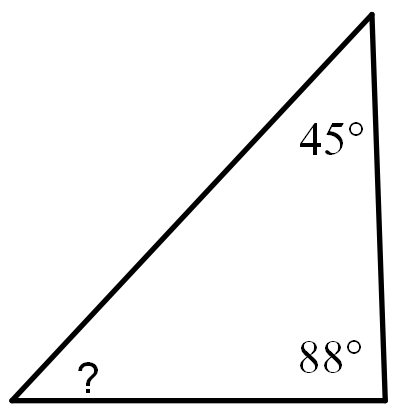
Find the measure of the missing angle.
1

47

2

57

3

53

4

133

12

Multiple Choice

Question image
Find the missing angle.  Find x.
1

20o

2

70o

3

160o

4

180o

13

Multiple Choice

Question image
What is the value of x?
1

8

2

22.5

3

11.25

4

60

14

Multiple Choice

Question image
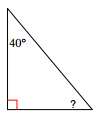
Find the measure of the missing angle.
1

90o

2

100

3

130o

4

50o

15

Multiple Choice

Question image
Write a rule for the translation.
1

 (x -1, y  + 2)

2

 (x -2, y  + 1)

3

 (x +2, y  - 1)

4

(x +1, y  -  2)

16

Multiple Choice

Question image
The image shows what type of transformation
1

Rotation

2

Translation

3

Reflection

17

Multiple Choice

Question image
What is this picture an example of? 
1

An angle

2

A cat vertex 

3

Rotation 

18

Multiple Choice

Question image
Identify the transformation from C to D.
1

90o Clockwise Rotation

2

180o Rotation

3

270o Clockwise Rotation

4

360o Rotation

19

Multiple Choice

Triangle LMN has vertices L(–1, 4), M(–2, 4), and N(–1, –1). What are the coordinates of the image of point M after a dilation with a scale factor of 3?

1

(-6, 12)

2

(-6, 4)

3

(-2, 12)

4

(12, -6)

20

Multiple Choice

Point A(3, 5) was dilated, and the point after dilation was A’(6, 10).  What was the scale factor used?

1

1/2

2

2

3

1

4

3

21

Multiple Choice

Question image

What scale factor was used for the dilation shown?

1

1/2

2

1

3

2

4

3

22

Multiple Choice

Question image
Determine how to translate triangle A'B'C' to triangle ABC.
1

(x+2, y-5)

2

(x+2, y-9)

3

(x-2, y-9)

4

(x-2, y+9)

23

Multiple Choice

Question image
Determine where X' would be if you translated X 3 units to the left and 9 units down.
1

(-4, 4)

2

(-10, 2)

3

(-4, -5)

4

(-1, 5)

24

Multiple Choice

Two objects that are the same shape but not the same size are _______.
1

Congruent

2

Vertical

3

Similar

4

Complementary 

25

Multiple Choice

If the scale factor is less than one, the new figure will be
1

an enlargement

2

a reduction

3

a scale factor

4

bigger

26

Multiple Choice

Question image

Are the triangles shown similar, congruent or neither?

1

Similar

2

Congruent

3

Neither

27

Multiple Choice

Question image
.
1

Yes they are similar

2

No they're not similar

3

Cannot be determined

​Vertical Angles

​When two lines intersect, 4 angles are created.

  • ​The angles that are across from each other are always congruent.

  • ​These are called VERTICAL ANGLES.

media

Show answer

Auto Play

Slide 1 / 27

SLIDE