
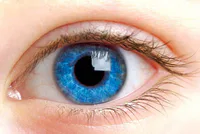
The Eyes

Presentation
•
Fun
•
6th - 8th Grade
•
Practice Problem
•
Medium

CHRISTOPHER HARTMANN
Used 116+ times
FREE Resource
11 Slides • 4 Questions
1

Eye Structure
and Seeing Light
2

The eye is like a camera: Light enters, is focused
on a surface, and a picture is made.
Light enters your eye through a clear portion of
the sclera (the tough, white, outer covering of the
eye), called the cornea.
3

The cornea is curved, so it slightly bends the light
as it goes through.
Light then passes through the aqueous humor (a
clear fluid for eye nourishment, in the anterior chamber)
and through the pupil.
The pupil is simply a hole in the iris.
4
Multiple Choice
What is the hole in the eye that light passes through?
Pupil
Cornea
Retena
5

The iris is a muscle that controls the size of the
pupil. The iris is the colored part of the eye.
In bright light, the iris expands and the pupil gets smaller
In low light, the iris contracts and the pupil gets bigger
6

Directly behind the iris is the lens. This structure
changes shape to focus the light so that we can
see clearly. Its shape is convex, meaning it curves
outward on both sides.
The ciliary muscles above and below the lens
control the shape of the lens.
7

Behind the lens is a clear gel called the vitreous
humor. After moving through the vitreous humor,
the light strikes the retina. The retina is the lining
on the inside of the back of the eye that contains
two types of light-sensitive cells: rods and cones.
8
Multiple Select
What are the TWO light sensitive cells in the eye?
Rods
Pupils
Cones
Retinas
9

Rods sense black and white and work in low light.
L
-
cones
sense long wavelengths in the
red range
M
-
cones
sense mid
-
range wavelengths in
green range
S
-
cones
sense short wavelengths in the
blue range
Cones sense
color and must
have more light
than rods to
work. Three
kinds of cones:
10

The rods and cones send messages to the brain
through the optic nerve. The brain makes sense of
all the information it is receives.
In your brain, the sight
center is in the back,
between your ears. This
location explains why a
blow to the back of your
head might cause
blindness, even though
your eyes are fine.
11
Multiple Choice
True or False: The Rods can detect all 7 colors
True
False
12

1. Genetic (you are born with these types) Sometimes a
cone is missing, or the cone does not recognize the
correct wavelengths of light. L- and M-cone problems
result in red-green color blindness, the most common.
Two Causes of Color Blindness
13

2. Non-Genetic (these types occur after birth) Accidents
that damage the vision center of the brain, cataracts,
glaucoma, Parkinson’s Disease can cause S-cone
problems, diabetic retinopathy can affect color vision
14
Multiple Choice
What is the name of the condition in which cones cannot see certain wavelengths of light?
Visual Impairment
Photophobia
Color Blindness
Optic Atrophy
15

Eye Anatomy Review
cornea
pupil
iris
anterior chamber
aqueous humor
lens
vitreous humor
retina
fovea
choroid
sclera
optic nerve
Eye Structure
and Seeing Light
Show answer
Auto Play
Slide 1 / 15
SLIDE
Similar Resources on Wayground

10 questions
Integers and number line
Presentation
•
7th Grade
10 questions
Theme Lesson
Presentation
•
6th - 8th Grade
10 questions
Verbs
Presentation
•
6th - 8th Grade
11 questions
Identifying Variables In Experiments
Presentation
•
6th - 8th Grade
10 questions
Christmas
Presentation
•
KG
12 questions
Anne Frank Character Change
Presentation
•
6th - 9th Grade
12 questions
Using R.A.C.E. to Construct Short-Answer Responses
Presentation
•
6th - 8th Grade
12 questions
RACE(S) Writing
Presentation
•
6th - 8th Grade
Popular Resources on Wayground
10 questions
How much do you know about our Portrait of an Eagle?

Quiz
•
10th Grade
10 questions
Fast Food Slogans
Quiz
•
6th - 8th Grade
21 questions
Continents and Oceans
Quiz
•
6th Grade
20 questions
Parts of Speech
Quiz
•
5th Grade
16 questions
Subject & Predicate
Quiz
•
5th Grade
25 questions
Multiplication Facts
Quiz
•
5th Grade
12 questions
Map Skills
Quiz
•
3rd Grade
22 questions
Continents and Oceans
Quiz
•
5th Grade
Discover more resources for Fun
10 questions
Fast Food Slogans
Quiz
•
6th - 8th Grade
20 questions
Brand Labels
Quiz
•
5th - 12th Grade
16 questions
Fun Brain Riddles and Teasers Quiz
Quiz
•
8th Grade
11 questions
NFL Football logos
Quiz
•
KG - Professional Dev...
20 questions
FAST FOOD Fun!!!
Quiz
•
6th - 8th Grade
18 questions
candy
Quiz
•
8th Grade
16 questions
Logos
Quiz
•
7th Grade
15 questions
Middle School Fun Trivia Questions
Quiz
•
7th - 8th Grade