
Classification of Life

Presentation
•
Science
•
8th Grade
•
Practice Problem
•
Medium
+6
Standards-aligned

Rachael Stark
Used 36+ times
FREE Resource
11 Slides • 9 Questions
1

2
Reorder
Reorder the following from most broad to most specific
Domain
Kingdom
Phylum
Class
Order
3
Reorder
Reorder the following from most broad to most specific
Class
Order
Family
Genus
Species
4

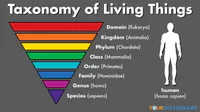
Scientists compare the physical, chemical, and genetic traits of all living things to organize them.
Why do we do this? To keep them organized, and so that we can follow trends throughout evolutionary time. It's how we know that birds came from dinosaurs, and whales came from a goat/deer like creature.
Question: How/Why do we classify life?

5

6

7
How can we remember this system?
Come up with a pneumonic or Memory Tool!
Dumb ------- Dear ------------------- Dear
King ---------- Karla's --------------- Katie
Phillip ------- Pizza ----------------- Please
Came ------- Center --------------- Come
Over --------- Over ------------------ Over
From -------- Filled ----------------- For
Germany -- Grandma's -------- Great
Swimming -Sandwich --------- Snacks
8
Archaea are single celled protists (no nucleus or membrane bound organelles). They used to be called Extremophiles because they live in EXTREME places (inside hotsprings, inside cold-seeps, on the edge of hydrothermal vents) where no other kinds of life can really exist.
-
Bacteria are protists (no nucleus or membrane bound organelles). We know what bacteria are.
-
Eukaryotes DO have nuclei and membrane bound organelles. Eukaryotic cells MAKE UP YOU, and the plants/animals YOU love.
Question: What are the 3 Domains?

9
Multiple Choice
Which Domain do humans exist in?
Bacteria
Eukarya
Archaea
10
There are FOUR kingdoms that make up Eukarya: Fungi, Plantae, Animalia, and Protista.
Fungi are funguses. No, mushrooms are NOT plants. They cannot perform photosynthesis or make their own food (they are heterotrophs).
-
Animalia speaks for itself. It's made of animals; just like how Plantae is made of plants.
-
Protists are single-celled eukaryotic organisms, or multicellular eukaryotic organisms. They can be autotrophic or heterotrophic. Kelp is an autotrophic protist.
Question: What are the Kingdoms?

11
Multiple Choice
A scientist finds an organism that cannot move. It has many cells, produces spores, and gets food from its environment. Which kingdom does it likely belong to?
Animalia
Plantae
Fungi
Protista
12
The further we go down the Linnean Classification system, the MORE classifications there are because organisms get more and more closely related. In Kingdom Animalia alone, there are 9 Phyla. YOU DO NOT NEED TO KNOW ALL OF THEM!
The main one we will be following along with is Chordata (ours). Chordata is the ONLY Phylum where animals have a backbone/central nervous system/spinal chord.
Question: What are Phyla?

13

Classes contain organisms that are more closely related than those that JUST share a Phylum.
-
Example: Snakes and Bears both are members of the Phylum Chordata, but Bears and Cats are both members of the Class Mammalia, and Snakes and Lizards are both members of the Class Squamata.
-
Similarly, organisms that share an Order are more closely related than those that just share a Class.
-
Example: Bears and Monkeys are both in the Class Mammalia. But, where Bears and Wolves are both in the Order Carnivora, Monkeys and Gorillas are both in the Order Primates.
Question: What are Class and Order?
14
Genuses contain organisms that are more closely related than those that JUST share an Order.
-
Example: Bears and Wolves both are members of the Order Carnivora, but Black Bears and Polar Bears are both members of the Genus Ursus, and Wolves and Doga are both members of the Genus Canis.
-
Species is the ACTUAL ANIMAL you are talking about.
-
Example: Black Bears are Ursus americanus.
-
Scientists HAVE to italicize or underline the genus and species names, and the Genus is ALWAYS capitalized.
Question: What are Genus and Species?
15
Multiple Choice
What are the two parts of a scientific name?
Domain and Genus
Domain and Kingdom
Phylum and Class
Genus and Species
16
Multiple Choice
Pick the BEST answer: Organisms that are not closely related to each other will likely share a...
Class
Order
Phylum
Genus
17
Multiple Choice
Pick the BEST answer: Which level do cats and dogs most likely share?
Species
Order
Phylum
Genus
18
Reorder
Reorder the following from most broad to most specific
Domain
Kingdom
Phylum
Class
Order
19
Reorder
Reorder the following from most broad to most specific
Class
Order
Family
Genus
Species
20

SUMMARY: How does the Pyramid shape relate to the Linnean Classification System?
Show answer
Auto Play
Slide 1 / 20
SLIDE
Similar Resources on Wayground

18 questions
Lunar Cycle
Presentation
•
8th Grade
12 questions
Adaptations
Presentation
•
8th Grade
18 questions
Scientific Method Notes
Presentation
•
8th Grade
15 questions
Weather Fronts
Presentation
•
8th Grade
16 questions
Intro to the Solar System
Presentation
•
8th Grade
17 questions
calc speed/motion graphs
Presentation
•
8th Grade
17 questions
Acceleration
Presentation
•
8th Grade
16 questions
The Scientific Method
Presentation
•
8th Grade
Popular Resources on Wayground
10 questions
Safety Day 2026 – Student Review

Quiz
•
9th Grade
21 questions
Continents and Oceans
Quiz
•
6th Grade
20 questions
Parts of Speech
Quiz
•
5th Grade
16 questions
Subject & Predicate
Quiz
•
5th Grade
25 questions
Multiplication Facts
Quiz
•
5th Grade
12 questions
Map Skills
Quiz
•
3rd Grade
22 questions
Continents and Oceans
Quiz
•
5th Grade
15 questions
Rounding Decimals
Quiz
•
5th Grade
Discover more resources for Science
20 questions
Newton's Laws of Motion
Quiz
•
8th Grade
15 questions
potential and kinetic energy
Quiz
•
8th Grade
21 questions
Newton's Laws of Motion
Quiz
•
8th Grade
20 questions
Elements, Compounds and Mixtures
Quiz
•
8th Grade
10 questions
Exploring Chemical and Physical Changes

Interactive video
•
6th - 10th Grade
20 questions
Physical vs Chemical Changes
Quiz
•
8th Grade
20 questions
Conduction, convection, and Radiation Practice
Quiz
•
8th Grade
21 questions
Waves and Wave Properties
Quiz
•
6th - 8th Grade