
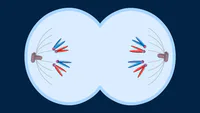
Powers Cell Cycle and Mitosis Notes

Presentation
•
Biology
•
9th - 12th Grade
•
Medium
+1
Standards-aligned

Christopher Powers
Used 6+ times
FREE Resource
27 Slides • 18 Questions
1


5.1 The Cell Cycle and Mitosis Notes
10.1
KEY CONCEPT
Cells have distinct phases of growth, reproduction,
and normal functions.
2

5.1 The Cell Cycle
•In most cases, living things grow by producing more
cells
• On average, the cells of an adult organisms are not
bigger than those of an infant organisms, there are just
more of them
• In order for organisms to maintain a consistency
(homeostasis) between new and old cells, an
organizational systems must be in place
• Scientists call the system that has evolved the Cell
Cycle
• The cell cycle is a regular pattern of growth, DNA
replication, and cell division.
10.1
3


5.1 The Cell Cycle
10.1
4

5.1 The Cell Cycle
• The 2 main stages of the cell cycle are:
1. Interphase:
○ The entire time that the cells needs to prepare for cell
division
○ Largest portion of Cell Cycle
- Gap 1 (G1): cell growth and normal functions
- DNA synthesis (S): copies DNA
- Gap 2 (G2): additional growth and prepare for division
2. Cell Division/Mitosis (M):
○ Includes division of the cell nucleus (mitosis) and
division of the cell cytoplasm (cytokinesis)
• Cell division occurs only if the cell is large enough and
the DNA is undamaged.
10.1
5
Multiple Choice
G1 phase
S phase
G2 phase
M phase
6
Multiple Choice
mitosis
cytokinesis
Interphase
None of the above
7
Multiple Choice
Cell Division
Cell Cycle
Cytokinesis
Mitosis
8


5.1 The Cell Cycle
10.1
9
Multiple Choice
G1 phase
S phase
G2 phase
M phase
10
Multiple Choice
Interphase
S phase
M phase
G1 phase
11


5.1 The Cell Cycle
Key Concept: Cells divide at different rates.
• The rate of cell division varies with the need for those
types of cells.
• Some cells are unlikely to divide (G0).
10.1
12


5.1 The Cell Cycle
• Cell size is limited. Cells MUST be small.
• Volume increases faster than surface area.
• Cells need LARGE surface area but SMALL volume
• Large S.A. – easy for things to travel in and out of cell
• Small volume – quick diffusion (travel time) for things inside
of cell
10.1
13


5.1 The Cell Cycle
• Surface area must allow for adequate
exchange of materials.
– Cell growth is coordinated with
division.
– Cells that must be large have
unique shapes.
10.1
14


5.1 The Cell Cycle
KEY CONCEPT
Cells divide during mitosis and cytokinesis.
10.2
15


5.1 The Cell Cycle
• Mitosis
• All of your body cells will do mitosis because:
– Growth (from infant to adult)
– Replace dead or damaged cells
– Injury (cut skin)
• Some organisms will use mitosis to reproduce
ASEXUALLY
• The end result of cell division (sometimes referred to
as mitosis) are 2 cells that are genetically identical
10.2
16

5.1 The Cell Cycle
• Chromosomes condense at the start of mitosis.
• DNA wraps around proteins (histones) that condense it.
DNA double
helix
DNA and
histones
Chromatin
Supercoiled
DNA
10.2
17


5.1 The Cell Cycle
• DNA plus proteins is called chromatin.
• Chromatin is loosely coiled/
condensed
• A chromosome is very tightly
coiled/condensed
• One half of a duplicated
chromosome is a chromatid.
• Sister chromatids are held
together at the centromere.
• Sister chromatids are EXACTLY
THE SAME (product of DNA
Replication)
Condensed, duplicated chromosome
chromatid
telomere
centromere
telomere
10.2
18
Multiple Choice
DNA
RNT
WWE
DMA
19
Multiple Choice

Segments of DNA are called _______________________
Genes
Alleles
Traits
Chromosomes
20
Multiple Choice
meiosis
recessive traits
genes
heredity
21

Mitosis in Detail
● For the cell to maintain homeostasis, it needs a
complete copy of the genetic material (DNA)
● Interphase (G1, S, G2) is the copying of the DNA
and organelles
● Mitosis is the division of the DNA into 2 equal
parts (daughter cells), one complete copy for
each new cell
● Occurs in somatic (body) cells for growth,
repair/replacement of old/damaged cells
● Mitosis starts with 1 Diploid cell, and ends with 2
Diploid cells that are identical copies of the Parent
(original) cell.
22
Multiple Choice
What is chromatin?
The little protein balls that DNA is wrapped around.
The structure which holds two chromatids together.
The beads-on-a-string form of DNA in the nucleus of a non-dividing cell.
The most subtle color of blue-green.
23


5.1 The Cell Cycle
The phases of mitosis include:
- Prophase
- Metaphase
- Anaphase
- Telophase
10.2
24
Multiple Choice
The correct sequence of mitosis:
metaphase, anaphase, telophase, prophase
prophase, metaphase, anaphase, telophase
prophase, anaphase, metaphase, telophase
telophase, metaphase, prophase, anaphase
25


Prophase
●1st and longest phase of mitosis
●Chromosomes become visible as
the chromatin condenses
●Spindle fibers form from
centrioles
●Centrioles take their position on
opposite sides of the cell
●Nuclear membrane breaks down
26


Metaphase
● The shortest phase of mitosis.
● Chromosomes line up across
the middle of the cell.
● Spindle fibers connect the
centromere of each sister
chromatid to the poles of the
cell.
● “Meet in the middle”
27


Anaphase
●Chromosomes split apart as spindles pull them apart towards the ends of the
cell
●Chromosomes continue to separate until they have formed 2 groups at the
poles of the spindle
●Cell elongates
28


Telophase
●Nuclear membrane forms around each new cluster of chromosomes in order
to form new nuclei, one for each cell
29
Multiple Choice

Which phase is this in?
Prophase
Metaphase
Anaphase
Telephase
30
Multiple Choice

Which phase is this in?
Prophase
Metaphase
Anaphase
Telephase
31
Multiple Choice

Which phase is this in?
Prophase
Interphase
Anaphase
Cytokinesis
32
Multiple Choice

Which phase is this in?
Prophase
Metaphase
Anaphase
Telephase
33


Telophase continued...
● Telophase ends with
cytokinesis by
“pinching” inward
● This is the final division
of cytoplasm between
the 2 new identical cells
● Animal cells use a
cleavage furrow
● Plant cells use a cell
plate because of their
cell wall
34


Plant vs. Animal Cell Division
35
Reorder
Prophase
Metaphase
Anaphase
Telephase
cytokenises
36


5.1 The Cell Cycle
KEY CONCEPT
Many organisms reproduce by cell division.
37


5.1 The Cell Cycle
• Binary fission is similar in function to mitosis.
• Asexual reproduction is the creation of offspring from a
single parent.
– Binary fission produces two daughter cells genetically
identical to the parent cell.
– Binary fission occurs in
prokaryotes.
parent cell
DNA
duplicates
cell begins
to divide
daughter
cells
38


5.1 The Cell Cycle
• Some eukaryotes reproduce through mitosis.
• Budding forms a new organism from a small projection
growing on the surface of the parent.
bud
Hydra
Yeast
39


5.1 The Cell Cycle
• Fragmentation is the
splitting of the parent into
pieces that each grow into a
new organism.
• Vegetative reproduction
forms a new plant from the
modification of a stem or
underground structure on
the parent plant.
40


5.1 The Cell Cycle
• Environment determines what form of reproduction is most
advantageous.
– Asexual reproduction is
an advantage in
consistently favorable
conditions.
– Sexual reproduction is
an advantage in
changing conditions.
41
Multiple Choice
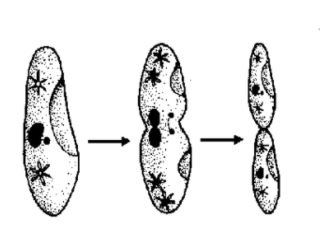
What type of asexual reproduction is illustrated in the diagram?
binary fission
budding
sporulation
regeneration
42
Multiple Choice
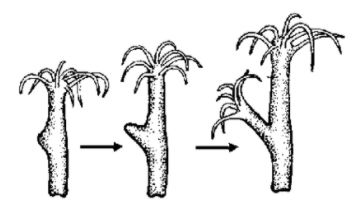
What type of asexual reproduction is illustrated in the diagram?
binary fission
budding
sporulation
regeneration
43
Multiple Choice
A cell with 46 chromosomes divides by mitosis, how many chromosomes will be present in the resulting daughter cells?
92
46
23
12
44


5.1 The Cell Cycle
• Let’s Practice!!
45


5.1 The Cell Cycle and Mitosis Notes
10.1
KEY CONCEPT
Cells have distinct phases of growth, reproduction,
and normal functions.
Show answer
Auto Play
Slide 1 / 45
SLIDE
Similar Resources on Wayground

41 questions
Double Object Pronouns
Presentation
•
9th - 12th Grade
41 questions
Nixon, Ford, Carter
Presentation
•
9th - 12th Grade
37 questions
Viruses
Presentation
•
9th - 12th Grade
38 questions
Newton's Third law
Presentation
•
9th - 12th Grade
38 questions
Pollution Control lesson
Presentation
•
9th - 12th Grade
40 questions
Balancing and 5 Types of Chemical Reactions
Presentation
•
9th - 12th Grade
41 questions
Nuclear Chemistry
Presentation
•
9th - 12th Grade
41 questions
Las Excusas (Pre-song Story)
Presentation
•
9th - 12th Grade
Popular Resources on Wayground
10 questions
How much do you know about our Portrait of an Eagle?

Quiz
•
10th Grade
10 questions
Fast Food Slogans
Quiz
•
6th - 8th Grade
21 questions
Continents and Oceans
Quiz
•
6th Grade
20 questions
Parts of Speech
Quiz
•
5th Grade
16 questions
Subject & Predicate
Quiz
•
5th Grade
25 questions
Multiplication Facts
Quiz
•
5th Grade
12 questions
Map Skills
Quiz
•
3rd Grade
22 questions
Continents and Oceans
Quiz
•
5th Grade
Discover more resources for Biology
20 questions
Characteristics of Life
Quiz
•
9th - 10th Grade
10 questions
Exploring the 4 Major Macromolecules and Their Functions

Interactive video
•
9th - 12th Grade
20 questions
Cell organelles and functions
Quiz
•
10th Grade
20 questions
Cell Transport
Quiz
•
9th - 12th Grade
25 questions
photosynthesis and cellular respiration
Quiz
•
9th Grade
20 questions
Macromolecules
Quiz
•
10th Grade
16 questions
Population Ecology
Quiz
•
9th - 12th Grade
20 questions
Cell Organelles
Quiz
•
9th Grade