
Reconstruction Review

Presentation
•
Social Studies
•
8th Grade
•
Practice Problem
•
Medium

Breana Park
Used 15+ times
FREE Resource
33 Slides • 21 Questions
1
Reconstruction Era
One of the biggest challenges of the Reconstruction Era was creating a system to give land to freedmen so they could farm and make a living. This system never developed due to political disagreements. The South experienced poverty for
generations with sharecropping and tenancy replacing
slavery, while northern businesses prospered.
Though passed during the Civil War, the Homestead and
Morrill acts provided new opportunities after the country was no longer at war.
2

Reconstruction Era, Major Events
13th
14th
& 15th
Amendments
Radical Reconstruction
Andrew Johnson
Sharecropping
Carpetbaggers and Scalawags
Compromise of 1877
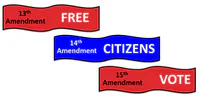
FREE
CITIZENS
VOTE
3
Unit Vocabulary-Reconstruction Era
Reconstruction– process of rebuilding the Union with
the readmission of the southern states
sharecropping– the practice of receiving a portion of
the crops in exchange for living and farming on a large
estate
carpetbagger– referred to Northerners who moved to
the South following the Civil War to take advantage of
the unsettled political situation
scalawag– referred to Southerners who cooperated
with federal authorities during Reconstruction, often
gaining an advantage
homestead– a tract of land with a home on it
4
Related Vocabulary:
Reconstruction Era
✔Legislation
✔Black Codes
✔Land Grant
✔ Amendment
✔ Civil Rights
✔ Due Process
5
Reconstruction
Amendments
13th
Amendment
14th
14th Amendment
15th
Amendment
FREE
CITIZENS
VOTE
6

Reconstruction
Amendments
13th
Amendment“FREE”
Abolish Slavery
Freed all enslaved people without compensation to
slave holders.
Legally forbade slavery in the United States.
7
Reconstruction
Amendments
14th
Amendment“CITIZENS”
Gave citizenship and equal protection to anyone born in the U.S.
Protect the rights of citizens
Citizenship (equal protection clause and due process clause).
8
Reconstruction
Amendments
15th
Amendment“VOTE”
Granted African American men the right
to vote
Universal male suffrage
Granting voting rights to formerly enslaved males
9
Multiple Choice
The 13th Amendment
Abolished Slavery except as a punishment for a crime.
granted citizenship to all persons "born or naturalized in the United States," including formerly enslaved people
Gave all males the right to vote regardless of race, color, or previous condition of servitude.
Freedom of
Religion
Assembly
Press
Petition
Speech
10
Multiple Choice
The 14th Amendment
"Neither slavery nor involuntary servitude, except as a punishment for crime whereof the party shall have been duly convicted, shall exist within the United States, or any place subject to their jurisdiction."
granted citizenship to all persons "born or naturalized in the United States," including formerly enslaved people
The right of citizens of the United States to vote shall not be denied or abridged by the United States or by any State on account of race, color, or previous condition of servitude.
Freedom of
Religion
Assembly
Press
Petition
Speech
11
Multiple Choice
The 15th Amendment
"Neither slavery nor involuntary servitude, except as a punishment for crime whereof the party shall have been duly convicted, shall exist within the United States, or any place subject to their jurisdiction."
granted citizenship to all persons "born or naturalized in the United States," including formerly enslaved people
The right of citizens of the United States to vote shall not be denied or abridged by the United States or by any State on account of race, color, or previous condition of servitude.
Freedom of
Religion
Assembly
Press
Petition
Speech
12
Multiple Choice
(RAAPS) Freedom of
Religion
Assembly
Press
Petition
Speech
15th Amendment
14th Amendment
13th Amendment
1st Amendment
13
Radical Reconstruction Congress
Legislative Reform Programs
Freedmen’s
Bureau
Established in the War
Department (in March, 1865).
Federal agency that supplied
the newly freed slaves with
money, education, houses
and protection.
The Bureau also assumed custody of confiscated lands
or property in the former Confederate States, border
states, District of Columbia, and Indian Territory.
14
Multiple Select
The purpose of the Freedmen's Bureau was to provide the following to assist formerly enslaved persons. (Choose all that apply).
Money and Education
Housing and Protection
40 acres and a mule
Revenge
15
Multiple Choice
The Freedmen's Bureau was also responsible for which of the following?
Taking custody of confiscated property or lands.
Serving as judges in the military districts.
Hunting down former Confederate Officers.
Writing legislation in the southern states.
16
Radical Reconstruction Congress
Legislative Reform Programs
Military Reconstruction Act of 1867
To enforce Reconstruction laws in the South.
Split the former Confederacy into 5 occupied military districts.
Strict guidelines on representation and requirements for readmission to Union.
Five Occupied Military Districts

17
Multiple Choice
How many military districts did the south create during Radical Reconstruction?
5
13
6
12
18
Multiple Choice
Texas and Louisiana were combined into which district?
District 1
District 3
District 4
District 5
19


Radical Reconstruction Congress
Legislative Reform Programs
Civil Rights Act of 1866
First time Congress passed a law protecting racial minorities.
Granted citizenship to persons born in the United States, except members of American Indian tribes
–
20

Problems
During Reconstruction
How to readmit the southern states back into the Union.
Passage of the Reconstruction Act
divided the Southern states into 5 military districts.
The Reconstruction Act
Supported by Radical Republicans (northern congressmen), who were resented by many Southerners.
–
Five Occupied Military Districts
21

Problems
During Reconstruction
How to rebuild the southern economy
A system of sharecropping
developed to replace enslaved labor
In the sharecropping system
plantation owners provided land to
formerly enslaved people in
exchange for a share of the crop
Formerly enslaved people also
became tenant farmers, paying rent
to plantation owners to be able to
farm a plot of land
22

Sharecropping
–
23
Multiple Choice
After the Civil War ended and the 13th Amendment abolished slavery in the us, what type of economy developed in the south?
Mining
Northern style factories
Sharecropping
Slavery continued illegally
24
Multiple Select
How did sharecropping contribute to the cycle of poverty? (select all that apply)
Sharecroppers often purchased food, clothing and other items from their landlords on credit.
Sharecroppers paid 50% of their harvest in exchange for renting the land and seed.
Sharecroppers didn't work very hard because they were lazy.
At harvest time the tenant farmer (sharecropper) often doesn't earn enough money to pay off their debt and ends up owing the landowner.
25

Problems
During Reconstruction
How to provide for the basic needs of formerly enslaved people
Freedmen’s Bureau was created
the bureau’s chief focus was to provide
food, medical care, help with resettlement,
administer justice, manage abandoned and
confiscated property, regulate labor, and establish schools.
Over 1,000 schools were built and some
services were provided, but most people were
not given what was promised
26
Problems
During Reconstruction
How to extend citizenship to formerly enslaved people
Fourteenth Amendment
added to the U.S. Constitution
granting citizenship to
formerly enslaved people.
Fifteenth Amendment
added to the U.S. Constitution
granting voting rights to
formerly enslaved males
27

Problems
During Reconstruction
Impact of these problems on different groups
Southerners- found ways to go around the federal laws put in place to protect formerly enslaved people.
Designed to restrict freed black's activity and ensure their availability as a labor force now that slavery had been abolished.
Black Codes – laws passed in the South during Reconstruction to limit the opportunities for African Americans.
28


Problems
During Reconstruction
Impact of these problems on different groups
Jim Crow Laws
State and local laws passed from the end of Reconstruction in 1877 through the mid-1950s by which white southerners reasserted their dominance by denying African Americans basic social, economic, and civil rights, such as the right to vote.
Laws enforcing racial segregation
29


Problems
During Reconstruction
Impact of these problems on different groups
Ku Klux Klan
a secret society formed to undermine Republican rule and terrorize African Americans and their supporters (including white
Republicans, carpetbaggers,
teachers in African American
schools, and others who
assisted African Americans)
30


Problems
During Reconstruction
Political and social divisions resulted
After Reconstruction ended, the Democratic Party controlled southern politics for over 100 years.
The clear division between northern and southern society extend far into the next century
Scalawags and Carpetbaggers
31
Multiple Choice
During the Reconstruction Era what were black codes?
Laws passed to limit the freedoms of freed African Americans.
Laws passed by the Freedmen's Bureau
The 13th, 14th and 15th Amendments
A new computer program.
32
Multiple Choice
All of the following are example of Black Codes EXCEPT?
Laws prohibiting African Americans from voting.
African Americans were not allowed to serve on juries.
African Americans were prohibited from testifying in court.
Mandatory education for all African Americans through 8th grade.
33
Multiple Choice
State and local laws passed from the end of Reconstruction in 1877 through the mid-1950s by which white southerners reasserted their dominance by denying African Americans basic social, economic, and civil rights, such as the right to vote.
Reconstruction Amendments
Jim Crow Laws
Black Codes
Bill of Rights
34
Multiple Choice
What were the main purpose of Jim Crow laws?
To force African American assimilation into white society.
To make sure the Reconstruction Amendments were unenforceable.
To enforce segregation.
To make the South pay for the war.
35

Scalawags
Southerners who worked with the Republicans (seen as traitors by the Southerners) gained political power.
Lived in the South
but supported the
Union.
36

Carpetbaggers
Carpetbaggers, so named for the luggage they carried
Northerners who went to the South and became
involved in the new state politics.
Lived in the North but
moved to the South
and took advantage
of the chaos. (Political Office, and economic opportunities).
37
Multiple Choice
A Scalawag was
A northerner that came south to take advantage of Reconstruction.
A southerner who was viewed as a traitor for going along with the Reconstruction government
38
Multiple Choice
A Carpetbagger was
A northerner that came south to take advantage of Reconstruction.
A southerner who was viewed as a traitor for going along with the Reconstruction government
39

Hiram Rhodes Revels
American clergyman and educator
Became the first African American citizen to be elected to
the U.S. Senate (1870-1871)
during Reconstruction.
He performed competently in office, advocating desegregation
in the schools and on the
railroads.
40

Hiram Rhodes Revels
In 1870, the Mississippi state legislature chose Revels to fill a
seat in the Senate that had been vacant since the start of the
Civil War. Although he served only a brief term, Revels was
seated as the first African American senator, against the
objection of white Southerners. As a senator, Revels won
notice for speaking out for racial equality.
41


Hiram Rhodes Revels
Historic African American Congressional Representation
1869-1901 - 20 representatives and 2 senators served, all from the South (1 senator from Louisiana was denied his seat)
No African American served as a representative again until 1929, and none from the South until 1973
No African Americans served as a senator again until 1967 with a total of 9 having served to date.
CONGRESS
42
Multiple Select
Which of the following choices apply to Hiram Rhodes Revels? (choose all that apply)
Clergyman and educator
Frist African American elected to the Senate.
Spoke out for racial equality
Was a Democrat
43

Legislative Acts
�Homestead Act
�Morrill Act
�Dawes Act
What is Congress’
main job
reasonability?
44

Homestead Act
Overview: law that a person could claim 160 acres of land
in the western territories. (Sooners)
-Granted adult heads of families 160 acres of
surveyed public land for a minimal filing fee.
Claimants were required to “improve” the plot
by building a dwelling and cultivating the land.
After 5 years on the land, the original filer was
entitled to the property, free and clear, except
for a small registration fee. Most of the land
went to speculators, cattlemen, miners,
lumbermen, and railroads. Of some 500 million
acres dispersed by the General Land Office
between 1862 and 1904, only 80 million acres
went to homesteaders.
45


Homestead Act
Impact: Accelerated the settlement of the western territory.
46


Morrill Act
Overview: land grant that established
agricultural-universities. (Texas A&M)
-This act made it possible for new western states to
establish colleges for their citizens. The new
land-grant institutions, which emphasized
agriculture and mechanic arts, opened
opportunities to thousands of farmers and working
people previously excluded from higher education.
The act committed the Federal Government to
grant each state 30,000 acres of public land issued
in the form of “land scrip” certificates for each of
its Representatives and Senators in Congress. The
Morrill Act of 1890 established sixteen higher
education institutions specifically dedicated to the
education of African Americans.
47


Morrill Act
Impact: major universities such as Nebraska, Washington State,
Clemson, and Cornell were chartered as land-grant schools. The Morrill
Act of 1862 facilitated the founding of the University of Texas and Texas A&M
University. When Texas rejoined the Union after the Civil War, the state legislature
authorized the first Texas public college, Agricultural and Mechanical College of
Texas (Texas A.M.C., now Texas A&M) in 1871. State colleges brought higher
education within the reach of millions of students, a development that could not
help but reshape the nation’s social and economic fabric.
48


Dawes Act
Overview: Allowed Native Americans the right to own their
own land in reservations and established a path to citizenship.
-The law allowed for the President to
break up reservation land, which was
held in common by the members of a
tribe, into small allotments to be
parceled out to individuals. Thus,
American Indians registering on a tribal
"roll" were granted allotments of
reservation land.
49


IDENTIFY THE EFFECTS OF LEGISLATIVE ACTS (9D).
Including, but not limited to:
Dawes Act
Impact: the purpose of the Dawes Act and the subsequent acts that
extended its initial provisions was purportedly to protect Indian property
rights, particularly during the land rushes of the 1890s, but in many instances
the results were vastly different. The land allotted to the Indians included desert
or near-desert lands unsuitable for farming. In addition, the techniques of
self-sufficient farming were much different from their tribal way of life. Many Indians
did not want to take up agriculture, and those who did want to farm could not afford
the tools, animals, seed, and other supplies necessary to get started.
50
Multiple Choice
The Homestead Act had what impact on American society?
Accelerated the settlement of the western territory.
Helped to establish agricultural universities like Texas A&M
Allowed Native Americans to own their own land and established a path to citizenship.
51
Multiple Choice
The Morrill Act had what impact on American society?
Accelerated the settlement of the western territory.
Helped to establish agricultural universities like Texas A&M
Allowed Native Americans to own their own land and established a path to citizenship.
52
Multiple Choice
The Dawes Act officially was an act to ...?
Accelerated the settlement of the western territory.
Helped to establish agricultural universities like Texas A&M
Allow Native Americans to own their own land and established a path to citizenship.
53
Multiple Choice
The Dawes Act had what impact on Native American society?
Accelerated the settlement of the western territory.
Helped to establish agricultural universities like Texas A&M
It allowed the President to break up reservation land, undermining the tribal structure.
54

Compromise of 1877
President Rutherford B. Hays promises to remove federal soldiers from the South if they vote for him as President. The South agrees.
It was an unwritten, informal compromise between the Republicans and Democrats in Congress.
Included measures to appease the south (removal of all federal troops from the southern states, appointment of at least one Southern Democrat to Hayes’s Administration, construction of a second transcontinental railroad in the South, and legislation enacted to help industrialize the South)
Reconstruction Era
One of the biggest challenges of the Reconstruction Era was creating a system to give land to freedmen so they could farm and make a living. This system never developed due to political disagreements. The South experienced poverty for
generations with sharecropping and tenancy replacing
slavery, while northern businesses prospered.
Though passed during the Civil War, the Homestead and
Morrill acts provided new opportunities after the country was no longer at war.
Show answer
Auto Play
Slide 1 / 54
SLIDE
Similar Resources on Wayground

46 questions
3. The New South: Change & Continuity
Presentation
•
8th Grade
51 questions
Washington/ Adams / Jefferson / Hamilton Quiz Review
Presentation
•
8th Grade
49 questions
Cycle 1 | Day 3
Presentation
•
8th Grade
49 questions
Unit 2.2 Civics Review
Presentation
•
7th Grade
49 questions
LESSON: Translating Expressions/Equations/Inequalities
Presentation
•
8th Grade
48 questions
Plate Tectonics
Presentation
•
8th Grade
50 questions
The cause and outcome of the civil war
Presentation
•
8th Grade
49 questions
8.18-8.19 Declaration of Independence & Patriots vs. Loyalists
Presentation
•
8th Grade
Popular Resources on Wayground
10 questions
Safety Day 2026 – Student Review

Quiz
•
9th Grade
21 questions
Continents and Oceans
Quiz
•
6th Grade
20 questions
Parts of Speech
Quiz
•
5th Grade
16 questions
Subject & Predicate
Quiz
•
5th Grade
25 questions
Multiplication Facts
Quiz
•
5th Grade
12 questions
Map Skills
Quiz
•
3rd Grade
22 questions
Continents and Oceans
Quiz
•
5th Grade
15 questions
Rounding Decimals
Quiz
•
5th Grade
Discover more resources for Social Studies
19 questions
Foundations of America
Quiz
•
6th - 8th Grade
10 questions
Exploring the Age of Exploration: Key Events and Figures

Interactive video
•
6th - 10th Grade
20 questions
Articles of Confederation
Quiz
•
8th Grade
15 questions
Middle Ages of the Middle East Vocab List (CFA #2)
Quiz
•
6th - 8th Grade
13 questions
American Revolution Review
Quiz
•
8th Grade
18 questions
American Revolution Unit 3
Quiz
•
8th Grade
10 questions
Indigenous Peoples' Day Quiz
Quiz
•
8th Grade
5 questions
American Revolutionary War
Interactive video
•
8th Grade