
Moiste methods slideshow and questions

Presentation
•
Other
•
9th - 12th Grade
•
Practice Problem
•
Easy

Erin Kainrath
Used 2+ times
FREE Resource
23 Slides • 5 Questions
1


Moist Heat Cooking
Methods
2

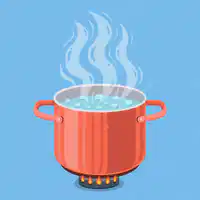
Boiling
3


Boiling
⬜
To cook in a liquid, usually water, in
which bubbles rise constantly and
break on the surface
4

Boiling Process
5
Reorder
Reorder the steps of boiling water.
Choose a pot
Pour water
Turn stove on high
Wait
Water is boiled!
6


Boiling Science
➔ The heat passes
from the burner into
the pot.
➔ The pot then heats
the water at the
bottom.
➔ Then, hot water rises
and cooler water
moves down to
replace it, causing a
circular motion.
➔ This motion results in
bubbles.
7

Boiling Tips
●Make sure there is enough liquid to
completely cover the food you wish
to boil
●Leave 2-3 inches at the top of the
pot or saucepan to allow for
bubbles to break the surface
without boiling over
●Leave room for anything you plan
on adding in the pot
●Adding salt to water actually
increases the boiling point to 216
degrees F
●Putting a lid on the pot WILL help it
boil faster due to the fact that heat
will remain in the pot
●Water boils at 212 degrees
Fahrenheit or 100 degrees Celsius
●No matter how heat is applied,
once water reaches this point its
temperature cannot increase
●It can heat things very quickly
(heat is heat regardless of how it
is transferred dry or wet)
●Boiling is often a place to start
from in a recipe- “bring to a boil
and reduce”
Boiling Facts
8

Simmer
9


Simmer
To cook in a liquid, usually water, right below the boiling
point. You will see some bubbles rise to the surface
10

Simmering Process
11
Match
simmering
neither
boiling
simmering
neither
boiling
12


Simmering Science
➔ The heat passes from
the burner into the
pot.
➔ The pot then heats the
water at the bottom.
➔ Then, hot water rises
and cooler water
moves down to replace
it, causing a circular
motion.
➔ This motion results
in gentle rising of
bubbles
*Poaching-bubbles forming on the
bottom-not yet breaking the surface
13

Simmering Tips
●Covering a pot for a few moments
allows you to get the pot up to
temperature without adding more
flame from below.
●If your pot is too hot, move it to the
side of the burner or give it a few
stirs to increase the surface area
and cool down.
●Adding some extra broth or cooking
liquid can cool down a pot, as well.
●Simmering is usually used for
things like cooking rice, where a
boil is much too hot for the cook
time.
●It's the ideal cooking method for
making stocks because it's hot
enough to break down the
cartilage in the bones but gentle
enough that it doesn't produce
large bubbles.
●A simmer may seem like what you
need to correctly poach
something, but a simmer is
actually too hot.
●Poaching, by comparison, is a
gentler technique, employing
temperatures 140 F to 180 F.
Simmering Facts
14

Poaching
15


Poaching
⬜
Poaching- to cook gently in hot liquid,
uncovered, BELOW the boiling point.
Carefully put food in
simmering water
16

Poaching Process
17
Multiple Select
Which of the following are some tips for poaching eggs.
Use a fresh egg
Use strainer
store in cold water
Use an older egg
18

Steaming
19


Steaming
⬜
To cook with the vapor produced by boiling
liquid (food sits above the liquid, not actually
in it)
20

Steaming Process
21
Multiple Choice
What should you use to help steam vegetables?
steamer pot
strainer spoon
blender
22

Steaming without a steamer basket?
The technique is simple: fill a medium pot with 1/2 inch of
water, place three golf ball–sized balls of aluminum foil on the
bottom, rest a heat-proof plate on top of the foil balls, cover the
pot, and bring the water to a boil. Add vegetables to the plate,
cover, and steam until crisp-tender
23


Steaming Science
➔
The heat passes from the
burner into the pot.
➔
The pot then heats the water
at the bottom.
➔
Then, the hot water molecules
evaporate producing steam.
➔
The food sits in a basket
above the boiling water and
steam (water molecules)
heat/cook the food
24

Steaming Tips
●Don’t add too much water to
your pot. You want the steam to
reach the food not the boiling
water-this would cause nutrient
loss
●Boil the water first and then
add the steamer basket
●If you steam for too long, the
food will become mushy/soggy
in texture
●Steaming food only takes a
couple of minutes
●Prepare the food before
steaming-mise en place
ingredients
●Steaming can help lower
cholesterol by removing some
of the fat from meat
●Steaming helps preserve the
color, flavor, and fiber within the
food
●Steaming actually ADDS
nutrients to the food without
losing them
●Water needs to boil at 212
degrees Fahrenheit for water
steam to be created
●Steam can burn you just like
boiling water (it’s hotter than
212 degrees)
Steaming Facts
25

Blanching
26


Blanching
To blanch is to cook briefly in boiling water.
Blanching neutralizes enzymes in the food,
which change how the foods react when
cooked with other ingredients.
27

Blanching Process
Hi
28
Reorder
Reorder the steps of the blanching process.
fill pot with water
add salt
fill bowl with ice water
place veggies in hot water
put in ice water
Moist Heat Cooking
Methods
Show answer
Auto Play
Slide 1 / 28
SLIDE
Similar Resources on Wayground

21 questions
Proper Etiquette for Virtual Learning
Presentation
•
9th - 12th Grade
19 questions
Swine Breeds
Presentation
•
9th - 12th Grade
21 questions
Reaction Rates
Presentation
•
9th - 12th Grade
21 questions
Linear Transformations
Presentation
•
9th - 12th Grade
21 questions
Cover Letters and Resumes
Presentation
•
9th - 12th Grade
21 questions
Chapter 3: Managing Stress
Presentation
•
9th - 12th Grade
19 questions
Ohms law
Presentation
•
9th - 12th Grade
21 questions
Visual Presentation
Presentation
•
9th - 12th Grade
Popular Resources on Wayground
10 questions
Safety Day 2026 – Student Review

Quiz
•
9th Grade
21 questions
Continents and Oceans
Quiz
•
6th Grade
20 questions
Parts of Speech
Quiz
•
5th Grade
16 questions
Subject & Predicate
Quiz
•
5th Grade
25 questions
Multiplication Facts
Quiz
•
5th Grade
12 questions
Map Skills
Quiz
•
3rd Grade
22 questions
Continents and Oceans
Quiz
•
5th Grade
15 questions
Rounding Decimals
Quiz
•
5th Grade
Discover more resources for Other
10 questions
Safety Day 2026 – Student Review
Quiz
•
9th Grade
20 questions
REGULAR Present tense verbs
Quiz
•
8th - 9th Grade
26 questions
SLIME!!!!!
Quiz
•
KG - 12th Grade
20 questions
Cell organelles and functions
Quiz
•
10th Grade
10 questions
Test Your Knowledge on Bullying
Quiz
•
9th Grade
12 questions
Absolute Value Equations
Quiz
•
9th Grade
20 questions
Position vs. Time Graphs
Quiz
•
9th Grade
20 questions
Function or Not a Function
Quiz
•
8th - 9th Grade