
Module 43 Lesson

Presentation
•
Other
•
10th Grade
•
Practice Problem
•
Hard

Phillip Garrard
Used 1+ times
FREE Resource
21 Slides • 2 Questions
1

5.12 Women in
Agriculture
2


6
For this learning goal, you will learn to:
• Explain how the percentage of women in the
agricultural labor force varies worldwide.
• Contrast differences between women in the
subsistence agricultural labor force and in the
commercial agricultural labor force.
How the percentage of women in the agricultural labor
force varies worldwide
3


7
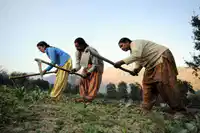
Women in the subsistence agriculture labor force
• Women spend more time in agriculture as men leave the villages to
find work in the cities.
• The Green Revolution has allowed some subsistence societies to
produce a surplus that can be sold in local or regional markets.
How the percentage of women in the agricultural labor
force varies worldwide
4


8
Women in the subsistence agriculture labor force
• A report by the World Bank indicates that
women in six countries in Africa provide 40
percent of agricultural labor, though their
share varies across countries.
• At the global scale, on average, women in
developing countries involved with subsistence
agriculture comprise about 45 percent of the
agricultural workforce.
How the percentage of women in the agricultural labor
force varies worldwide
5


9
Women in the commercial agriculture labor force
• 36 percent of all U.S. farm operators are women; in Europe it is 30
percent, and in Australia it is 32 percent.
• Higher numbers of women farmers are located in the eastern and
western margins of the United States.
• These farms are often engaged in dairying and/or market gardening.
How the percentage of women in the agricultural labor
force varies worldwide
6
Multiple Choice
Which of the following best explains why women were the earliest farmers?
a. Women collected seeds and fruits in hunter-gatherer societies and used this knowledge in early plant domestication.
b. Women were not successful hunting wildlife over long distances
c. Women were the earliest farmers because it kept them closest to the house and children.
d. Women were smaller in size and it made it easier for them to cultivate the soil and plants.
e. Women were not accepted in the business and trade occupations leaving them to work on farms
e. Women were not accepted in the business and trade occupations leaving them to work on farms
7


11
For this learning goal, you will learn to:
• Explain how women’s roles differ between
subsistence and commercial agriculture.
• Contrast differences between women’s roles in
subsistence and commercial agriculture.
How women’s roles differ between subsistence and
commercial agriculture
8


12
Subsistence agriculture
• Women spend more time in agriculture as men leave the villages to
find work in the cities.
• The Green Revolution has allowed some subsistence societies to
produce a surplus that can be sold in local or regional markets.
How women’s roles differ between subsistence and
commercial agriculture
Division of labor: How a group divides the range of tasks within a social
system; in subsistence systems, tasks are generally divided based on age
and gender.
9


13
Mixed crop/livestock farming in developing countries
• In general women are responsible for the crops and livestock kept at
or near the homestead.
• Women in mixed crop/livestock societies tend to the crops for the
family and help in the fields for any cash crops cultivated.
How women’s roles differ between subsistence and
commercial agriculture
10


14
Shifting cultivation
• For the most part, women are responsible for sowing the seeds and
harvesting the crop after the men have cleared the plot of vegetation.
• Many women have found it necessary to produce crafts for the local
tourist markets because the harvest of subsistence crops is often not
enough to feed the family.
How women’s roles differ between subsistence and
commercial agriculture
11


15
Paddy rice farming
• Women are responsible for planting, thinning, weeding, harvesting,
and processing the rice plants by hand.
• Women in paddy rice subsistence regions usually are not permitted to
work with the machinery and other technologies.
How women’s roles differ between subsistence and
commercial agriculture
12


16
Nomadic pastoralism
• Pastoralist societies are more male dominated than other subsistence
societies, restricting women’s participation in decision making.
• In some nomadic herding or pastoralist societies, women and
children may be involved with limited seasonal cultivation.
• Some women in pastoralist societies earn a small amount of money
by producing handmade crafts, which they sell at the local market.
How women’s roles differ between subsistence and
commercial agriculture
13


17
Women’s roles in subsistence agriculture: A summary
• Often, cultural barriers prevent women in developing countries from
assuming greater management in farm operations.
• Women in some cultures sell surplus crops, but only at the local
market, not at a regional or global market that would yield more
income.
• Some international programs work within societies’ cultures,
recognizing that both men and women need to be involved in the
empowerment of women.
How women’s roles differ between subsistence and
commercial agriculture
14


18
Commercial agriculture
• As farming became more mechanized during the Second Agricultural
Revolution, many tasks, including cheese and butter making, were
given over to factory production.
• As a result, women’s roles shrunk to those that involved tending to
the household and family garden.
How women’s roles differ between subsistence and
commercial agriculture
15


19
Commercial agriculture
• Overall, almost 40
percent of the
women in
agriculture in the
European Union are
over 65 years old.
How women’s roles differ between subsistence and
commercial agriculture
16


20
Commercial agriculture
• The 2017 U.S.
agricultural census
showed an increase
to 36 percent of all
farms currently
owned by women
farmers.
How women’s roles differ between subsistence and
commercial agriculture
17


21
Similarities and differences: A summary
• There is a formal division of labor in most subsistence societies that is
not present in commercial societies.
• Women in commercial societies often face gender role stereotypes,
but they are easier to address than the culture-based formal division
of labor that exists in subsistence societies.
How women’s roles differ between subsistence and
commercial agriculture
18


22
Similarities and differences: A summary
• Women in subsistence societies often lack full ownership of land,
crops, or livestock, which makes it difficult for them to manage farm
operations and the money that selling crops or livestock might bring
into the household.
• In commercial agriculture women farmers can purchase land,
livestock, and seed, and they can manage general farm operations.
How women’s roles differ between subsistence and
commercial agriculture
19


23
Similarities and differences: A summary
• In both subsistence and commercial agricultural regions, women have
access to important programs to enhance the roles of women in
agriculture.
• In both subsistence and commercial farming economies, the number
of women farmers is increasing, and especially in subsistence
societies they hold a key to global food security.
• As more women become successful in improving agricultural
production, food security will begin to increase at the regional scale,
leading eventually (one hopes) to food security for all people.
How women’s roles differ between subsistence and
commercial agriculture
20


25
Summary and Review
Women, who comprise about 45 percent
of the subsistence agricultural workforce,
spend more time in farming as men leave
the villages to find work in the cities
1) Describe women’s roles in
subsistence agriculture on a
global scale.
2) Describe women’s roles in
commercial agriculture on a
global scale.
Women, who comprise more than 30
percent of the commercial agriculture
workforce, are more commonly involved
with dairying and/or market gardening
21


26
How a group divides the range of tasks
within a social system; in subsistence
systems, tasks are generally divided based
on age and gender
3) Define division of labor.
4) Contrast differences in
gender roles between
subsistence and commercial
agriculture.
Women in commercial societies often face
gender role stereotypes, but they are
easier to address than the culture-based
formal division of labor that exists in
subsistence societies
Summary and Review
22


27
5) Contrast differences in farm
ownership between
subsistence and commercial
agriculture.
6) Describe similarities
regarding women’s roles in
subsistence and commercial
agriculture.
Women have access to important
programs, the number of women farmers
is increasing, and as more women become
successful in improving agricultural
production, food security will increase
Summary and Review
Women in subsistence societies often lack
full ownership of farms, whereas in
commercial agriculture women farmers
can purchase land, livestock, and seed,
and they can manage general farm
operations
23
Poll
How confident do you feel with this lesson?
1/4
2/4
3/4
4/4
5.12 Women in
Agriculture
Show answer
Auto Play
Slide 1 / 23
SLIDE
Similar Resources on Wayground

19 questions
Subject -Verb Agreement
Presentation
•
10th Grade
17 questions
Rockets Part 2: How Rockets Move
Presentation
•
10th Grade
17 questions
Beginning of the Vietnam War
Presentation
•
10th Grade
17 questions
Who is Ms. Dev
Presentation
•
10th Grade
18 questions
Direct and Indirect Speech
Presentation
•
10th Grade
18 questions
Age of Revolutions Wrap up
Presentation
•
10th Grade
19 questions
Radioactive Decay
Presentation
•
10th Grade
19 questions
History of the Cell Theory
Presentation
•
10th Grade
Popular Resources on Wayground
10 questions
How much do you know about our Portrait of an Eagle?

Quiz
•
10th Grade
10 questions
Fast Food Slogans
Quiz
•
6th - 8th Grade
21 questions
Continents and Oceans
Quiz
•
6th Grade
20 questions
Parts of Speech
Quiz
•
5th Grade
16 questions
Subject & Predicate
Quiz
•
5th Grade
25 questions
Multiplication Facts
Quiz
•
5th Grade
12 questions
Map Skills
Quiz
•
3rd Grade
22 questions
Continents and Oceans
Quiz
•
5th Grade
Discover more resources for Other
10 questions
How much do you know about our Portrait of an Eagle?
Quiz
•
10th Grade
20 questions
Brand Labels
Quiz
•
5th - 12th Grade
20 questions
Characteristics of Life
Quiz
•
9th - 10th Grade
10 questions
Exploring the 4 Major Macromolecules and Their Functions

Interactive video
•
9th - 12th Grade
20 questions
Cell organelles and functions
Quiz
•
10th Grade
10 questions
Exploring Chemical and Physical Changes
Interactive video
•
6th - 10th Grade
20 questions
Cell Transport
Quiz
•
9th - 12th Grade
20 questions
Budgeting
Quiz
•
9th - 12th Grade