
Food Web Energy Transfer

Presentation
•
Science
•
7th Grade
•
Practice Problem
•
Medium
+2
Standards-aligned

George Smithson
Used 23+ times
FREE Resource
8 Slides • 8 Questions
1
How organisms gain & pass on energy
2

As discussed, food webs are interconnecting food chains for multiple organisms
However, they're also a map of how energy & nutrients get passed along
Food webs
3
Match
Match the trophic level with the producer/consumer
Trophic Level 1
Trophic Level 2
Trophic Level 3
Trophic Level 4
Trophic Level 5
Energy producer
Primary Consumer
Secondary Consumer
Tertiary Consumer
Apex Predator
Energy producer
Primary Consumer
Secondary Consumer
Tertiary Consumer
Apex Predator
4

Food webs show the direction energy moves; the arrows indicate the flow of an organism's energy from one trophic level to another.
Ex: the shark eats the tuna, gaining energy
Energy flow
5
Match
Match the producer/consumer level with what they eat
Producers
Primary Consumers
Secondary Consumers
Tertiary Consumers
Apex Predators
Sun, water, CO2
Herbivores
Carnivores
Omnivores
Can eat anything below them
Sun, water, CO2
Herbivores
Carnivores
Omnivores
Can eat anything below them
6
Multiple Select
Which trophic level organisms do you think have the most available energy to them (opinion)?
1: Producers
3: Secondary Consumers
2: Primary Consumers
5: Apex Predators
4: Tertiary Consumers
7
The energy in food is measured in Kilocalories; 1000 calories.
This is the amount of energy it takes raise the temperarture of 1kg of water 1 degree (Celcius)
Food labels are in Kcal; you need between 1500 - 3000 Kcal a day (depending on gender, age, and muscle mass)
Energy Measurement
Energy producers - plants - typically have the most available energy to them.
The sun is consistent and constant, and plants use that to power photosynthesis
Energy Creation
8
Multiple Choice
How many Kcal will it take to move 1kg of water 5 degrees Celcius?
5 Kcal
5,000 Kcal
1,500 Kcal
1,000 Kcal
9
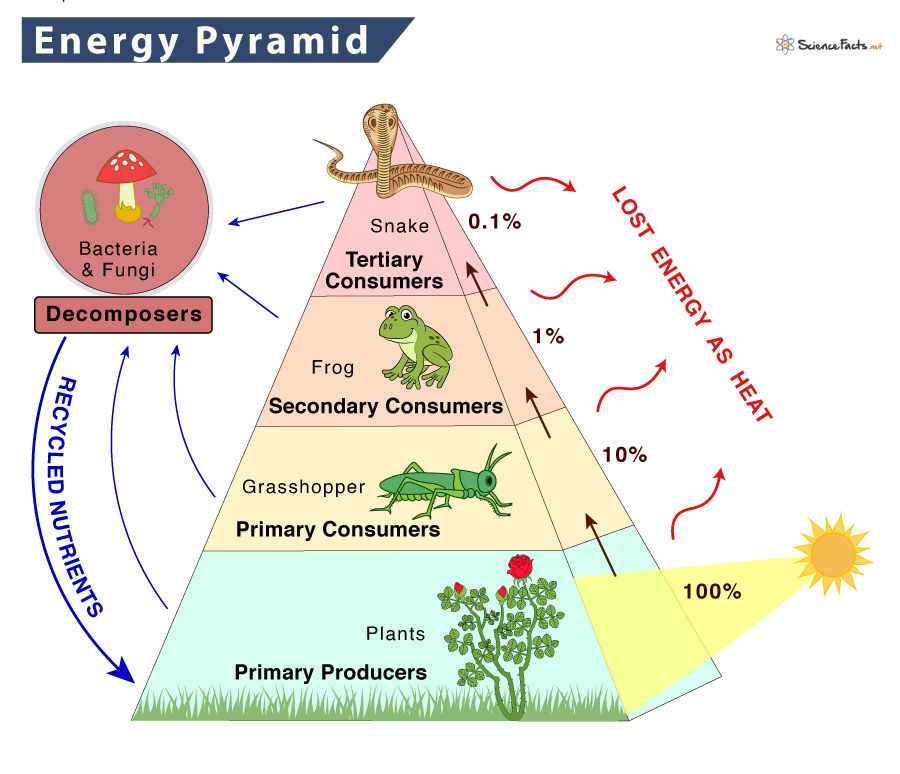
Available Kcal decreases every time you move up a trophic level
Only about 10% of energy in an organism is gained by eating it
Ex: There could be a total of 1,000 Kcal in a bowl of lettuce. If you eat it, your body only gains 100 Kcal
This is ten percent PER LEVEL increase; so if a fish eats a 100 KCal mayfly, and you eat that fish, you only gain 1 Kcal worth of that bug's energy! (100 x 0.1 x 0.1 = 1)
10
Multiple Choice
How much energy is passed along every trophic level increase?
50%
25%
100%
10%
11
Math Response
A field mouse gains 100Kcal of energy from eating berries; how many of these Kcal will transfer to a fox if it eats the mouse?
12
Multiple Choice
A gopher has gained 200 Kcal from eating grass all day. A snake comes along and eats that gopher, gaining a portion of those Kcal. A hawk swoops down and eats the snake; how many trophic levels have we moved up?
2
3
4
5
13
Math Response
A gopher has gained 200 Kcal from eating grass all day. A snake comes along and eats that gopher, gaining a portion of those Kcal. A hawk swoops down and eats the snake; how many Kcal from the grass is transferred to the hawk?
14
SImilar to a food chain or web, energy pyramids are a diagram that show us the amount of energy that moves from one trophic level to another
Energy Pyramid

15
Then, organize your organism's food web into an energy pyramid. Make this look good!
Your organism
Organize the food web on slide 9 of the Jamboard (Food Network) into an energy pyramid; most energy on bottom, least on top!
Jamboard
16
Progress reports are coming
I'd work on any missing work for other classes or mine. Tomorrow we'll have some makeup quiz days, as well as a quiz over this material so far.
How organisms gain & pass on energy
Show answer
Auto Play
Slide 1 / 16
SLIDE
Similar Resources on Wayground

15 questions
Organelles
Presentation
•
7th Grade
11 questions
8.11A Lesson
Presentation
•
8th Grade
11 questions
Section 3 Photosynthesis
Presentation
•
6th - 7th Grade
12 questions
Estuaries
Presentation
•
6th Grade
11 questions
Introduction to the Industrial Revolution
Presentation
•
7th Grade
10 questions
Thesis Statements
Presentation
•
7th Grade
11 questions
Cells
Presentation
•
7th Grade
12 questions
Carbon Cycle
Presentation
•
7th Grade
Popular Resources on Wayground
21 questions
Continents and Oceans

Quiz
•
6th Grade
20 questions
Parts of Speech
Quiz
•
5th Grade
16 questions
Subject & Predicate
Quiz
•
5th Grade
25 questions
Multiplication Facts
Quiz
•
5th Grade
12 questions
Map Skills
Quiz
•
3rd Grade
22 questions
Continents and Oceans
Quiz
•
5th Grade
15 questions
Rounding Decimals
Quiz
•
5th Grade
20 questions
Brand Labels
Quiz
•
5th - 12th Grade
Discover more resources for Science
17 questions
7.6D Aqueous Solutions
Quiz
•
7th Grade
20 questions
Claim, Evidence and Reasoning (CER)
Quiz
•
6th - 8th Grade
10 questions
Exploring Chemical and Physical Changes

Interactive video
•
6th - 10th Grade
16 questions
Photosynthesis and Cellular Respiration Review
Quiz
•
7th Grade
20 questions
Food Webs + Energy Pyramids
Quiz
•
7th Grade
24 questions
Cell Organelles
Quiz
•
7th Grade
20 questions
Human Body Systems
Quiz
•
7th Grade
10 questions
Exploring the Periodic Table
Interactive video
•
6th - 10th Grade